
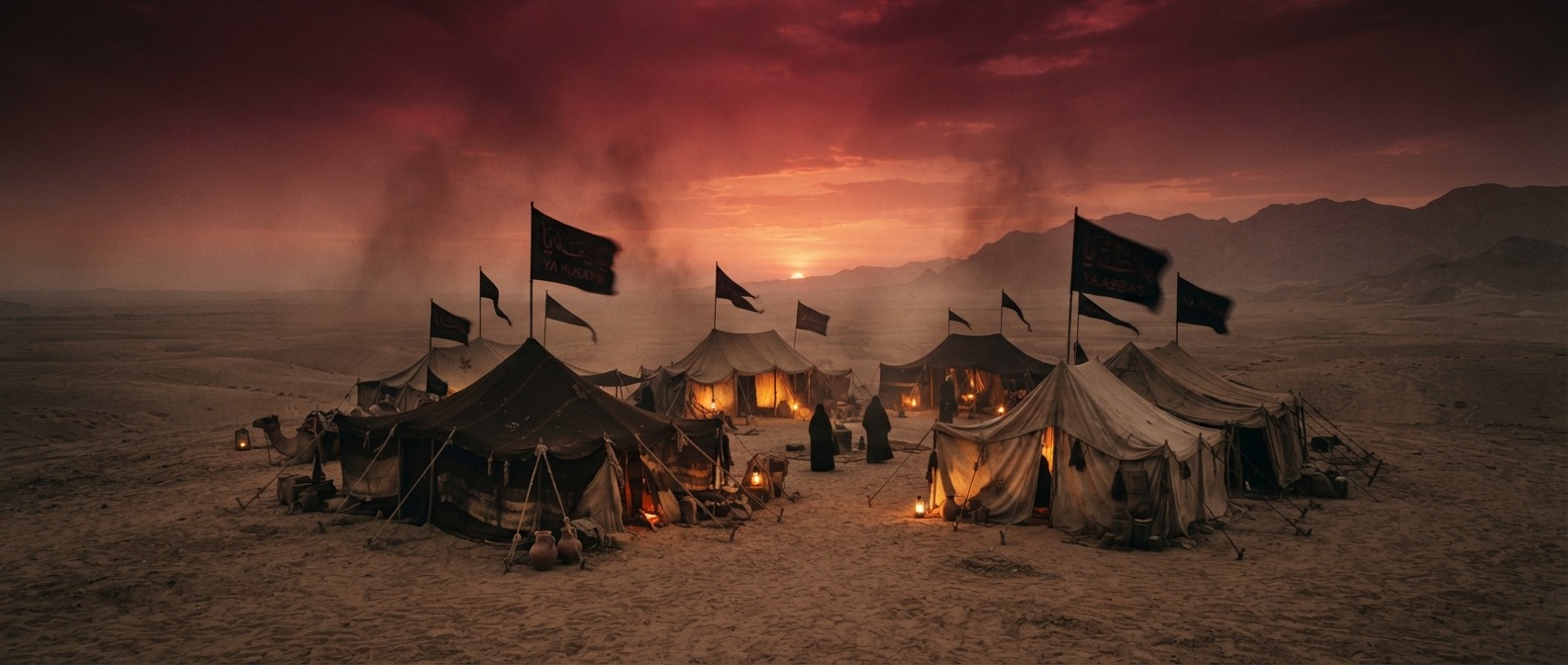
The story of Karbala is one of the most painful and powerful events in Islamic history. It began in Medina, passed through Mecca, and ended in the desert land of Karbala in Iraq near the Euphrates. At the center of this story stood Imam al-Husayn (a.s.), the grandson of Prophet Muhammad (S), who refused to submit to Yazid and chose a path that would change history forever.
Historical Background
After Muawiyah's death, Yazid took power and ordered his governors to force Imam al-Husayn (a.s.) into giving allegiance or face execution. Imam al-Husayn refused. He described Yazid as a lecherous, intoxicated tyrant who killed respectful souls, and he said that a person of his standing could never submit to such a ruler.
At the same time, thousands of letters and delegations came from the people of Kufa asking Imam al-Husayn to lead a revolution against the Umayyad regime. To judge the situation, he sent his cousin, Muslim ibn Aqil. But Muslim was betrayed and killed by Ubaydullah ibn Ziyad.
The journey that followed moved from Medina to Mecca and then toward Iraq, where the final tragedy would take place in Karbala. The name Karbala itself, as noted in the dossier, is connected to two Arabic words: Karb, meaning agony, and Balaa', meaning ordeal.
The Story
The Refusal in Medina
At midnight in Medina, the governor al-Walid summoned Imam al-Husayn (a.s.) and demanded his allegiance to Yazid. Imam al-Husayn rejected the demand without hesitation. He declared:
«"O Governor, we are the household of prophecy, the core of the (divine) message, frequently visited by the angels, and (we are) the center of mercy. Allah has commenced with us and shall seal with us. Yazid is a lecherous, intoxicated man who kills the respectful soul and promulgates his acts of immorality. My like should never pay homage to him or his likes."»
— Imam al-Husayn (a.s.) to al-Walid
Realizing the danger around him, Imam al-Husayn decided to leave for Mecca. Before departing, he visited the tomb of his grandfather, Prophet Muhammad (S), and complained to Allah about the hardships surrounding him. He also called his sister, Lady Zaynab (a.s.), who did not hesitate to join him and stand with him in his revolution.
The Journey to Mecca and Iraq
In Mecca, Imam al-Husayn received thousands of letters from the people of Kufa pledging support. But after sending Muslim ibn Aqil, he learned that Muslim had been martyred.
Knowing that assassination plots were waiting for him in Mecca, he addressed his companions and said:
«"Death is mapped out for every human being in the same way as a necklace leaves a mark on a girl's neck."»
— Imam al-Husayn (a.s.) to his companions
On the eighth of Dhul-Hijjah, in the year 60 A.H., he departed with his household, including Lady Zaynab, whom he knew would later play a critical role in preserving his legacy.
At Shuraf, the caravan was intercepted by a large Umayyad vanguard of over one thousand horsemen led by al-Hurr ibn Yazid al-Riyahi. Even in this tense moment, Imam al-Husayn saw that the enemy troops were suffering from thirst, so he ordered his companions to give water to them and to their horses.
Soon after, a messenger came from Ubaydullah ibn Ziyad with an order for al-Hurr to force the Imam into a barren place without shelter or water.
Arrival at Karbala
Al-Hurr forced the caravan to stop. Imam al-Husayn asked the name of the land. When he was told it was Karbala, he raised his hands and prayed:
«"O Allah: I seek Your protection against agony and ordeal."»
— Imam al-Husayn (a.s.) upon arriving at Karbala
He then told his companions:
«"This is the place of agony and ordeal. This is the place where we, as well as our riding animals, will reside and our blood will be shed."»
— Imam al-Husayn (a.s.) to his companions
The Umayyad army, now under the command of Umar ibn Saad, surrounded the camp and cut them off completely from water for three days.
On the eve of Ashura, Imam al-Husayn gathered his companions and released them from their allegiance, allowing them to leave in the darkness. He told them:
«"Indeed, I am the one they want. When they get me, they will not go after anyone else."»
— Imam al-Husayn (a.s.) to his companions
But his brother, Abul-Fadl al-Abbas, and the rest of the companions refused. They replied:
«"Why should we do so? Is it for that we will live after you? No! We supplicate to the Lord to forbid it."»
— The companions of Imam al-Husayn
That same night, Lady Zaynab heard her brother reciting poetry about the betrayal of the world and the nearness of death. Realizing that he was preparing for martyrdom, she lost consciousness. Imam al-Husayn poured water on her face and comforted her, binding her with an oath to remain patient and not tear her clothes or slap her face when he was slain.
The Day of Ashura
When the battle began on the day of Ashura, al-Hurr was struck by conscience and left the Umayyad army to join Imam al-Husayn.
Imam al-Husayn's small band of warriors fought bravely against the vast enemy force and were eventually martyred one by one.
Then the youths of the Prophet's household stepped forward. Among them was Ali al-Akbar, the eighteen-year-old son of Imam al-Husayn, who was said to be the most similar to the Holy Prophet (S) in form, morals, and personality. He fought with great bravery before being ambushed and struck down by Murrah ibn Munqidh.
After that came Abul-Fadl al-Abbas. As the guardian of the harem, he asked permission to bring water for the children who were dying of thirst. He charged toward the enemy ranks and scattered them until he reached the Euphrates.
Even though his heart burned with thirst, he refused to drink a single drop while his brother remained thirsty. On the way back with the waterskin, hypocrites ambushed him and severed both his right and left hands. Still he held the waterskin with his teeth until an arrow pierced it and the water spilled out. Then a man struck him on the head with an iron post.
Imam al-Husayn rushed to his severed body and cried:
«"From now my back has broken and I am without hope while my enemies are rejoicing at my misfortune."»
— Imam al-Husayn (a.s.) over the body of al-Abbas
Even Imam al-Husayn's six-month-old baby, Abdullah, was murdered while the Imam was holding him and asking the enemy for water.
The Final Stand
After all his companions and family members had been martyred, Imam al-Husayn stood alone and continued to fight with extraordinary firmness. Before his final moments, he returned to the tents and gave his last instructions to Lady Zaynab and the women:
«"Prepare yourselves for the imminent misfortunes. You should know that Allah will guard, protect, and save you from the evils of those enemies."»
— Imam al-Husayn (a.s.) to Lady Zaynab and the women
He then returned to the battlefield, where he was struck with swords and lances. At last, the ruthless Shimr beheaded him. Under Umar ibn Saad's orders, ten horsemen rode their horses over the chest and back of the Imam's headless body.
That dark night, Lady Zaynab took on the mission of protecting the surviving women and children. She walked through the desert gathering the terrified orphans. The next day, as the captives were marched past the mutilated bodies of their loved ones, she cried out:
«"Oh, Muhammad! May the King of the Heavens bless you! This is Husayn! He is stained with his blood and his limbs are severed!"»
— Lady Zaynab (a.s.) at Karbala
Through her courage and her later speeches in Kufa and Damascus, she made sure that the revolution of Imam al-Husayn would not be forgotten.
Quran Verses
Surah Al-Ahzab (33:33)
إِنَّمَا يُرِيدُ اللَّهُ لِيُذْهِبَ عَنْكُمُ الرِّجْسَ أَهْلَ الْبَيْتِ وَيُطَهِّرَكُمْ تَطْهِيرًا
"Allah only desires to keep away the uncleanness from you, O people of the House! and to purify you with a (thorough) purifying."
Surah Al-Ahzab (33:33)
Explanation: This verse is used in the dossier to show the divine purity and high rank of the household that Imam al-Husayn and his family represented.
Surah Ash-Shura (42:23)
قُلْ لَا أَسْأَلُكُمْ عَلَيْهِ أَجْرًا إِلَّا الْمَوَدَّةَ فِي الْقُرْبَى
"Say: I do not ask of you any reward for it but love for my near relatives."
Surah Ash-Shura (42:23)
Explanation: This verse is used to show the religious duty to love the Prophet's family, a duty that was ignored by the Umayyads at Karbala.
Hadith
The dossier provides these report summaries, but it does not give full Arabic texts or complete source chains:
- Imam al-Husayn declared before Allah that Ali al-Akbar was the "most similar to Your Prophet in form, morals, and personality."
- Archangel Gabriel foretold to Prophet Muhammad (S) that Imam al-Husayn would be slain by the River Euphrates in Karbala.
- Imam Ali (a.s.) narrated that the Holy Prophet (S) said Lady Fatimah would demand justice for her son's killer on the Day of Resurrection, and Allah would judge in her favor.
Lessons From This Story
- Absolute selflessness: Abul-Fadl al-Abbas refused to drink water from the river while his Imam and the children were still thirsty.
- Unwavering loyalty and faith: The companions of Imam al-Husayn refused to flee in the dark and chose death rather than abandon him.
- Courage against tyranny: Imam al-Husayn chose death over submission to an illegitimate and oppressive ruler.
- Unshakable patience: Lady Zaynab showed remarkable endurance by gathering the survivors and remaining steadfast after the slaughter.
References
- Book: Lady Zaynab
- Author: Badr Shahin
- Publisher: Ansariyan Publications
- Relevant sections and pages:
- Refusal of Yazid's Leadership — pages 123–125
- In Mecca — pages 126–127
- Leaving for Iraq — pages 135–139
- In Karbala — pages 147–148
- Lady Zaynab's Panic — pages 156–158
- Day of Ashura — page 161
- The War — pages 169–174
- The Grand Adversity — pages 181–185
Frequently Asked Questions
He refused to give allegiance to Yazid and left after al-Walid demanded it.
He left Medina because the danger around him was growing.
He was betrayed and killed by Ubaydullah ibn Ziyad.
The Imam's camp was trapped, blocked from water, and finally attacked on Ashura.
Lady Zaynab carried the message forward through her courage and speeches in Kufa and Damascus.