
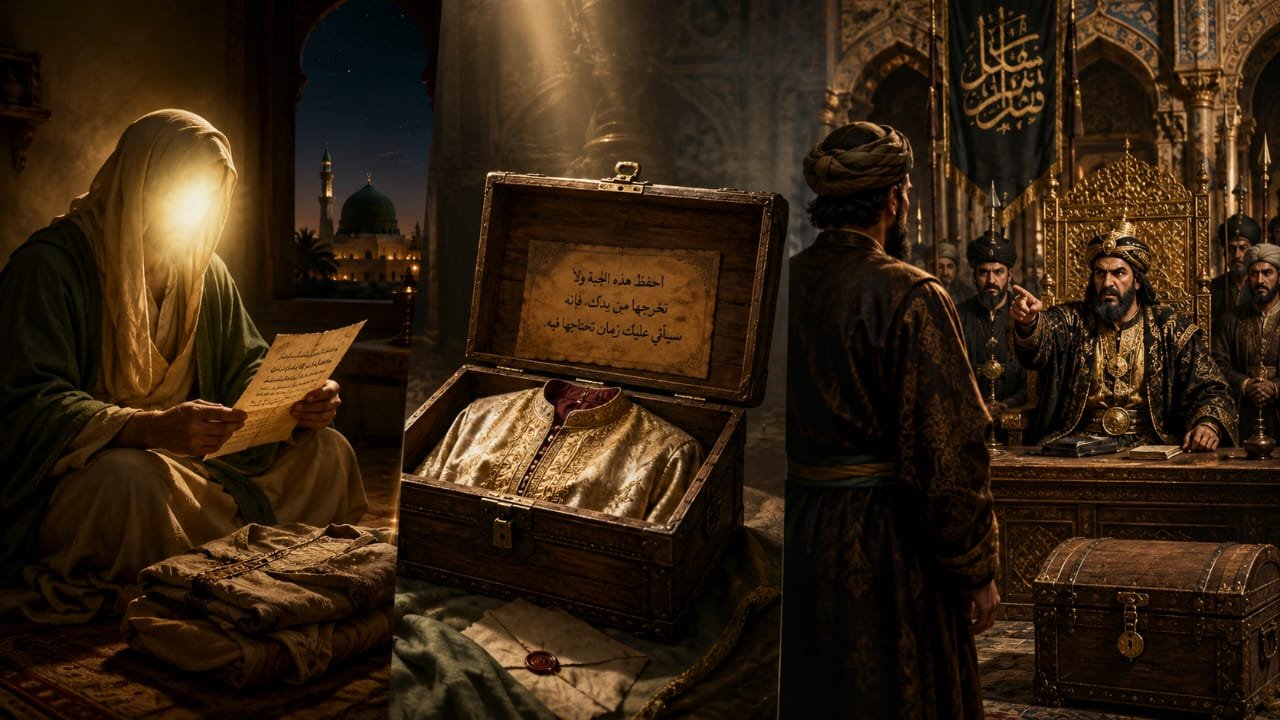
There was a time when a single accusation at the Abbasid court could cost a person his life.
Ali ibn Yaqtin held an important position in the government of Harun al-Rashid, yet he was secretly a loyal follower of Imam Musa al-Kazim (AS). In an atmosphere of suspicion and persecution, his position was dangerous. One accusation could turn the caliph against him.
That danger eventually came.
But Imam Musa al-Kazim (AS) had already given Ali ibn Yaqtin something that would save him: a simple instruction concerning a royal robe.
At the time, Ali did not know why.
Historical Background
The incident took place during the reign of the Abbasid caliph Harun al-Rashid, between Baghdad, where Ali ibn Yaqtin served in the imperial court, and Medina, where Imam Musa al-Kazim (AS) resided.
The Shia community and the descendants of Prophet Muhammad (peace be upon him and his family) were living under severe oppression and persecution. According to the research, Imam Musa al-Kazim (AS) permitted trusted followers such as Ali ibn Yaqtin to remain inside the Abbasid government when doing so could protect believers and serve the needs of the community.
Ali ibn Yaqtin therefore held a special position. He served the Abbasid government while secretly maintaining loyalty to Imam Musa al-Kazim (AS) and using his position to protect the lives, property, and rights of Shia believers.
Harun al-Rashid was highly suspicious of allegiance to Imam Musa al-Kazim (AS). Sending royal gifts to the Imam or paying religious funds to him could be treated as an act of treason and could lead to execution.
It was in this dangerous environment that the incident of the royal robe took place.
The Royal Gift
Harun al-Rashid once gave Ali ibn Yaqtin a collection of valuable garments and royal gifts. Among them was a precious embroidered silk robe known as a jebbeh.
Ali ibn Yaqtin was deeply devoted to the Ahlul Bayt. He collected the valuable gifts as well as religious funds and sent them from Baghdad to Imam Musa al-Kazim (AS) in Medina.
When the gifts reached the Imam, he accepted the financial funds and the other garments.
But he separated one particular item: the royal robe.
The Imam sent the robe back to Ali ibn Yaqtin with a written instruction:
«"Keep this robe, and do not let it leave your hand, for a time will come when you will need it."»
Ali received the robe and the Imam's letter.
He did not know why the Imam had returned it. Nevertheless, he obeyed.
He placed the robe inside a chest, perfumed it, sealed the box, and kept it safely in his home.
At that moment, Ali had no idea that the robe would soon become the evidence that saved his life.
The Slander
Not long afterward, one of Ali ibn Yaqtin's cousins secretly went to Harun al-Rashid.
The cousin was driven by envy and personal malice. He accused Ali of secretly supporting Imam Musa al-Kazim (AS).
He told Harun:
«"Ali bin Yaqtin believes in the Imamate of Musa bin Ja'far, pays religious taxes to him, and has even given him the special royal robe that you bestowed upon him as an honor."»
The accusation was extremely serious.
According to the research, the royal robe was not an ordinary gift. It represented royal favor and honor. Giving such a garment to Imam Musa al-Kazim (AS) could therefore be understood as transferring allegiance to a spiritual rival of the Abbasid ruler.
Harun became furious.
He immediately summoned Ali ibn Yaqtin to his court. Omar bin Bazi' was also present.
Harun Demands an Answer
Harun angrily asked Ali:
«"What did you do with the robe I gave you?"»
Ali calmly answered:
«"I placed it in a chest, sealed it with perfume, and preserved it to seek blessings from it on special occasions."»
The answer alone did not settle the matter.
Omar bin Bazi' then suggested that Harun order Ali to prove his statement immediately.
He told Harun:
«"Tell him to send someone to bring it right now!"»
Ali ibn Yaqtin sent his trusted servant to his home with strict instructions to bring the sealed chest containing the robe.
The servant went to the house, retrieved the box, and returned with it directly to the court.
The Chest Is Opened
Harun opened the box in front of those present.
Inside was the royal robe.
It was exactly as Ali ibn Yaqtin had described it. The robe was intact, neatly folded, and still carried the smell of perfume.
Ali had not given it to Imam Musa al-Kazim (AS).
Harun's anger immediately turned into regret and embarrassment. He had suspected his minister, but the evidence before him proved the accusation false.
Harun turned to Omar bin Bazi' and declared:
«"It is no longer appropriate for me to accept any slander against Ali bin Yaqtin after this!"»
He then ordered fifty thousand dirhams to be given to Ali ibn Yaqtin as an award and as restoration of his honor.
The accusation had failed.
Ali ibn Yaqtin left the court with the royal robe and the fifty thousand dirhams.
The Imam's Foresight Becomes Clear
Only now did the meaning of Imam Musa al-Kazim's earlier instruction become clear.
The Imam had told Ali to keep the robe and not let it leave his possession because a time would come when he would need it.
That moment had arrived.
The robe became the evidence that disproved the cousin's accusation and protected Ali from the danger of the Abbasid court.
After returning home, Ali praised Allah for exposing the slanderer and showing his accusation to be false.
The research records Ali's words:
«"The slanderer against me was one of my cousins, whom Allah disgraced and exposed as a liar, Praise be to Allah."»
The event became an example in the sources of the knowledge and foresight attributed to Imam Musa al-Kazim (AS), and of the importance of Ali ibn Yaqtin's obedience to his Imam even when he did not yet understand the reason behind the command.
Divine Foresight and Obedience
The most striking part of the story is not simply that the robe was preserved.
It is that Imam Musa al-Kazim (AS) instructed Ali to preserve it before the danger appeared.
At the time, Ali could not see the reason.
He did not know that a relative would later accuse him before Harun al-Rashid. He did not know that the accusation would concern the very robe he had sent to the Imam. And he did not know that the robe would become the proof that protected him.
He simply obeyed.
That obedience became the means through which the trap failed.
Lessons From This Story
- Obeying the Imam Even Without Knowing the Reason — Ali ibn Yaqtin followed the instruction of Imam Musa al-Kazim (AS) even though he did not understand why the robe had been returned. The story presents this obedience as crucial to his safety.
- Protection of the Faithful — The incident shows how Imam Musa al-Kazim (AS), according to the research, guided trusted believers living under severe political pressure and helped them protect the Shia community.
- The Failure of Envy and Slander — Ali's cousin secretly tried to destroy his position through accusation. Instead, the accusation was exposed as false, the slanderer was disgraced, and Ali's honor was restored.
- Taqiyyah and Prudence — Ali ibn Yaqtin's service within the Abbasid government was presented as a form of careful dissimulation permitted by Imam Musa al-Kazim (AS) in order to protect believers and serve the community.
- Divine Foresight — The incident is presented in the research as an example of the divine knowledge and foresight granted by Allah to Imam Musa al-Kazim (AS), allowing him to prepare Ali for a danger that had not yet appeared.
Quran Verses
The specific account of the royal robe does not contain a direct Quranic verse as part of the historical narration. The research instead places the event within the broader Quranic framework of divine guardianship and Allah's protection of believers from the plans of oppressors.
Hadith Reference
The narration of the royal robe is reported by Abu Ali bin Rashid and a group of companions and recorded by early scholars.
The recorded account includes Harun's reaction after seeing the robe:
«"O Omar! It is no longer appropriate for me to accept anything said against Ali bin Yaqtin after this!"»
The narration also records the order that fifty thousand dirhams be given to Ali ibn Yaqtin and his statement that Allah had disgraced and exposed the cousin who had slandered him.
References
- Al-Kharaij wa al-Jaraih, Qutb al-Din al-Rawandi, Vol. 1, p. 318.
- Bihar al-Anwar, Allamah Majlisi, Vol. 48, p. 62.
- Ikhtiyar Ma'rifat al-Rijal (Rijal al-Kashshi), Sheikh al-Tusi / al-Kashshi, Vol. 2, p. 549.
Frequently Asked Questions
Ali ibn Yaqtin was a high-ranking official in the Abbasid government and a secret follower and companion of Imam Musa al-Kazim (AS).
The Imam instructed Ali ibn Yaqtin to keep it because a time would come when he would need it.
One of his cousins, motivated by envy and malice, accused him before Harun al-Rashid.
Harun accused Ali of giving the royal robe to Imam Musa al-Kazim. When the sealed chest was brought from Ali's home and opened before the court, the robe was still there, proving the accusation false.
Harun al-Rashid ordered fifty thousand dirhams to be given to Ali ibn Yaqtin and restored his honor.