
Introduction
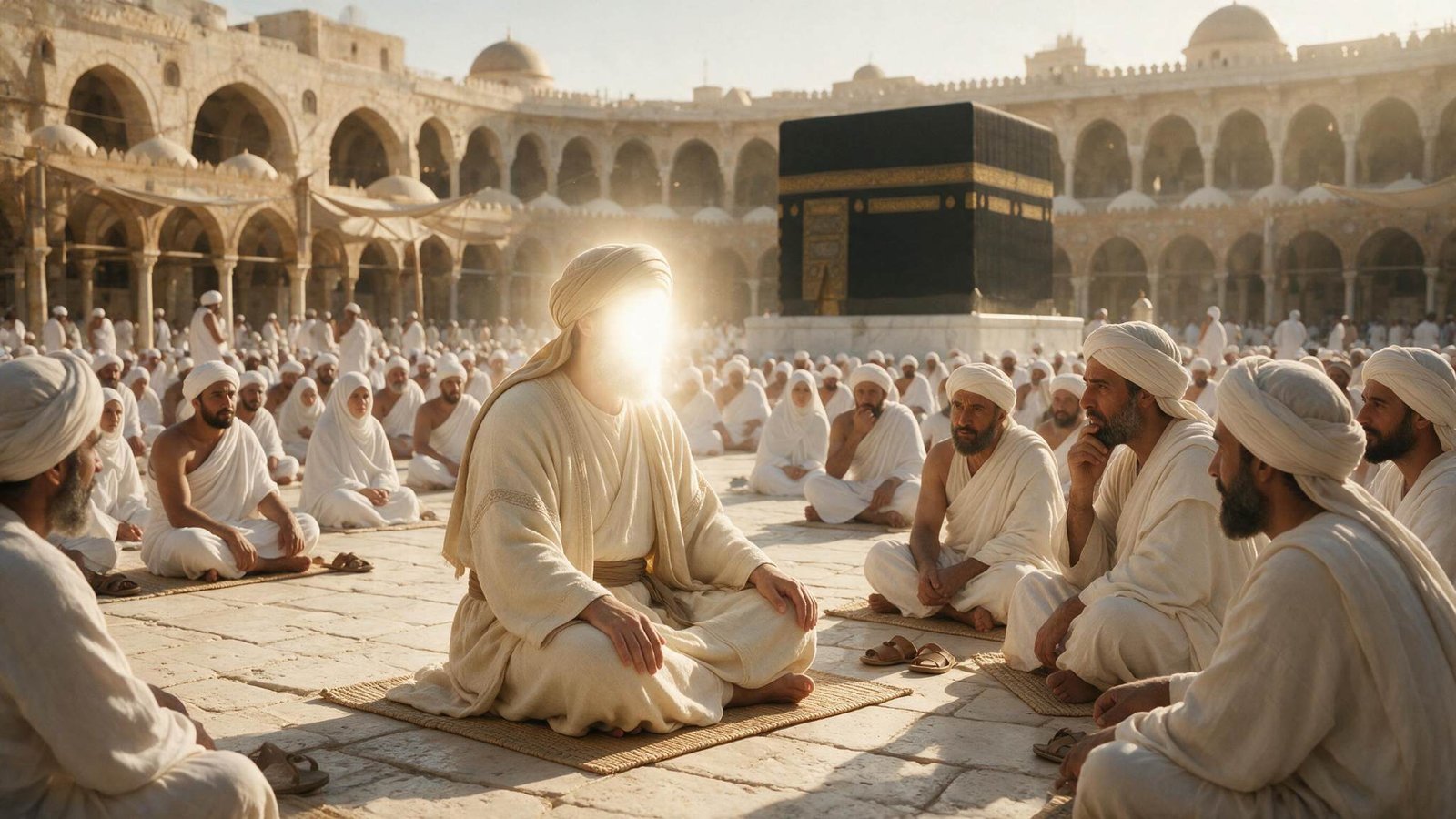
During the Hajj season in Mecca, inside Masjid al-Haram, a remarkable series of debates took place between Imam Ja'far al-Sadiq (AS) and a group of zindiqs. They came hoping to challenge him publicly and weaken his influence. Instead, they walked away defeated, exposed by his knowledge, logic, and calm reasoning.
Historical Background
The events took place in Mecca, inside Masjid al-Haram, during the annual Hajj season, before the year 155 AH.
At that time, Imam Ja'far al-Sadiq (AS) was surrounded by people. He was issuing fatwas, interpreting the Quran, and answering questions with clear proofs. This attracted attention, including the attention of atheists and ideological opponents who gathered there during Hajj.
Among them was Ibn Abi al-Awjaa, a notorious zindiq of his time. He was later captured by the governor of Kufa, Abu Ja'far Muhammad bin Sulayman, and executed in 155 AH. According to Baladhuri, his execution was tied to his disrespect for the Quran, his mockery of prayer, and his promotion of zindiq ideas.
The Story
The Gathering in Masjid al-Haram
During the Hajj season, a group of disbelievers gathered in Masjid al-Haram. They included Ibn Abi al-Awjaa, Ibn Talut, Ibn A'ma, and Ibn al-Muqaffa.
While Imam Ja'far al-Sadiq (AS) was in the mosque answering people's questions, the group observed the great respect people had for him. Ibn al-Muqaffa had already praised the Imam's knowledge. Seeing this, the disbelievers urged Ibn Abi al-Awjaa to go forward and challenge him openly.
They wanted him to ask a question that would disgrace the Imam in front of the people.
The Debate on God's Visibility
Ibn Abi al-Awjaa accepted the challenge and approached the Imam. He argued that if there is a God, He should show Himself directly to people and command them to worship Him without any intermediaries, so that no two people would ever disagree.
Imam Ja'far al-Sadiq (AS) answered by pointing to the world around them and to the human being itself. He explained that God's power is already visible in creation. He told Ibn Abi al-Awjaa to look at himself and see God's power in his own creation, in his aging, in his eventual death, and even in his changing emotions such as joy and anger.
Another zindiq then interrupted and asked how people could worship a God they had never seen.
The Imam replied:
«"Hearts see Him with the light of faith, and intellects, with their awakening, prove Him like obvious matters, and eyes see Him through the beauty of His composition and the firmness of His creation (interconnectedness). Furthermore, His Prophets, His signs, His books, and His clear verses prove His existence, and scholars suffice with His signs pointing to His greatness without Him being seen."»
The Conversion of the Egyptian Zindiq
The Imam then turned to another zindiq, a man from Egypt.
He asked him:
«"Have you ascended to the sky, or descended to the earth, to know what is beyond them? Does a rational person deny what they do not know?"»
The Egyptian man admitted:
«"No one but you has spoken this to me!"»
The Imam asked him whether he was in doubt, saying that perhaps it was true and perhaps it was not. The man answered, "And maybe it is."
Then Abu Abdullah (Imam Ja'far al-Sadiq) (AS) gave him a deeper argument. He told him that there is no proof for one who does not know against one who knows, and that the ignorant has no proof over the knowing. He pointed to the sun, the moon, the night, and the day. They enter and do not overtake each other. They go and return, yet they are compelled and submissive.
He then explained that if they had real power, they could go and not return. Why does night not appear during the day, and day during the night? He said they are compelled by God.
The Imam continued by challenging the belief in "Dahr" (time/nature). If time takes things away, why does it bring them back? And if it brings them back, why does it take them away? He then pointed to the sky raised above and the earth laid below, and said that neither falls into the other, because their Creator and Manager sustains them.
The Egyptian man was convinced at once and embraced faith at the hands of the Imam.
Imam Ja'far al-Sadiq (AS) then turned to his companion Hisham and told him:
«"Take him tonight and teach him."»
The Plot of the Worms
Ibn Abi al-Awjaa did not stop there. He then tried to outsmart the Imam's companions.
He approached Mu'min al-Taq and claimed: "Whoever creates a thing is its creator." He asked for one or two months to prove his point.
Later that year, Mu'min al-Taq went for Hajj and visited Imam Ja'far al-Sadiq (AS). The Imam already knew what the atheist intended to do. He warned Mu'min al-Taq that the man was preparing a vessel containing a number of worms, and that he would claim before others that he was their creator.
The Imam told Mu'min al-Taq to ask him:
«"If you are their creator, which of them are male and which are female?"»
When Mu'min al-Taq confronted Ibn Abi al-Awjaa with exactly this question, Ibn Abi al-Awjaa was disgraced.
He admitted that this was not Mu'min al-Taq's own word and said:
«"This is not your word; you brought this by camels from the Hijaz (hathihi allati hamalathu al-ibil min al-Hijaz)."»
The Defeat
Ibn Abi al-Awjaa returned to his companions in distress. He told them:
«"I asked you to spread a bed for my sleep, but you threw me on hot stones (fire)!"»
His companions angrily replied:
«"Be quiet! By God, you disgraced us with your confusion and silence, and today we saw no one more insignificant than you in the presence of Ja'far al-Sadiq."»
Defeated, Ibn Abi al-Awjaa pointed to the large crowds of pilgrims in Masjid al-Haram and said:
«"Do you say this to me? He is the son of the one who shaved the heads of all these people you see."»
With that, the challenge ended in humiliation for the zindiqs and victory for the Imam's reasoning.
Quran Verses
Surah Al-'Ankabut (29:46)
وَ لَا تُجَادِلُوا أَهْلَ الْكِتَابِ إِلَّا بِالَّتِي هِيَ أَحْسَنُ
"And do not argue with the People of the Book except in a way that is best."
Surah Al-'Ankabut (29:46)
Surah An-Nahl (16:125)
ادْعُ إِلَى سَبِيلِ رَبِّكَ بِالْحِكْمَةِ وَ الْمَوْعِظَةِ الْحَسَنَةِ وَ جَادِلْهُمْ بِالَّتِي هِيَ أَحْسَنُ
"Invite to the way of your Lord with wisdom and good instruction, and argue with them in a way that is best."
Surah An-Nahl (16:125)
Surah Ya-Sin (36:79)
قُلْ يُحْيِيهَا الَّذِي أَنْشَأَهَا أَوَّلَ مَرَّةٍ
"Say, 'He will give them life who produced them the first time.'"
Surah Ya-Sin (36:79)
Hadith
A narration by Hisham describing Imam Ja'far al-Sadiq's debate with the Egyptian zindiq and the man's conversion to Islam.
A narration by Mu'min al-Taq about his encounter with Ibn Abi al-Awjaa and the Imam's instruction regarding the worms and their gender.
A narration from Imam Hasan al-Askari (AS) explaining that debate in religion is permitted when it is done bi-l-lati hiya ahsan.
A narration from Husayn bin Yazid, through Imam Ja'far al-Sadiq (AS) from Imam Baqir (AS):
"Whoever helps us with his tongue against our enemy, God will make him speak his proof on the Day he stands before Him, Mighty and Majestic."
A narration from Tayyar in which Imam Ja'far al-Sadiq (AS) described a skilled debater with the metaphor of one who flies and lands well.
A narration from Abd al-A'la in which the Imam advised that incompetent debaters should remain silent so they do not weaken the faith or embolden the enemy.
Lessons From This Story
- The power of the intellect: God is not seen by physical eyes, but is known through faith, reason, and the order of creation.
- The attributes of a creator: A false creator can be exposed by ignorance of what he claims to have made.
- Rationality over blind denial: A person should not deny what lies beyond his own physical reach without honest investigation.
- The value of open dialogue: Truth does not fear discussion. It becomes clearer when false ideas are confronted.
- Etiquette of debating: Debate is valuable only when it is done with wisdom, gentleness, and strong proof.
Frequently Asked Questions
It happened in Mecca, inside Masjid al-Haram, during the Hajj season.
He was a well-known zindiq who challenged Imam Ja'far al-Sadiq (AS).
Yes, the Egyptian zindiq embraced faith after debating with the Imam.
He taught that debate should be done with wisdom, gentleness, and the best manner.
It showed that false claims of creation can be exposed by simple knowledge of the created thing.