
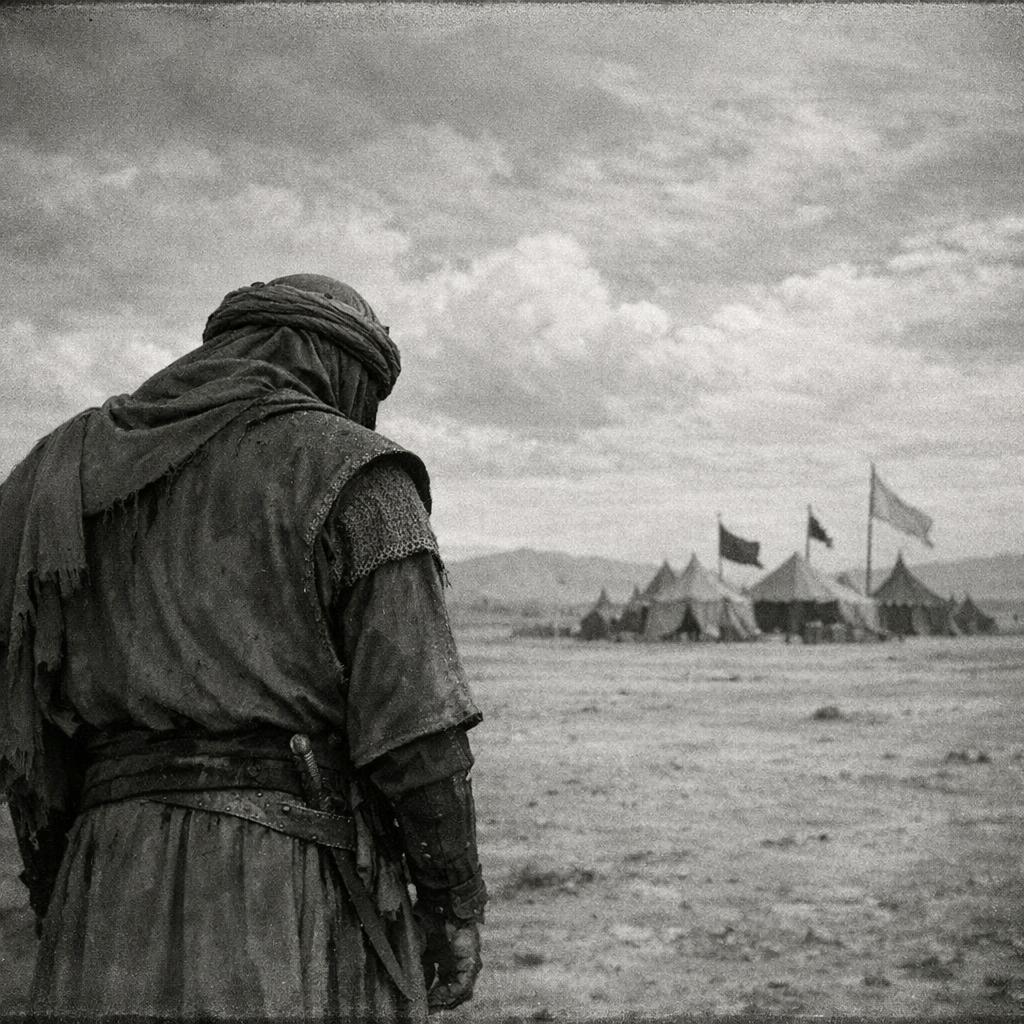
The road from Mecca to Kufa became one of the most painful roads in Islamic history. In the year 61 AH, Imam Husayn ibn Ali (peace be upon him) was moving through the desert with his caravan, guided by the letters and promises sent to him by the people of Kufa. But before he could reach them, an Umayyad force was sent to stop him.
At the head of that force stood Hurr bin Yazid al-Riyahi, a commander ordered to intercept the Imam and prevent him from entering Kufa. What followed was not only a military standoff, but also a moment that showed the dignity of the Ahlul Bayt, the pressure of political power, and the possibility of repentance even at the edge of death.
Historical Background
Before this encounter, the people of Kufa had written many letters to Imam Husayn, asking him to come and lead them. They were living under Umayyad oppression and hoped that he would guide them.
Imam Husayn responded to their call. He sent his emissary, Muslim bin Aqil, to Kufa first. But the situation changed quickly. The Kufans abandoned Muslim bin Aqil, and he was executed by Ubaydullah bin Ziyad, the Umayyad governor of Kufa.
After that, Ibn Ziyad sent an armed vanguard to stop Imam Husayn before he could reach the city. This force was placed under the command of Hurr bin Yazid al-Riyahi. It consisted of 1,000 horsemen.
The Story
Imam Husayn departed from Mecca and continued his journey toward Kufa. He was moving with the hope created by the letters and pledges that had reached him earlier. But before he could enter Kufa, he met the force of Hurr bin Yazid al-Riyahi in the desert.
The two sides faced one another on the road. Hurr had his orders. He was not allowed to let Imam Husayn go on to Kufa, and he was also not allowed to let him return freely to Medina.
At that point, Imam Husayn spoke clearly to the people who had blocked his path. He said that he had not come to them until their letters and messengers had come to him. He also made it known that if they regretted their invitation and no longer wanted him there, he was ready to return to where he had come from.
But the situation did not allow an easy end. Hurr remained firm under the command he had been given. He refused to let the Imam continue toward Kufa or return to Medina.
In the middle of this tense meeting, Imam Husayn said to Hurr, “May your mother mourn you, what do you want?” This was a sharp rebuke in the language of that moment, spoken during a dangerous confrontation.
Hurr answered with striking respect. He said that if anyone else among the Arabs had mentioned his mother in that way, he would have responded in the same manner. But he added that, by God, he could not mention the mother of Imam Husayn except in the best of terms.
That reply showed that even while standing on the side of the enemy force, Hurr still carried deep respect for the household of the Prophet. He did not cross the line of reverence for the Ahlul Bayt.
After this, Hurr proposed a temporary solution. He said that he had not been ordered to fight Imam Husayn, but he had been ordered not to leave him until he brought him to Ubaydullah bin Ziyad. He suggested that Imam Husayn take a path that would neither lead to Kufa nor return to Medina, while Hurr wrote to Ibn Ziyad for further instructions.
This compromise did not free the Imam. Instead, the enemy forces kept him under pressure until his caravan was forced to stop at Karbala.
There, the journey came to a halt on the desolate plains that would later become the place of the tragedy of Ashura.
Then came the morning of Ashura.
By that time, Hurr understood the real intention of the Umayyad army. He saw that the path ahead was not one of negotiation, but one of deadly conflict. In that moment, he made a choice that changed his fate.
Hurr left his position in the enemy ranks and crossed over to Imam Husayn. He repented and chose not to fight the grandson of the Prophet for the sake of worldly reward. Instead, he joined Imam Husayn’s camp and sought salvation before the great massacre began.
Ending
The story ends at the point when Hurr entered Imam Husayn’s side on the morning of Ashura, before the tragedy of the battlefield fully unfolded.
He had been sent to stop the Imam, but in the end, he turned away from the army of oppression and stood with the truth.
Lessons from the Story
This story teaches that respect for the Ahlul Bayt matters deeply, even in the middle of hostility. Hurr’s reverence for Lady Fatima and the family of the Prophet remained visible even before his repentance.
It also shows that sincere repentance can happen very late, even at a moment when death is near.
The story further shows that worldly rank and military power are nothing when compared with truth. Hurr gave up his high position and chose the side of justice.
It also highlights the conduct of Imam Husayn, who did not come with aggression. He made his position clear, explained why he had come, and offered to return if his presence was no longer wanted.
Quran and Hadith
The provided research did not name a specific Quranic verse for this event.
The account is grounded in historical narrations and the recorded speeches and direct dialogue between Imam Husayn and Hurr bin Yazid al-Riyahi.
Sources
- Karbala Research Dossier, Section I: Historical and Political Background.
- Karbala Research Dossier, Section II: The Journey and Interception.
- Karbala Research Dossier, Section III and IV: Eve and Morning of Ashura.
- Tarikh Sayyid al-Shohada, page 422.
- Tarikh Sayyid al-Shohada, page 435.
- Tarikh Sayyid al-Shohada, page 440.