
Introduction
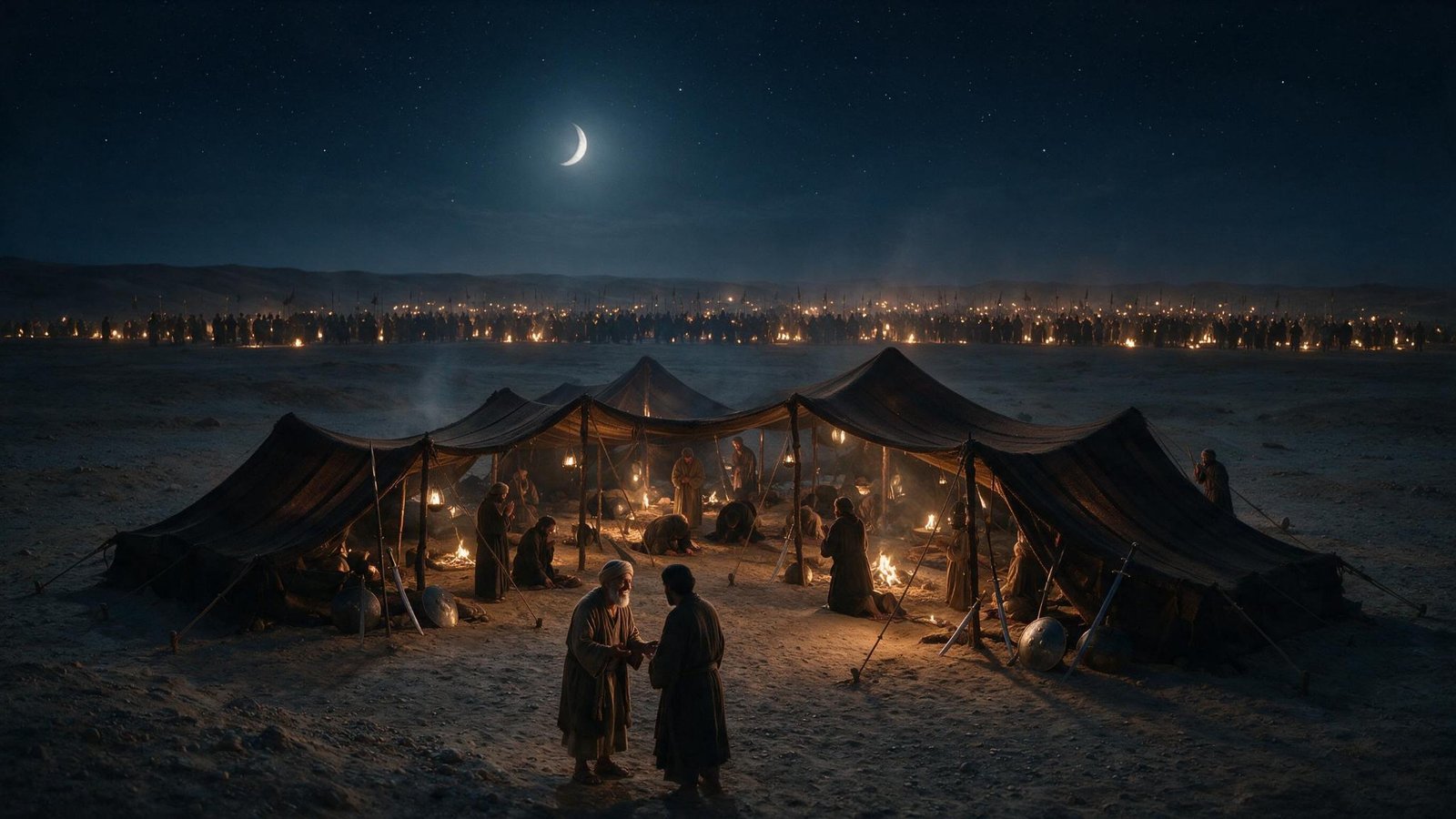
The night before Ashura was one of the darkest nights in Karbala.
Imam Husayn ibn Ali (AS), his family, and his companions were surrounded by a large Umayyad army. They had been deprived of water, and they knew that battle was coming at dawn.
Yet the atmosphere inside Imam Husayn's camp was not one of panic.
Prayer filled the tents. Supplication continued through the night. And one of the Imam's elderly companions, Burayr ibn Khudayr, was even seen joking with another companion.
Why was a man facing death able to smile on such a night?
His answer reveals something about the faith of those who stood with Imam Husayn (AS) at Karbala.
Historical Background
The events took place on the ninth night of Muharram, 61 AH, on the plain of Karbala in Iraq.
Imam Husayn (AS), his family, and his companions had been surrounded by the Umayyad army. The camp had been deprived of access to water, and the small group faced the battle that would come the following morning.
The two camps represented sharply different positions. According to the research, the Umayyad camp stood for worldly ambition, despotism, and oppression, while the camp of Imam Husayn (AS) represented monotheism, remembrance of God, piety, sincerity, and sacrifice in the path of truth.
The companions had also been given the opportunity to leave under the cover of darkness. They refused to abandon Imam Husayn (AS) and chose to remain with him.
The Story
A Strange Kind of Joy
As the night of Ashura continued, an unusual atmosphere filled Imam Husayn's camp.
The group knew that they were facing martyrdom. Yet there was tranquility rather than fear, worship rather than panic, and devotion rather than despair.
Among those present was Burayr ibn Khudayr al-Hamdani, an elderly and deeply pious companion of Imam Husayn (AS).
Burayr was known throughout his life as a serious and devout man. He was not known for frivolous joking.
Yet on this particular night, he began joking and engaging in lighthearted conversation with another companion, Abdurrahman ibn Abd Rabbah al-Ansari.
Abdurrahman was surprised.
He looked at Burayr and said:
«“This is no time to jest.”»
Burayr explained why he was behaving differently.
He said:
«“My people know that I never liked to jest, neither as a middle-aged man nor as a young man, but [it is because] I am delighted by what we shall meet. By God, there is nothing between us and the houris except their swords. I wish that they would attack us now.”»
Burayr's words showed that his unusual happiness came from what he believed was waiting for him beyond the battle.
He was not treating the danger lightly.
He was expressing joy at the sacrifice that he believed lay only hours away.
A Camp Filled With Prayer
While Burayr expressed his anticipation through cheerful words, the wider camp was absorbed in worship.
The companions of Imam Husayn (AS) spent the night praying. The reports describe the sound of the camp as “droning like bees”, referring to the continuous and low sound of Quranic recitation and prayer coming from the tents.
Some companions were standing.
Others were sitting.
Some were bowing.
Others were prostrating.
As dawn approached, they carried the visible signs of people devoted to God. At the same time, the sharp swords around them showed that they were prepared for what was coming.
The night was therefore filled with two things at once: worship and preparation.
The companions knew what awaited them, but they did not turn away from God.
Lady Zaynab's Night of Worship
The same spirit could be found inside the tents of the Prophet's Household.
Lady Fatima, the daughter of Imam Husayn (AS), later described the state of her aunt, Lady Zaynab (SA), during that final night.
She said:
«“My aunt Zaynab spent all that night standing in her prayer niche pleading for succour from her Lord. By God our eyes did not find sleep nor did the sounds [of our prayers] abate.”»
The night passed without sleep for those in the tents.
Lady Zaynab remained standing in prayer and asking Allah for help.
The prayers of the women and the companions continued while the camp waited for the morning.
The Last Night
The night before Ashura therefore became a striking picture of the spiritual state of Imam Husayn's camp.
There was Burayr, whose joy came from his expectation of sacrifice.
There were the companions, praying through the night with the sound of their worship filling the camp.
And there was Lady Zaynab, standing in her prayer niche and pleading with her Lord while those around her remained awake in devotion.
They were physically surrounded, deprived of water, and facing battle.
Yet their final night was marked by worship, patience, and readiness.
By the time dawn came, the camp had spent its final night preparing to give everything for the sake of what it believed to be Divine justice.
Quran Verses
Surah al-Asr (103:2–3)
«“Surely, most people are at a loss and those who prosper are only a small group. Those are the people who enjoin one another to follow the truth and enjoin one another to patience.”»
Surah al-Asr (103:2–3)
Surah al-Ahqaf (46:20)
«“You have exhausted your good things in the life of the world.”»
Surah al-Ahqaf (46:20)
Surah al-Qamar (54:55)
The research connects this verse with the ultimate abode of the truthful in the presence of the Almighty.
Surah al-Qamar (54:55)
Hadith References
The dossier includes the following reports:
She transmitted the report describing Lady Zaynab's continuous prayer during the night before Ashura:
«“My aunt Zaynab spent all that night standing in her prayer niche pleading for succour from her Lord. By God our eyes did not find sleep nor did the sounds [of our prayers] abate.”»
«“Whatever you miss of the world is booty [for you].”»
A report transmitted by Ibn Qulawayh is connected in the source with the spiritual state and visitation guidelines associated with Ashura.
Lessons From This Story
- Tranquility in Faith — The story shows the tranquility displayed by Imam Husayn's companions when facing death. Burayr's joy at the approaching sacrifice reflects the way they viewed martyrdom for truth.
- Detachment From Worldly Pleasures — The research connects attachment to worldly pleasures with weakness and emphasizes limiting oneself to true needs so that the heart remains free to stand for truth.
- Worship Under Pressure — The companions and the Ahl al-Bayt did not abandon worship even during their most difficult physical circumstances. Their final night was filled with prayer, prostration, Quranic recitation, and supplication.
- Moral Courage Over Material Power — Imam Husayn's camp was greatly smaller than the opposing army. Yet the research presents their monotheism, sincerity, and commitment to truth as greater than numerical and material strength.
Frequently Asked Questions
Burayr ibn Khudayr al-Hamdani was an elderly and deeply pious companion of Imam Husayn (AS), known for his devotion.
Burayr explained that he was delighted by what he expected to meet in the coming battle and wanted the enemy to attack immediately.
They spent the night in prayer and Quranic recitation. The reports describe the sound of their worship as “droning like bees.”
According to the narration of Fatima bint al-Husayn, Lady Zaynab spent the entire night standing in her prayer niche and asking Allah for help.
It shows the spiritual state of Imam Husayn's camp before the battle: devotion, patience, sacrifice, and steadfastness despite the certainty of what was coming.