
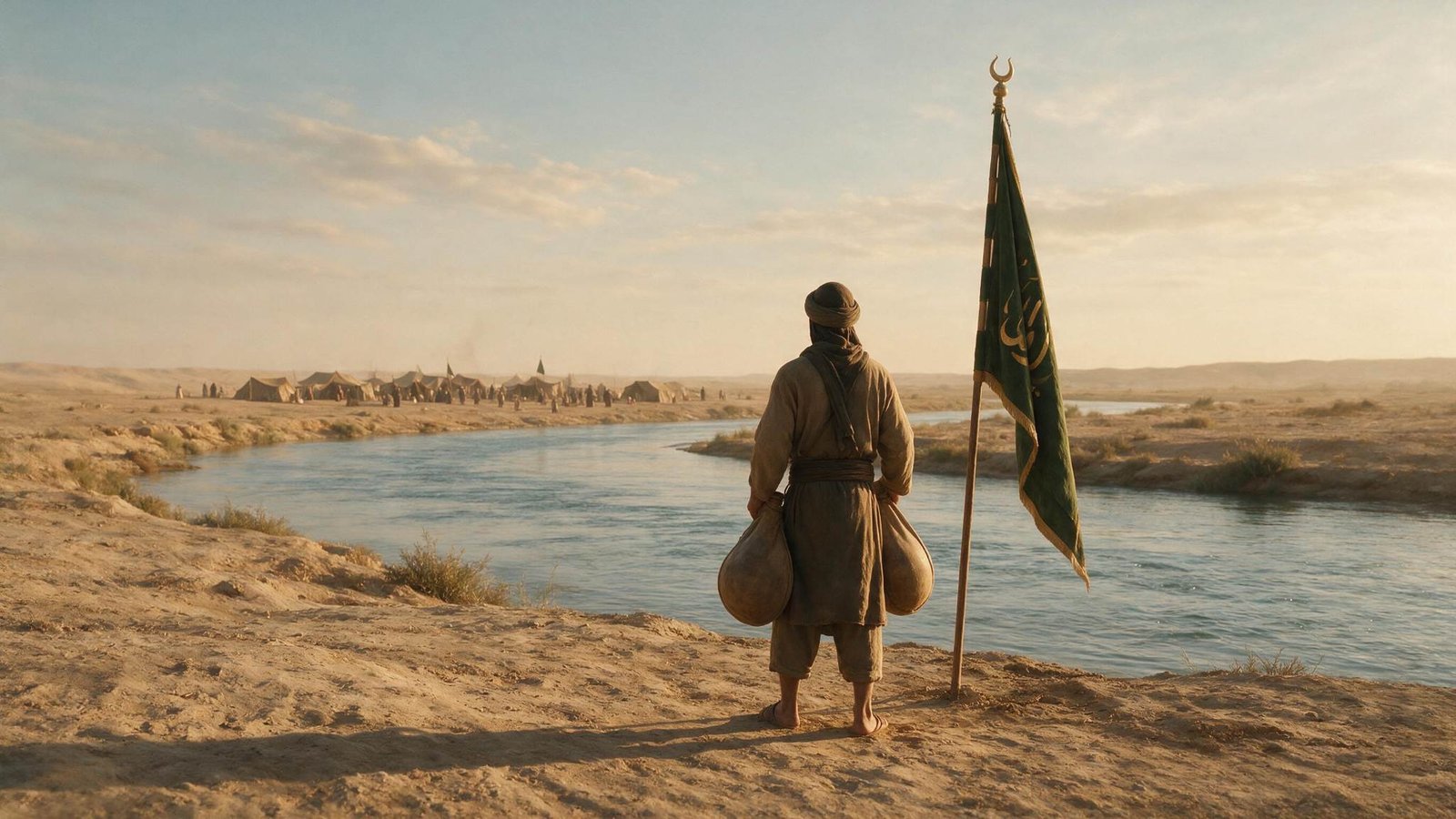
In the desert land of Karbala, a story unfolded that would remain deeply remembered in Islamic history. It was the story of Abbas ibn Ali (a.s.), known as Abul-Fadl al-Abbas, the brother of Imam al-Husayn (a.s.), the holder of the standard, and the guardian of the harem. On the eve of Ashura and on the day that followed, his loyalty, courage, and sacrifice stood at the center of one of the most painful chapters of Karbala.
Historical Background
The events took place in the 61st year of Hijrah, in Karbala, Iraq, near the River Euphrates, also called River al-Alqami. Imam al-Husayn (a.s.) had refused to pay homage to Yazid, whom he described as a lecherous, intoxicated tyrant. Because of this refusal, the Umayyad authorities sent a massive army against him.
Imam al-Husayn’s caravan was intercepted and forced to stop in the desolate land of Karbala. Then came the blockade. For three days, the Imam’s camp, including women and children, was cut off from the water of the Euphrates. That thirst became one of the sharpest pains of Karbala.
The Story
The Eve of Ashura: A Pact of Unshakable Loyalty
On the night before the battle, al-Abbas knew that a massacre was near. He took charge of the Hashemite warriors and gathered his full brethren, nephews, and cousins. He asked them:
«“Brothers, nephews, and cousins: what are you going to do in the morning?”»
— Abbas ibn Ali (a.s.) addressing his family
They replied:
«“You decide, and we carry out.”»
— The Hashemite warriors
Then al-Abbas made his position clear. He said that their companions and supporters were not their relatives, while their own family had to carry a heavy burden. He declared that the next morning they would be the first to fight and would go ahead of their companions to death so that no one could blame them later.
All the family members agreed with him. Lady Zaynab, who was watching the tents with anxiety, overheard the exchange and understood that the companions and family would never let Imam al-Husayn down.
The Sacrifice of the Brethren
On the day of Ashura, after the companions and the youths of the Prophet’s household had been martyred, al-Abbas turned to his full brothers. He told them to proceed to battle so that he could know they had acted sincerely for the sake of Allah and His Messenger, and so that he could avenge their blood, since they had no children.
His brothers accepted his call. They went forward bravely and were all martyred. Al-Abbas stood near their bodies and wept for the loss of their bright faces.
The Plea for Water
When al-Abbas saw the loneliness of his brother and the martyrdom of the whole household, he went to Imam al-Husayn and asked for permission to fight. He said he could no longer endure the situation and wanted to take revenge upon those hypocrites.
Imam al-Husayn replied in a sad tone that al-Abbas was his standard-bearer and his right hand. But because al-Abbas insisted, the Imam asked him first to try to secure water for the harem and the children, who were suffering greatly from thirst.
Confrontation at the Enemy Lines
Al-Abbas rode toward the Umayyad army and addressed Umar ibn Saad. He warned him against Allah’s punishment and reminded him that al-Husayn was the son of the daughter of Allah’s Messenger. He told him that the companions and household had been killed, and now the children and harem were thirsty. He asked for water.
No one answered except Shimr ibn Dhil-Jawshan. Shimr responded with cruelty, saying that even if the whole surface of the earth were under their control, they would not give a single drop until al-Husayn submitted to the leadership of Yazid.
Al-Abbas returned to his brother and reported what had happened.
The Ultimate Altruism at the Euphrates
When al-Abbas heard the cries of the children and saw their dry lips, he could wait no longer. He rode toward the River Euphrates with a waterskin. Fighting fearlessly, he scattered the Umayyad troops guarding the bank. The reports say they were about four thousand warriors, and they fled before his bravery.
At last he reached the water alone. His heart burned with thirst. He extended his hand to the water and tried to drink, but then he remembered the thirst of his brother Imam al-Husayn and the thirst of the children and harem.
So he threw the water from his hand and refused to drink even a single drop while his brother and leader remained thirsty.
He filled the waterskin and turned back toward the camp.
The Ambush and Martyrdom
The enemies surrounded him from every side so that the water would not reach the tents. Al-Abbas fought valiantly and caused heavy losses. The enemy soldiers fled in terror.
Then a filthy hypocrite from Kufa attacked him from behind a date-palm tree and struck him, severing his right hand.
«“Even if you cut my hand, I will keep defending my religion and leader.”»
— Abbas ibn Ali (a.s.) after losing his right hand
A little later, another man hidden behind a tree struck him with a sword and severed his left hand. Bleeding and thirsty, al-Abbas held the waterskin with his teeth and hurried to bring water to the children.
But then a spear pierced the waterskin, and the water spilled onto the ground.
Al-Abbas stood there with sorrow and confusion. At that moment, another enemy attacked him with an iron post and struck his head. As he fell to the ground, he called out for the last time:
«“Peace be upon you, Abu Abdullah!”»
— Abbas ibn Ali (a.s.) to Imam al-Husayn
The Grief of the Imam and the Harem
The wind carried his words to Imam al-Husayn. The Imam rushed toward the River al-Alqami, pushed through the enemy troops, and threw himself onto the severed body of his brother. Then he cried out in grief:
«الْآنَ انْكَسَرَ ظَهْرِي، وَقَلَّتْ حِيلَتِي، وَشَمَتَ بِي عَدُوِّي “From now my back has broken and I am without hope while my enemies are rejoicing at my misfortune.”»
— Imam al-Husayn (a.s.) over the body of al-Abbas
The Imam could barely move his feet as he left the body and returned to the camp, wiping away his tears.
His daughter Sukaynah came to him and asked, “Where is my uncle al-Abbas?” The Imam wept openly and told her that al-Abbas had been martyred.
When Lady Zaynab heard the news, she put her hand on her heart and shouted in agony:
«“Oh, for my brother! Oh, for al-Abbas! We have certainly lost everything as...”»
— Lady Zaynab (a.s.) upon hearing of al-Abbas’s martyrdom
Quran Verses
Surah Al-Ahzab (33:33)
إِنَّمَا يُرِيدُ اللَّهُ لِيُذْهِبَ عَنْكُمُ الرِّجْسَ أَهْلَ الْبَيْتِ وَيُطَهِّرَكُمْ تَطْهِيرًا
“Allah only desires to keep away the uncleanness from you, O people of the House! and to purify you with a (thorough) purifying.”
Surah Al-Ahzab (33:33)
Connection to the story: The dossier uses this verse to show the purity and high rank of the household that al-Abbas gave his life to protect.
Surah Hud (11:18)
أَلَا لَعْنَةُ اللَّهِ عَلَى الظَّالِمِينَ
“The curse of Allah is upon the oppressors.”
Surah Hud (11:18)
Connection to the story: The dossier uses this verse to frame the injustice of the Umayyad army, who deprived the Prophet’s family of water and killed al-Abbas.
Lessons From This Story
- Absolute selflessness: al-Abbas refused to drink water while his brother, the children, and the harem were still thirsty.
- Unwavering loyalty and faith: even after both hands were cut off, he continued to defend his religion and his Imam.
- Strategic and sincere leadership: he sent his full brothers forward first so their sincerity would be clear.
- Courage against tyranny: he fought a large enemy force and scattered the soldiers guarding the river.
References
Primary source provided in the dossier:
- Book: Lady Zaynab
- Author: Badr Shahin
- Publisher: Ansariyan Publications
- Relevant sections: “In Karbala”, “Martyrdom of al-Abbas”, “Lady Zaynab’s panic”
- Pages: 160, 174, 175, 176, 177, 178, 179, 221
- Volume: Not provided in the dossier
- Hadith number: Not provided in the dossier
Frequently Asked Questions
He was the brother of Imam al-Husayn (a.s.), the holder of the standard, and the guardian of the harem.
It took place in Karbala, Iraq, near the River Euphrates, also called River al-Alqami.
The Umayyad troops imposed a strict blockade and prevented the camp from reaching the river for three days.
He went to secure water for the harem and children, who were suffering from thirst.
He refused to drink and threw the water away because Imam al-Husayn and the children were still thirsty.