
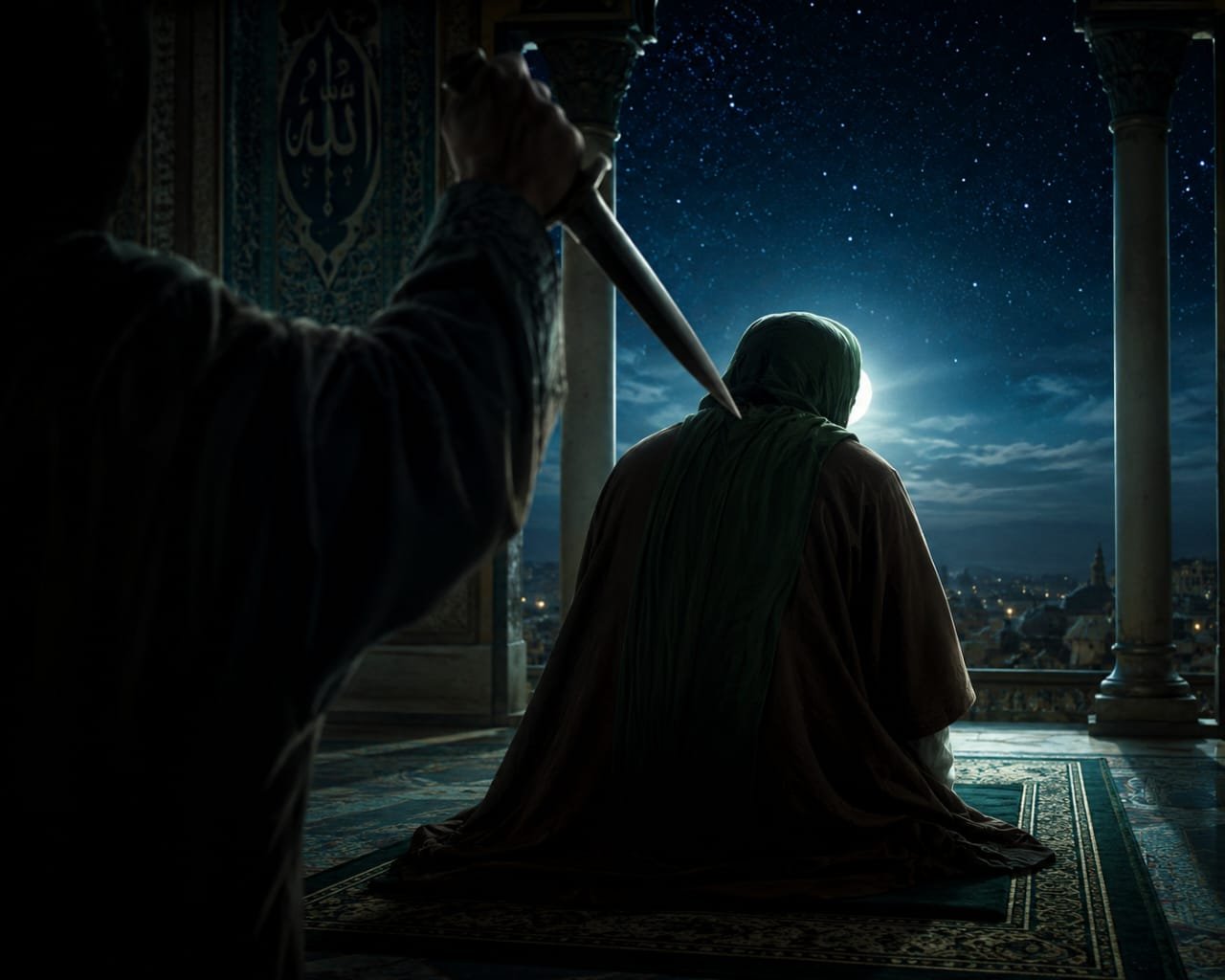
Imam Ali (a) was assassinated by Abd-al-Rahman ibn Muljim, a Kharijite, during Fajr prayer in the mosque of Kufa on the 19th of Ramadan. The attack was part of a wider Kharijite plot formed in Mecca, and Imam Ali (a) met his death with extraordinary faith, justice, and mercy.
Historical Background
The assassination of Imam Ali (a) did not happen in isolation. It was rooted in a time of major political unrest in the Muslim community. A group known as the Kharijites had emerged after bitter conflicts within the ummah, the Muslim community.
According to the dossier, the Kharijites held a secret meeting in Mecca. They discussed the crises facing the Muslims and blamed three leading figures for the troubles of the time:
- Imam Ali (a)
- Muawiyah ibn Abu Sufyan
- Amr ibn al-As
They decided to assassinate all three men at the same time.
One of those chosen for the mission was Abd-al-Rahman ibn Muljim. He was assigned to kill Imam Ali (a). The plan was fixed for after Fajr prayer on the 19th of Ramadan.
But why did this happen?
Because political anger had turned into violence. The Kharijites believed they could solve their problems by removing the men they blamed. Instead of peace, their hatred led them to murder.
Why Was Imam Ali Targeted?
Imam Ali (a) was targeted because the Kharijites considered him responsible for the events that had shaken the Muslim world. Their anger was not based on justice or sound judgment. It was driven by blame, rebellion, and extremist thinking.
The dossier also shows that Abd-al-Rahman ibn Muljim was personally pushed further into the plot when he met a Kharijite woman in Kufa. Her father and brother had been killed in the Battle of al-Nahrawan, and she demanded a shocking dowry: money, servants, and the assassination of Imam Ali (a) as revenge.
This detail makes the story even darker. The murder was not only political. It also became tied to personal vengeance.
The Night Before the Attack
The night before the assassination, Imam Ali (a) had a strong and strange feeling that something terrible was near. The dossier says that on the night of the 18th of Ramadan, he stayed awake throughout the night because it was Friday, spending his time in Quran recitation and prayer.
This is one of the most moving parts of the story. While others slept, Imam Ali (a) remained awake in worship.
He was not described as frightened. Instead, he was spiritually alert, calm, and devoted to Allah.
The Assassination in Kufa
At dawn on the 19th of Ramadan, Imam Ali (a) left for the mosque in Kufa.
The dossier mentions several signs on the way:
- Swans cried out in his face
- He said, "All power and might belong only to Allah. These cries will be followed by wailings."
- He also experienced difficulty opening his door, which he recognized as another sign
These moments mattered because they showed that Imam Ali (a) understood the morning was unusual.
When he reached the mosque, he awakened the people for prayer, as was his custom. Then he began the prayer.
During the prayer, after the first sajdah, which means the first prostration in prayer, Abd-al-Rahman ibn Muljim struck him with a poisoned sword. The blow split Imam Ali's forehead and reached his brain.
The attack happened in the very place where peace, worship, and humility should have been strongest.
What happened next?
At the moment of the wound, Imam Ali (a) raised his voice and said:
"فُزْتُ وَرَبِّ الْكَعْبَةِ"
"By the Lord of the Kaabah, I have triumphed."
These words are unforgettable. He did not speak like a defeated man. He spoke like someone who understood martyrdom as victory in the sight of Allah.
Imam Ali's Final Words
One of the most powerful parts of this story is not only how Imam Ali (a) was attacked, but how he responded afterward.
People rushed to him with broken hearts and carried him home. The murderer was captured. Yet Imam Ali (a), even in his final hours, showed mercy.
He instructed Imam al-Hasan (a) to treat the prisoner kindly. He said the people of the household of the Prophet are people of mercy and forgiveness, and he told his son to feed the captive from their own food and give him their own drink.
This is remarkable. The man who had been struck by a poisoned sword still thought about justice, mercy, and ethics.
He also gave strict instructions about the assassin:
- If he died, Imam al-Hasan (a) could punish the murderer according to Allah's law
- But no mutilation was allowed
- He cited the teaching of the Messenger of Allah (S) that the dead body must not be abused
He also said that if he survived, he would forgive the attacker, because forgiveness was part of the ethics of the Ahl al-Bayt, the family of the Prophet.
What Happened After the Attack?
In the last part of the night, Imam al-Hasan (a), together with his brothers, carried Imam Ali's pure body to his final resting place in al-Najaf.
This burial in al-Najaf became one of the most sacred and remembered places in Shia history.
The loss was enormous. The Muslim ummah had lost a leader known for knowledge, courage, justice, and devotion to Allah.
Key Figures in the Story
| Figure | Role in the Story |
|---|---|
| Imam Ali (a) | The leader who was attacked and martyred |
| Abd-al-Rahman ibn Muljim | The Kharijite assassin |
| The Kharijite woman | She demanded Imam Ali's death as revenge |
| Imam al-Hasan (a) | Imam Ali's son who received his final guidance |
| Imam al-Husayn (a) | Imam Ali's son who helped after the attack |
Timeline of Major Events
Lessons and Historical Significance
The martyrdom of Imam Ali (a) was not only a political assassination. It was a moment that revealed the moral height of the Ahl al-Bayt.
Several lessons stand out:
- Extremism destroys communities — The Kharijites believed violence would solve their problems. Instead, their actions created more grief and division.
- True leadership is shown in crisis — Imam Ali (a) was not only brave in battle. He was even greater in the way he faced death itself.
- Mercy matters even when wronged — He ordered kindness toward his captive and forbade cruelty to the dead body of his killer.
- Faith changes the meaning of death — His final words show that martyrdom, in his understanding, was not defeat. It was success in the sight of Allah.
- Justice and forgiveness can live together — Imam Ali (a) did not ignore justice. But he also did not abandon mercy. That balance is one of the most powerful parts of his legacy.
Frequently Asked Questions
1. Who killed Imam Ali (a)?
Imam Ali (a) was killed by Abd-al-Rahman ibn Muljim, a Kharijite assassin.
2. When was Imam Ali assassinated?
He was attacked during Fajr prayer on the 19th of Ramadan.
3. Where was Imam Ali attacked?
He was struck in the mosque of Kufa, which was the capital of the Islamic state at the time.
4. What weapon was used?
A poisoned sword was used in the attack.
5. Why was Imam Ali targeted?
According to the dossier, the Kharijites blamed Imam Ali (a), Muawiyah, and Amr ibn al-As for the troubles of the Muslim community and planned to kill them.
6. What were Imam Ali's final words after being struck?
He said, "By the Lord of the Kaabah, I have triumphed."
7. Did Imam Ali know something was going to happen?
The dossier says he had strange feelings on the night before the attack and remained awake in prayer, anticipating a frightening event.
8. How did Imam Ali treat his assassin?
He instructed his son to feed and water the prisoner kindly and forbade mutilation of the body.
9. Where was Imam Ali buried?
He was buried in al-Najaf.
10. Why is Imam Ali's martyrdom important today?
It shows his courage, justice, mercy, and complete devotion to Allah, even at the moment of death.
Conclusion
So, who killed Imam Ali (a)?
The historical answer is Abd-al-Rahman ibn Muljim, acting as part of a wider Kharijite plot. But the deeper story is about much more than one assassin. It is about how political hatred can turn into murder, and how a great leader can meet injustice with faith, mercy, and dignity.
Imam Ali (a) was struck down in prayer, yet his final words sounded like victory. That is why his martyrdom has remained one of the most powerful and emotional moments in Islamic history.