
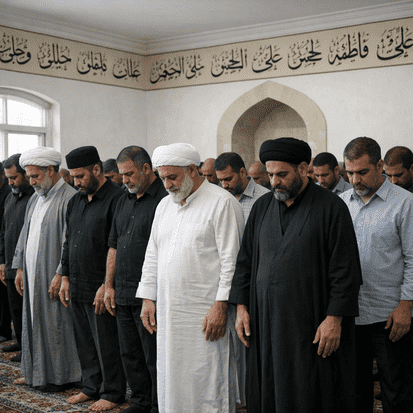
Prayer, or Namaz, is the pillar of religion and one of the most important acts of worship in Islam. In Shia Islam, prayer is not treated as a quick ritual. It is a serious act of devotion that begins with purity, intention, and respect, and it ends with peace, remembrance, and gratitude.
For beginners, the easiest way to understand Shia prayer is this: it is a complete act of worship that brings a person close to Allah through recitation, bowing, prostration, and sincere attention. It has clear rules, but those rules are meant to help the worshipper stand before God in the right way.
Why Prayer Matters So Much
Shia teachings place prayer at the center of religious life. It is described as the pillar of faith. If prayer is accepted, then other deeds are accepted as well. If it is rejected, the rest of a person’s deeds are also rejected.
Prayer is also one of the greatest forms of worship after recognizing Allah. Imam Sadiq (AS) said that after knowing Allah, he knew of nothing more beloved than prayer.
The importance of prayer is also shown in the Quran. The Quran connects prayer with purification, remembrance of Allah, and success. It also shows that prayer was part of the message of earlier prophets, including Prophet Jesus (AS). That means prayer is not just one practice among many. It is a timeless act of obedience that has always been part of divine religion.
Before Prayer Begins: The Seven Preparations
Before a person starts prayer, seven important conditions must be met.
1. Ritual purity
A person must be in a state of ritual purity. This is done through Wudu (ablution, a washing process), Ghusl (a full ritual bath), or Tayammum (a dry purification using earth when water cannot be used).
2. Clean body and clothes
The body and clothing must be free from physical impurity.
3. Correct time
Prayer must be offered within its proper time.
4. Proper covering
The body must be covered correctly during prayer.
5. Permissible place
The place of prayer must be lawful and not taken unfairly from someone else.
6. Facing the Qiblah
The worshipper must face the direction of the Kaaba.
7. Intention
There must be a sincere intention in the heart to pray for the sake of Allah.
These seven preparations show that prayer in Shia Islam begins long before the first word is spoken. It starts with readiness, cleanliness, and purpose.
Adhan and Iqamah: Calling Yourself to Prayer
Before the prayer begins, many Shia Muslims recite the Adhan and Iqamah.
The Adhan is the call to prayer. It has 18 phrases. It begins with praise of Allah, includes testimony to His oneness and the prophethood of Muhammad (PBUH), and invites the believer toward prayer and success. One phrase in it says, “Hasten to the best of deeds,” which shows how highly prayer is valued.
The Iqamah is the second call, said just before prayer starts. It is very similar to the Adhan but is shorter and includes the phrase “the prayer has been established.”
In Shia practice, saying “Ashhadu anna Aliyyan waliyyullah” is highly recommended, but it is not a formal part of the Adhan or Iqamah. It is not to be treated as an obligatory phrase.
The Opening of Prayer
The prayer begins with Takbirat al-Ihram, which means saying “Allahu Akbar” at the start. This opening is essential. It marks the moment when the prayer begins, and it must be said correctly.
Once this opening is said, the person enters the state of prayer and should remain focused until the end.
The Main Parts of Shia Prayer
A Shia prayer follows a clear order. The exact details depend on which prayer is being performed, but the basic structure remains the same.
1. Recitation
In the first two rak’ats, the worshipper recites Surah Al-Fatihah and one complete Surah after it. The Bismillah is part of the Surah and must be recited.
In the third and fourth rak’ats, the person may either recite Surah Al-Fatihah alone or say Tasbihat Arba’ah, which is a set of four praises: glorifying Allah, praising Him, and declaring His oneness and greatness.
2. Qunut
In the second rak’at, there is a recommended supplication called Qunut. It is done before bowing and is a moment of asking Allah with humility.
3. Ruku
After recitation, the worshipper bows in Ruku. This is a sign of respect and submission. In Ruku, a dhikr is recited, usually:
“Subhana Rabbiyal-'Azim wa bi-hamdih”
After bowing, the person must stand up fully before moving on.
4. Sujud
Then comes Sujud, or prostration. This is one of the most humbling parts of prayer. It is done twice in each rak’at.
In Sujud, seven parts of the body touch the ground: the forehead, both palms, both knees, and both big toes. The forehead must be placed on natural earth or on something that comes from the earth, as long as it is not something worn or eaten.
The dhikr usually recited here is:
“Subhana Rabbiyal-A'la wa bi-hamdih”
Between the two prostrations, the worshipper sits up fully before going down again.
5. Tashahhud
After the second prostration in the second rak’at and again in the final rak’at, the person sits and recites the Tashahhud. This is the testimony of faith. It affirms the oneness of God and the messengership of the Prophet, followed by blessings upon the Prophet and his family.
6. Salam
The prayer ends with Salam, the closing greeting. This is what brings the prayer to its completion and takes the person out of the state of prayer. The main phrase is:
“As-salamu 'alaykum wa rahmatullahi wa barakatuh”
7. Ta'qibat
After the prayer, many Muslims perform Ta'qibat, which means post-prayer supplications and remembrances. The most emphasized one is the Tasbih of Fatimah Zahra (AS), which is recited as:
34 times Allahu Akbar
33 times Alhamdulillah
33 times Subhanallah
This part is highly recommended and helps keep the heart connected to Allah after the prayer has ended.
What Makes Prayer So Powerful?
Prayer is not only a duty. It also has deep spiritual wisdom behind it.
First, it keeps a person remembering Allah. The Quran describes prayer as being established for the remembrance of God.
Second, prayer cleans the soul. It removes bad deeds and replaces them with good deeds.
Third, prayer strengthens piety. A person who prays regularly becomes more aware of Allah and less likely to fall into hidden sins.
In other words, prayer shapes the heart. It is not only about movements of the body. It is about living in the presence of God.
Common Questions About Shia Prayer
What breaks the prayer?
Prayer is broken by intentional speaking, loud laughter, crying for worldly matters, turning fully away from the Qiblah, or doing anything that destroys the form of prayer. Losing Wudu also breaks prayer.
How does a traveler pray?
A traveler who covers the required distance shortens the four-rak’at obligatory prayers to two rak’ats.
Is congregational prayer important?
Yes. Congregational prayer is highly recommended, and its reward is extremely great.
Shia Prayer Times and Joining Prayers
One important feature of Shia prayer is that some prayers may be joined. Dhuhr and Asr can be offered in a shared time, and Maghrib and Isha can also be offered in a shared time.
This does not mean the prayers are not important. It means the time given for them is flexible within the rules taught by the Ahl al-Bayt. The time for Dhuhr and Asr begins when the sun declines, and the two prayers share that time until sunset. Similarly, Maghrib and Isha share a time after sunset until midnight.
For Shia Muslims, Maghrib begins when the redness in the eastern sky disappears.
Wudu in Shia Prayer
Before prayer, Shia Muslims perform Wudu. In this washing, the face and arms are washed, and then the front of the head and the top of the feet are wiped with the remaining moisture on the hands.
This is one of the well-known differences in practice between Shia and Sunni schools of Islam.
A Simple Way to Remember the Prayer
If you are new to the topic, remember the order like this:
Prepare yourself.
Make Wudu or another form of purification.
Face the Qiblah.
Say your intention.
Recite the Adhan and Iqamah if needed.
Begin with Allahu Akbar.
Recite, bow, and prostrate with humility.
End with Tashahhud and Salam.
Finish with remembrance and supplication.
That is the heart of Shia prayer in simple form.
Conclusion
Shia prayer is a complete act of worship built on purity, intention, remembrance, and submission to Allah. It begins with preparation, moves through recitation and physical devotion, and ends with peace and prayerful remembrance. It is one of the strongest signs of faith and one of the most important ways a believer stays close to God.
For a beginner, the most important thing to understand is this: prayer is not only a duty to perform. It is a connection to protect, a discipline to respect, and a path to spiritual growth.
Frequently Asked Questions
1. What is the first thing required before Shia prayer?
The first requirement is ritual purity. A person must be clean through Wudu, Ghusl, or Tayammum before starting prayer.
2. What is the opening phrase of Shia prayer?
Shia prayer begins with Takbirat al-Ihram, which is saying “Allahu Akbar”.
3. What is recited in the first two rak’ats?
In the first two rak’ats, the worshipper recites Surah Al-Fatihah and one complete Surah after it.
4. How many prostrations are in each rak’at?
There are two prostrations in each rak’at.
5. What is said after prayer in Shia Islam?
After prayer, many Shia Muslims recite post-prayer supplications, especially the Tasbih of Fatimah Zahra: 34 times Allahu Akbar, 33 times Alhamdulillah, and 33 times Subhanallah.