
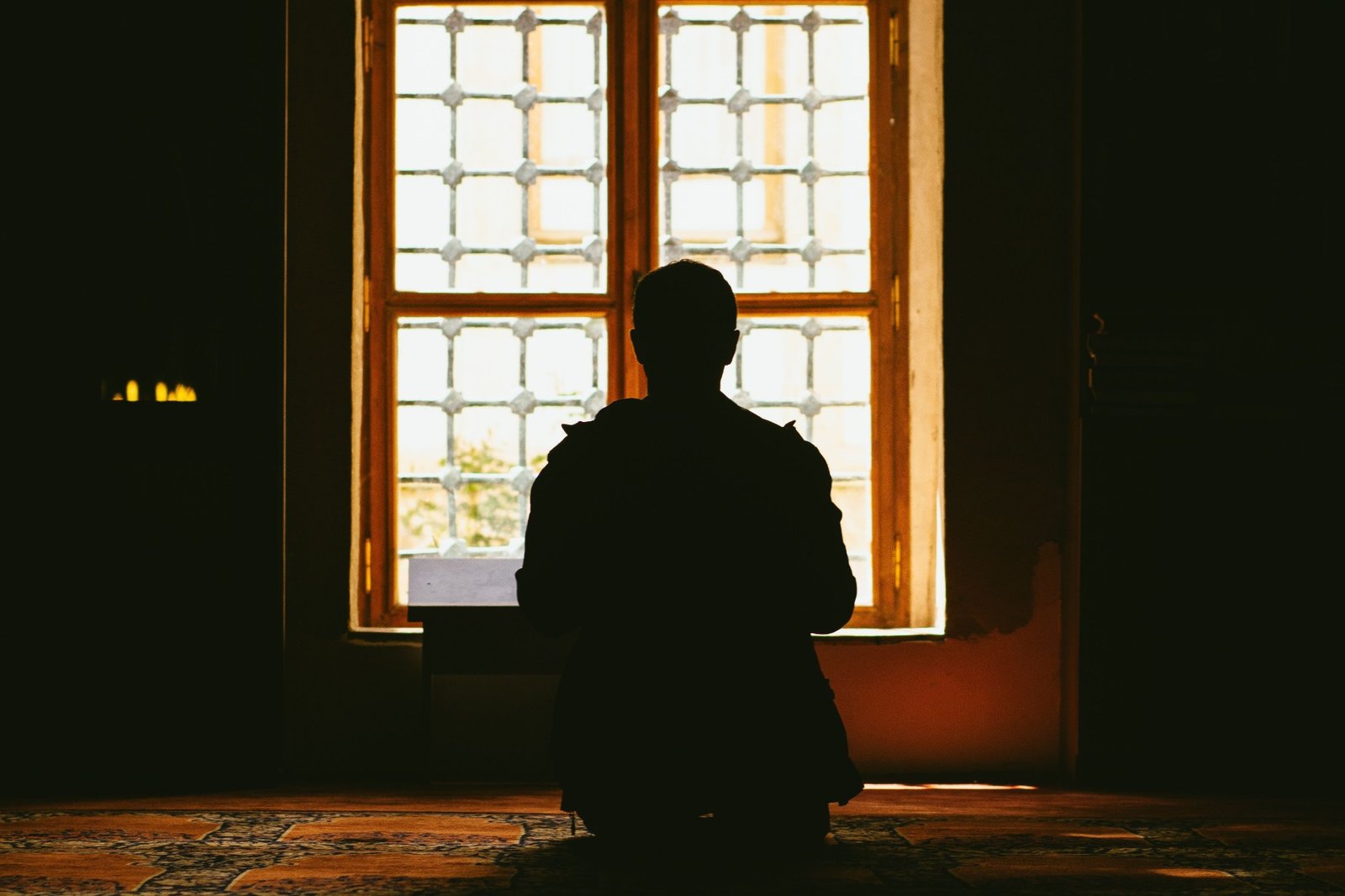
In Shia jurisprudence, Isha is prayed after Maghrib within a shared prayer period that extends from sunset until midnight. Before beginning, the worshipper must meet several conditions, including ritual purity, proper clothing, facing the Qiblah, and making the intention to pray for Allah.
This guide explains the Shia Isha prayer in order, from preparing for prayer to the final salam.
How Many Rak'ahs Are in Shia Isha Prayer?
For a person who is not required to shorten the prayer because of travel, Isha consists of four rak'ahs.
A rak'ah is one complete unit of prayer. During the prayer, the worshipper stands, recites Quran, bows in ruku, and performs two prostrations in sujud.
The basic structure of Isha is:
| Rak'ah | Main recitation |
|---|---|
| First | Surah Al-Fatihah + another complete Surah |
| Second | Surah Al-Fatihah + another complete Surah |
| Third | Surah Al-Fatihah alone or Tasbihat al-Arba'ah |
| Fourth | Surah Al-Fatihah alone or Tasbihat al-Arba'ah |
The second rak'ah also includes the recommended Qunut before ruku.
When Do Shia Muslims Pray Isha?
In Shia jurisprudence, Maghrib and Isha have a shared period from sunset until midnight.
This means that a Shia Muslim may pray Maghrib and then Isha consecutively without needing an emergency or special circumstance to combine them.
This practice is known as Jam', meaning joining or combining prayers.
For example, someone may pray Maghrib after sunset and then immediately pray Isha. The two prayers remain separate prayers, but they can be performed one after another within their shared time.
The research dossier connects this understanding with narrations from Imam Ja'far al-Sadiq (AS) concerning the shared times of the daily prayers.
Why Do Shia Muslims Combine Maghrib and Isha?
The Shia position is that the prescribed time for Maghrib and Isha gives them a shared window. The practice of combining prayers is also connected in the research to the actions of the Prophet Muhammad (PBUH), who combined prayers in Medina even when there was no fear or rain, making the religion easier for his community.
So, combining Maghrib and Isha is not understood as changing the number of prayers. Both remain obligatory prayers; they are simply performed consecutively within the time permitted for them.
What Must Be Done Before Shia Isha Prayer?
Before beginning Isha, seven important conditions must be fulfilled. These are known as Muqaddamat, meaning the required preparations or prerequisites.
1. Ritual Purity
The worshipper must be in a state of ritual purity.
This may be achieved through:
- Wudu (ablution)
- Ghusl (ritual bath)
- Tayammum when applicable
A person should also be free from physical ritual impurities.
2. Purity of the Body and Clothing
The body and clothing used for prayer must be free from ritual impurities such as blood or urine.
This is different from the first condition. The first concerns the worshipper's ritual state, while this concerns physical impurity.
3. The Correct Prayer Time
Isha must be performed within its prescribed time.
According to the research, the shared period for Maghrib and Isha extends from sunset until midnight.
4. Proper Clothing
The required parts of the body must be covered according to the rules of prayer.
5. A Permissible Place
The prayer should be performed in a permissible place. The research specifically notes that the place should not be usurped or unlawfully taken.
6. Facing the Qiblah
The worshipper must face the direction of the Kaaba in Mecca, known as the Qiblah.
7. Intention (Niyyah)
The intention should be made sincerely for Allah.
Niyyah does not require a person to announce the intention aloud. It is the sincere intention in the heart to perform the obligatory Isha prayer for the sake of Allah.
Should You Say the Adhan and Iqamah Before Isha?
Reciting the Adhan and Iqamah before prayer is highly recommended.
The research dossier describes the Adhan as consisting of eighteen phrases and the Iqamah as seventeen phrases.
They prepare the worshipper mentally and spiritually for prayer and call attention away from ordinary activities toward worship.
One phrase highlighted in the research is:
Hayya 'ala khayril-'amal
This means, in essence, "Come to the best of deeds."
It serves as a reminder that prayer is not simply another daily activity. It is an important act of worship and a way of turning the heart toward Allah.
Is "Ashhadu anna Aliyyan waliyyullah" Part of the Adhan?
No. According to the Shia scholarly position presented in the research, the third testimony,
Ashhadu anna Aliyyan waliyyullah
is not an official obligatory part of the Adhan or Iqamah.
It may be recited as an expression of faith, and the research describes this as highly recommended. However, it should not be recited with the belief that it is a required component of the formal Adhan or Iqamah.
This distinction is important because something can be a recommended expression of faith without being considered an official part of the prescribed Adhan.
Step-by-Step: How to Pray Isha in Shia Islam
Once the necessary preparations are complete, the four-rak'ah Isha prayer can begin.
Step 1: Make the Intention
Before beginning, intend in your heart that you are praying the obligatory Isha prayer for the sake of Allah.
There is no need to make a long verbal statement. The important thing is the sincere intention.
Step 2: Say Takbirat al-Ihram
Stand facing the Qiblah and begin the prayer by saying:
Allahu Akbar
This opening declaration is called Takbirat al-Ihram.
It marks the beginning of the formal state of prayer. According to the research, it must be pronounced correctly in Arabic, and intentionally changing or omitting it can invalidate the prayer.
Step 3: Recite the Quran in the First Rak'ah
In the first rak'ah, recite:
- Surah Al-Fatihah
- Another complete Surah
The Bismillah is included in the recitation of Al-Fatihah.
For someone learning how to pray, it may help to think of the first rak'ah as:
Stand → recite Al-Fatihah → recite another Surah → bow → prostrate twice.
Step 4: Perform Ruku
After the recitation, bow into ruku.
During ruku, a typical dhikr is:
Subhana Rabbiyal-'Azim wa bi-hamdih
The worshipper then rises and stands completely upright before moving to the next position.
This complete standing between ruku and sujud is important. The prayer is not simply a series of movements; each position has its own place and order.
Step 5: Perform Two Sujud
After standing upright, perform the first sujud, or prostration.
In Shia prayer, seven parts of the body touch the ground:
- The forehead
- The two palms
- The two knees
- The two big toes
The forehead must rest on natural earth or something that grows from the earth, according to the rules described in the research.
A common dhikr during sujud is:
Subhana Rabbiyal-A'la wa bi-hamdih
After the first prostration, sit up completely and then perform the second prostration.
That completes the physical pattern of the first rak'ah.
The Second Rak'ah
After completing the first rak'ah, stand for the second.
Quran Recitation
Again, recite:
Surah Al-Fatihah + one complete Surah
Qunut: A Recommended Supplication
Before going into ruku in the second rak'ah, it is recommended to perform Qunut.
Qunut is a supplication made while raising the hands. It is a beautiful moment in the prayer to turn directly to Allah and ask for His mercy, guidance, forgiveness, and help.
After Qunut, continue with ruku and the two prostrations as in the first rak'ah.
Tashahhud After the Second Rak'ah
After the second rak'ah, sit and recite Tashahhud.
Tashahhud is the testimony of faith recited while sitting. It includes testimony to the oneness of Allah and the messengership of Prophet Muhammad (PBUH), followed by Salawat.
At this point, the first two rak'ahs of Isha are complete.
The Third Rak'ah
Stand for the third rak'ah.
Here there is a difference from the first two rak'ahs.
The worshipper may recite either:
- Surah Al-Fatihah alone, or
- Tasbihat al-Arba'ah
The Tasbihat al-Arba'ah are the four glorifications used in the later rak'ahs of prayer.
The research identifies this as the required recitation option for the third rak'ah.
After the recitation, perform ruku, stand upright, and complete the two sujud.
The Fourth Rak'ah
The fourth rak'ah follows the same basic pattern as the third.
The worshipper recites either:
- Surah Al-Fatihah alone, or
- Tasbihat al-Arba'ah
Then come:
Ruku → standing → first sujud → sitting → second sujud
After completing the second prostration, sit for the final Tashahhud.
Final Tashahhud and Salam
After the fourth rak'ah, sit and recite Tashahhud.
The worshipper then completes the prayer with Salam, the concluding greeting that exits the formal state of prayer.
A commonly recited concluding greeting is:
As-salamu 'alaykum wa rahmatullahi wa barakatuh
With the Salam, the four-rak'ah Isha prayer is complete.
What Should You Do After Isha Prayer?
After completing the obligatory prayer, Ta'qibat, or post-prayer supplications and remembrances, are highly recommended.
One of the most important is the Tasbih of Fatimah al-Zahra (AS).
It consists of:
- 34 times: Allahu Akbar
- 33 times: Alhamdulillah
- 33 times: Subhanallah
This simple remembrance can turn the moments immediately after prayer into an opportunity for continued remembrance of Allah.
What Happens If a Person Is Traveling?
A traveler, known as a Musafir, has different prayer rules.
According to the research, a person who travels the required distance of 8 farsakhs must shorten four-rak'ah obligatory prayers.
Therefore, Isha is shortened from:
4 rak'ahs → 2 rak'ahs
The same shortening applies to Dhuhr and Asr.
This is an important difference for travelers because someone who normally prays four rak'ahs for Isha does not perform the full four while the conditions for shortening are present.
What Invalidates Shia Isha Prayer?
A prayer can become invalid when certain actions or conditions occur.
The research identifies several examples.
Intentional Speaking
Intentionally speaking during prayer can invalidate it.
Laughing Out Loud
Loud laughter during prayer invalidates the prayer.
Crying for Worldly Matters
Crying because of worldly matters can invalidate the prayer.
Turning Away From the Qiblah
A significant turning away from the Qiblah can invalidate the prayer.
Breaking Wudu
The prayer is also invalidated if the worshipper loses ritual purity, such as by:
- Passing wind
- Urinating
- Sleeping
- Losing consciousness
Destroying the Form of Prayer
Actions that are so extensive that they destroy the recognizable form of prayer can also invalidate it.
The key idea is that prayer has a defined structure. Unrelated actions or words can take a person outside that structure.
Do Shia Muslims Cross Their Arms During Isha Prayer?
No. In the Shia prayer practice described in the research, crossing the arms (Takattuf) is not part of the prescribed prayer.
Shia Muslims rely on the teachings attributed to the Ahl al-Bayt in maintaining the form of prayer.
Similarly, saying additions such as "Amen" after the recitation is not considered part of the prescribed Shia prayer and is treated differently from Sunni practice.
These are examples of differences in ritual practice between Shia and Sunni schools.
How Is Shia Isha Prayer Different From Sunni Isha Prayer?
The basic purpose of the prayer is shared: Muslims turn toward Allah in worship, recite Quran, bow, prostrate, and remember God.
However, there are differences in jurisprudence and ritual practice.
One important difference concerns combining prayers.
In Twelver Shia jurisprudence, Maghrib and Isha have a shared time extending from sunset to midnight, allowing them to be performed consecutively.
The research contrasts this with the Sunni schools, where the ordinary prayer times are generally treated more separately and combining is allowed in particular circumstances.
There is also a difference in Wudu. In Shia jurisprudence, the tops of the feet are wiped during Wudu rather than washed, based on the interpretation of the relevant Quranic wording.
Another visible difference occurs during prayer itself: Shia Muslims do not normally cross their arms, and the prayer does not include additions such as "Amen" as part of the prescribed form.
The purpose of such differences is not to create a different religion. They arise from different interpretations of Islamic sources and different traditions of jurisprudence.
Why Is Prayer So Important in Shia Islam?
Learning the movements of Isha is important, but prayer is more than a sequence of physical actions.
The research describes prayer as a fundamental pillar of Islam and one of the greatest acts of worship after knowing Allah.
A narration attributed to Imam Ja'far al-Sadiq (AS), transmitted through Mu'awiyah ibn Wahb and cited in Resaleh Salatiye, expresses this importance:
«"After knowing Allah, I know of nothing better than this prayer."»
— Imam Ja'far al-Sadiq (AS)
The message is simple: knowing Allah should lead to worship, and prayer is one of the clearest ways that knowledge becomes action.
Prayer and Remembrance of Allah
The Quran connects prayer with remembering Allah.
In Surah Al-Isra (17:78), the Quran says:
«"Establish prayer at the decline of the sun [from its meridian] until the darkness of the night..."»
Surah Al-Isra (17:78)
The research explains that this verse is used in the teachings of the Ahl al-Bayt to establish the divinely ordained times for the daily prayers.
Prayer therefore gives the believer regular points throughout the day to stop, remember Allah, and step away from worldly distractions.
Prayer and Spiritual Purification
Surah Al-A'la (87:14–15) says:
«"He has certainly succeeded who purifies himself. And mentions the name of his Lord and prays."»
Surah Al-A'la (87:14–15)
The research connects these verses with the idea that prayer and remembrance help purify the human being.
Prayer is not only about completing an obligation. It is also intended to shape the believer's character and protect the heart from sin.
Prayer Was Also Part of the Mission of Earlier Prophets
Prayer is not unique to Muslims.
In Surah Maryam (19:31), Prophet Jesus (AS) says:
«"...And He has enjoined upon me prayer and Zakat as long as I remain alive."»
Surah Maryam (19:31)
This shows the wider place of prayer in the revealed religions.
A Simple Summary of the Four Rak'ahs
For a beginner, the structure can be remembered like this:
| Rak'ah | Recitation | Main movements |
|---|---|---|
| 1 | Al-Fatihah + another Surah | Ruku + 2 Sujud |
| 2 | Al-Fatihah + another Surah | Qunut + Ruku + 2 Sujud + Tashahhud |
| 3 | Al-Fatihah alone or Tasbihat al-Arba'ah | Ruku + 2 Sujud |
| 4 | Al-Fatihah alone or Tasbihat al-Arba'ah | Ruku + 2 Sujud + Tashahhud + Salam |
In simple terms:
Prepare → Intend → Allahu Akbar → Recite → Ruku → Sujud → Repeat the rak'ahs → Tashahhud → Salam.
Is Congregational Isha Prayer Recommended?
Yes. Congregational prayer (Jama'ah) is highly recommended in Shia Islam.
The research describes the reward of congregational prayer as extremely great and reports that when a congregation exceeds ten people, the reward for a single rak'ah is so immense that all the angels combined cannot record it.
This emphasizes the spiritual value of worshipping Allah together rather than always praying alone.
Frequently Asked Questions
Yes. In Twelver Shia jurisprudence, Maghrib and Isha share a prayer period from sunset until midnight, so they may be performed consecutively.
It is normally four rak'ahs. A traveler who meets the conditions for shortening the prayer performs two rak'ahs instead.
Yes. According to the research, a qualifying Musafir shortens four-rak'ah obligatory prayers, including Isha, to two rak'ahs.
No. Qunut in the second rak'ah is recommended, not one of the required elements of the prayer.
The research states that Shia Muslims do not include "Amen" as an addition to the prescribed form of prayer.
No. "Ashhadu anna Aliyyan waliyyullah" is not considered an official obligatory part of the Adhan or Iqamah. It may be recited as an expression of faith, but not with the belief that it is a mandatory component of the formal Adhan.
A beginner should first focus on learning the basic order correctly: Wudu → Qiblah → Intention → Takbirat al-Ihram → Recitation → Ruku → Sujud → Tashahhud → Salam. Once the overall structure is understood, the individual recitations and detailed rules become much easier to learn.
Final Thoughts
Shia Isha prayer is a four-rak'ah obligatory prayer for a person who is not required to shorten it because of travel. In Twelver Shia jurisprudence, it shares its prayer time with Maghrib from sunset until midnight, which allows the two prayers to be performed consecutively.
Before beginning, the worshipper prepares through ritual purity, proper clothing, a permissible place, facing the Qiblah, observing the correct time, and making a sincere intention.
The prayer then follows a clear order of Takbir, Quran recitation, ruku, sujud, Tashahhud, and Salam, with Qunut recommended in the second rak'ah and post-prayer remembrance highly encouraged.
But behind these movements is a deeper purpose: remembering Allah, purifying the heart, developing piety, and turning knowledge of God into worship.
For someone learning Shia Isha prayer for the first time, the most important thing is not to memorize everything at once. Learn the order of the four rak'ahs first, then gradually learn the Arabic recitations and detailed rules. In this way, the prayer becomes easier to perform and, more importantly, easier to understand.