
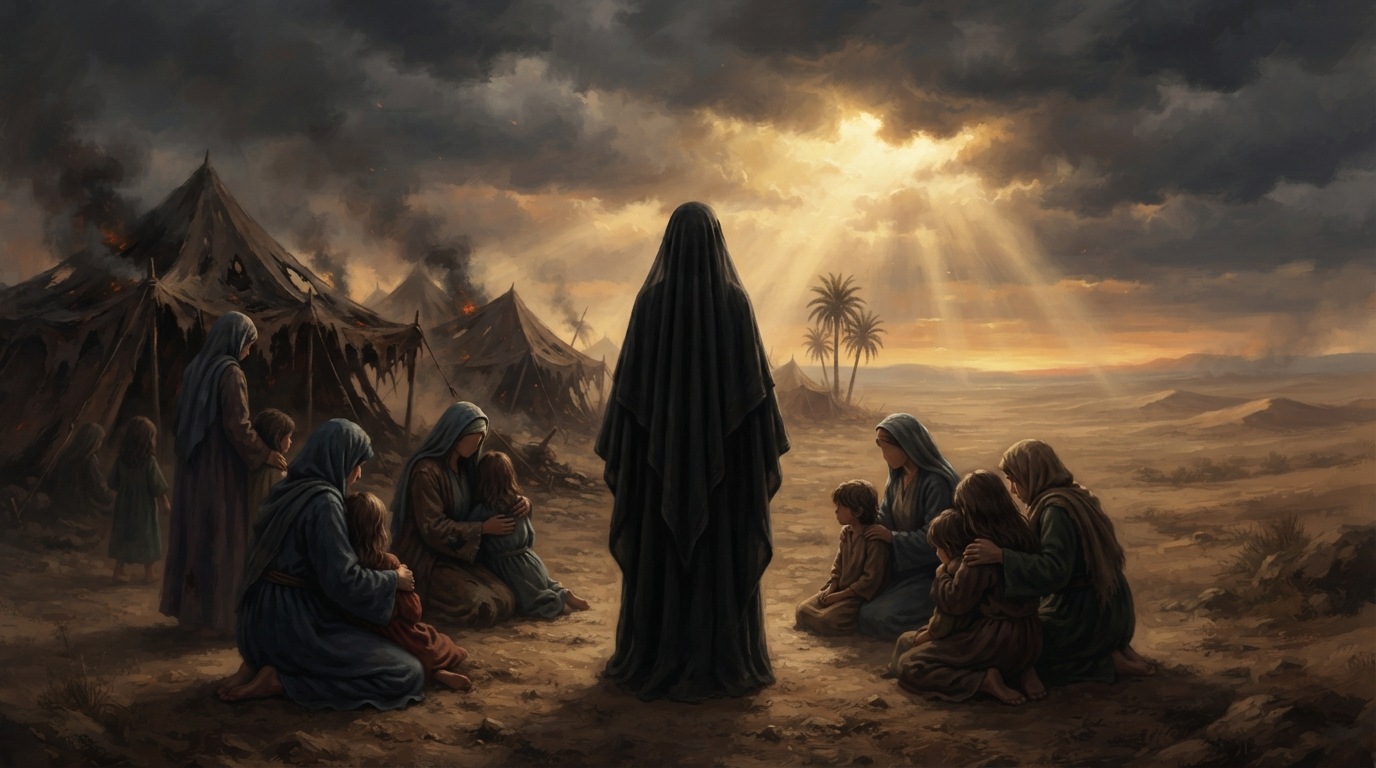
Lady Zaynab (a.s.) is one of the most remarkable women in Islamic history. Her life was shaped by faith from the very beginning, tested by tragedy again and again, and crowned by courage that changed the course of history. She was not only the granddaughter of Prophet Muhammad (S), but also the daughter of Imam Ali (a.s.) and Lady Fatimah al-Zahra (a.s.). In other words, she grew up in the most radiant household in Islam.
But Lady Zaynab is remembered for more than her noble birth. She is remembered because she carried truth through the darkest moments of Karbala, defended the dignity of the Ahl al-Bayt, and spoke with fearless clarity in front of tyrants. Her life is a lesson in patience, wisdom, and unwavering loyalty.
Who Was Lady Zaynab?
Lady Zaynab was the daughter of Imam Ali Amir al-Muminin (a.s.) and Lady Fatimah al-Zahra (a.s.), whom the dossier calls the Veracious. She was also the granddaughter of Prophet Muhammad (S) and Lady Khadijah on her mother's side, and the granddaughter of Abu Talib and Fatimah bint Asad on her father's side.
She was the sister of Imam al-Hasan (a.s.) and Imam al-Husayn (a.s.), the two figures whom the Prophet called the Chiefs of the Youth of Paradise. So from birth, Lady Zaynab was surrounded by light, knowledge, sacrifice, and divine guidance.
Her life was not easy, but perhaps that is exactly why her story matters so much. She showed what faith looks like when it is tested by loss.
Her Birth and Early Life
A name chosen by Allah
The dossier says that when she was born, Imam Ali did not want to name her before the Prophet (S). The Prophet also refused to choose a name before Allah did. Then Archangel Gabriel came with the message that Allah had chosen the name Zaynab.
The name is explained as meaning "a handsome, fragrant tree." It is a beautiful name, and in the dossier it carries the sense of beauty, purity, and blessing.
The first sounds she heard
Imam Ali recited the Azan in her right ear and the Iqamah in her left.
For a beginner, these terms are simple: the Azan is the call to prayer, and the Iqamah is the second call that announces the prayer is about to begin. According to the dossier, the first words Lady Zaynab heard were declarations of Allah's greatness.
That detail matters. It shows that her life began with worship, not with worldly noise.
The Prophet's sorrowful prophecy
When the Prophet held the newborn Zaynab, he wept heavily. The dossier says he foretold that she would face terrible misfortunes and tragedies after his death and after the deaths of her parents.
That prophecy was fulfilled in painful stages. As a child, she witnessed the death of her grandfather, the suffering of her mother, and the struggle over her father's rightful leadership. By the age of five, she had already seen grief beyond what most people face in a lifetime.
Raised in the house of prophecy
Lady Zaynab was brought up in a home filled with divine guidance. After the death of Lady Fatimah, she was raised by Umamah, whom Imam Ali married according to Fatimah's will.
The dossier describes her as being fed with the core of true faith and nurtured by the most perfect personalities of the age. This was not just a noble household. It was a school of faith, patience, and character.
Her Names, Nicknames, and Titles
Lady Zaynab was known by many names and titles. Each one highlights a different part of her personality.
| Title | Meaning and Significance |
|---|---|
| Zaynab | A handsome, fragrant tree. Chosen by Allah. |
| Ummu-Kulthum / Ummu-al-Hasan | Early nicknames given to her |
| Al-Aqilah | The Noble or Wise Woman |
| Al-Alimah | The Woman of Knowledge |
| Abidatu Ali | The Most Worshipping Woman of Ali's household |
| Al-Kamilah | The Perfect Woman |
| Al-Fadhilah | The Virtuous Lady |
| Al-Siddiqah al-Sughra | The Junior Veracious Lady |
| Umm al-Masaib | Mother of Misfortunes |
These titles are not decorative. They reflect how her family, scholars, and later generations understood her place in Islamic memory.
Her Character and Knowledge
A life rooted in faith
Lady Zaynab's strength came from exclusive devotion to Allah. The dossier shows that her faith was not abstract. It was living, active, and tested under the heaviest burden.
At Karbala, after standing over the severed body of Imam al-Husayn, she said: "O Allah, accept this offering from us".
اللَّهُمَّ تَقَبَّلْ مِنَّا هَذَا الْقُرْبَانَ
That sentence reveals the depth of her submission to Allah. Even in unbearable grief, she spoke as a servant of God who trusted divine wisdom.
Knowledge and wisdom
She memorized the Holy Quran and the sayings of the Prophet. During Imam Ali's rule in Kufa, she held sessions for Muslim women, teaching Quranic interpretation and Islamic law.
The dossier quotes Imam Zayn al-Abidin (a.s.) as saying: "She is so knowledgeable herself that she does not need to be taught by somebody else."
إِنَّهَا عَالِمَةٌ غَيْرُ مُعَلَّمَةٍ
That description tells us something very important. Lady Zaynab was not only brave. She was learned. Her speeches later in Kufa and Damascus were not emotional outbursts; they were the words of a woman deeply grounded in knowledge.
Asceticism and self-restraint
Like her parents, she rejected worldly comfort. The dossier says she left behind her wealth in order to accompany her brother Husayn. That decision shows how completely she placed duty above personal ease.
Dignity and honour
After Karbala, the captives were exhausted and hungry. Yet Lady Zaynab refused to allow the children to eat alms given by the women of Kufa.
She declared: "It is forbidden for us, the Ahl al-Bayt, to receive from the alms."
الصَّدَقَةُ مُحَرَّمَةٌ عَلَيْنَا أَهْلَ الْبَيْتِ
This is more than a rule. It is a sign of dignity. Even in captivity, she protected the honour of the Prophet's family.
Courage and firmness
Lady Zaynab spoke fearlessly against tyrants such as Ubaydullah ibn Ziyad and Yazid. She used logic, the Quran, and strong rhetoric to expose their crimes. Her courage did not come from anger alone. It came from moral certainty.
Her Marriage and Family
Lady Zaynab married her cousin, Abdullah ibn Jafar, the son of Jafar ibn Abu Talib. The dossier describes him as noble and generous.
They had five children: Awn, Ali al-Zaynabi, Muhammad, Abbas, and Ummu-Kulthum.
The sacrifice of Awn
Her son Awn joined Imam al-Husayn at Karbala and fought bravely until he was martyred by Abdullah al-Tai. Lady Zaynab received his body with patience and with trust in Allah's reward.
That moment is one of the clearest signs of her strength. She was not spared pain by her devotion. She was given strength to endure it.
Her daughter Ummu-Kulthum
The dossier says Ummu-Kulthum was known for her beauty and chastity. Muawiyah tried to arrange her marriage to his son Yazid through Marwan ibn al-Hakam, hoping to gain prestige. Imam al-Husayn stopped this and instead married her to her cousin al-Qasim, the son of Muhammad ibn Jafar.
Her Relationship with Imam al-Husayn
The bond between Lady Zaynab and Imam al-Husayn was extraordinary. The dossier says Husayn would stand in respect when she visited him. That alone shows the honour he gave her.
She was also his most trusted confidante. On the Day of Ashura, Husayn bade her farewell and asked her to remember him in her Night Prayer.
When Abdullah ibn Abbas advised Husayn not to take the women to Iraq, Zaynab wept and said: "No, by Allah, we either live with him or die with him. We have nothing left except him."
That is one of the most powerful lines in the dossier. It captures her loyalty perfectly. She did not see herself as separate from Husayn's mission. She saw herself as part of it.
Without Lady Zaynab, the story of Karbala could have been buried under Umayyad propaganda. With her, the truth was carried forward.
The Ordeal of Karbala
The eve of Ashura
On the night before the massacre, Lady Zaynab watched the tents carefully, aware that tragedy was near. She overheard Habib ibn Muzhahir and the companions pledging to die before any Hashemite blood would be shed.
That kind of loyalty must have given her strength, but it could not remove the sorrow that followed.
The Day of Ashura
She witnessed the slaughter of her family and companions. The dossier specifically mentions the martyrdom of Ali al-Akbar, her son Awn, and finally Imam al-Husayn.
When the Umayyad army trampled Husayn's body and set the tents on fire, Lady Zaynab gathered the children and surviving women and protected them.
This is one of the greatest scenes in Islamic history. When everything collapsed, she became the shelter.
Protecting the next Imam
When Shimr tried to kill the sick Imam Zayn al-Abidin (a.s.), Lady Zaynab threw herself over him and declared: "No, you should first kill me before you kill him."
The dossier says this forced Shimr to stop and saved the line of Imamate. Her courage was not only emotional. It was life-saving.
Her Great Speeches and Confrontations
Lady Zaynab's speeches are among the most powerful moments in the dossier. They show how she turned captivity into testimony.
1) The first address in Kufa
The captives were brought through Kufa, and the people began to cry. Lady Zaynab silenced them and rebuked them sharply.
She exposed their false loyalty, compared them to a woman who unravels her own spun thread, and condemned them for murdering the grandson of the Prophet.
The force of her speech was so strong that Imam Zayn al-Abidin gently interrupted her, noting the depth of her knowledge.
2) Her confrontation with Ubaydullah ibn Ziyad
When she was brought before Ubaydullah in Kufa, he boasted that Allah had exposed and destroyed her revolution. Her reply was unforgettable. She said that praise belongs to Allah who honoured the Ahl al-Bayt and purified them, while shame belongs to the corrupt and immoral.
Then he mocked her by asking how she viewed what Allah had done to her brother. Her answer became one of her most famous lines:
"I see nothing but His Grace."
مَا رَأَيْتُ إِلَّا جَمِيلًا
This is not denial of pain. It is faith beyond pain. She saw martyrdom through the lens of divine wisdom.
3) Her second address in Damascus
In Damascus, Yazid celebrated as the captives and the severed heads were brought before him. He boasted about revenge for Badr. Lady Zaynab stood up and destroyed the meaning of his victory.
She quoted Quran 11:18 to remind him that Allah's curse is upon the oppressors. She condemned him for parading the daughters of the Prophet while protecting his own women. She also reminded him that the Prophet had spared his ancestors at the Conquest of Mecca.
Then she swore that his plots would fail and that the shame of his crimes would never disappear.
When a Syrian man asked Yazid for Fatimah bint al-Husayn as a servant, Lady Zaynab strongly rejected it, saying that neither he nor Yazid had such authority unless they left Islam.
Her speeches in Kufa and Damascus did what weapons could not. They exposed falsehood in public.
Quranic Connections
The provided books explicitly connect several Quranic verses to Lady Zaynab and the Ahl al-Bayt.
1) Surah al-Ahzab (33:33)
إِنَّمَا يُرِيدُ اللَّهُ لِيُذْهِبَ عَنْكُمُ الرِّجْسَ أَهْلَ الْبَيْتِ وَيُطَهِّرَكُمْ تَطْهِيرًا
"Allah only desires to keep away the uncleanness from you, O people of the House and to purify you with a thorough purifying."
Surah al-Ahzab (33:33)
Simple explanation: The dossier says this verse confirms the divine purification of the Ahl al-Bayt. That purity became central to Lady Zaynab's defence against the accusations of tyrants.
2) Surah Ash-Shura (42:23)
قُلْ لَا أَسْأَلُكُمْ عَلَيْهِ أَجْرًا إِلَّا الْمَوَدَّةَ فِي الْقُرْبَى
"Say: I do not ask of you any reward for it but love for my near relatives."
Surah Ash-Shura (42:23)
Simple explanation: This verse establishes love for the Prophet's family. The dossier says the Umayyads violated this duty.
3) Surah al-Baqarah (2:155–157)
وَبَشِّرِ الصَّابِرِينَ الَّذِينَ إِذَا أَصَابَتْهُمْ مُصِيبَةٌ قَالُوا إِنَّا لِلَّهِ وَإِنَّا إِلَيْهِ رَاجِعُونَ أُولَئِكَ عَلَيْهِمْ صَلَوَاتٌ مِنْ رَبِّهِمْ وَرَحْمَةٌ
"And give good news to the patient who, when a misfortune befalls them, say: Surely we are Allah's and to Him we shall surely return. Those are they on whom are blessings and mercy from their Lord."
Surah al-Baqarah (2:155–157)
Simple explanation: The dossier uses these verses to show Lady Zaynab's patience in the face of overwhelming tragedy.
4) Surah Hud (11:18)
أَلَا لَعْنَةُ اللَّهِ عَلَى الظَّالِمِينَ
"Indeed, the curse of Allah is upon the oppressors."
Surah Hud (11:18)
Simple explanation: Lady Zaynab used this verse in Damascus to condemn Yazid's tyranny.
Traditions About Lady Zaynab
The dossier includes several traditions that honour her.
Weeping for her sorrow
The Prophet is reported to have said that weeping for the misfortunes of Zaynab is like weeping for her brothers, al-Hasan and al-Husayn.
A place in Paradise
A tradition reported by Hudhayfah says that the Prophet described Zaynab and Ruqayyah among the best of people and said they shall be in Paradise.
Protection from Hellfire
Imam Jafar al-Sadiq (a.s.) confirmed a tradition that because Lady Fatimah guarded her chastity, Allah forbade Hell to take in her progeny, naming al-Hasan, al-Husayn, Zaynab, and Ummu Kulthum.
A trusted narrator
Lady Zaynab also transmitted important reports, including her mother's Fadak speech, the story of Imam al-Husayn's birth, the story of the Heavenly Food, and the prayer of her mother. Scholars quoted her with great respect, even calling her "our Aqilah," meaning our Wise Lady.
Different Historical Reports
The dossier presents several disagreements in the historical record. It is important to treat them fairly.
1) Her year of birth
One view says she was born in the 5th year after Hijrah. This is presented as the most acceptable view in the dossier.
A second view places her birth in the 6th year after Hijrah.
A third view says the 9th year after Hijrah, but the dossier rejects this because it does not fit the timeline of her mother's death.
2) Her burial place
There are also three reported views about her final resting place.
Al-Baqi in Medina
Some say she was buried secretly at night in al-Baqi, like her mother.
Damascus, Syria
A popular tradition says she moved to Syria with her husband during a famine, and that she is buried there. The dossier notes that this story is disputed and that one historical report identifies the Damascus burial as belonging to her sister Zaynab al-Wusta.
Cairo, Egypt
Another tradition says she was banished from Medina after opposing Yazid, went to Egypt with her nieces Fatimah and Sukaynah, was received by Maslamah ibn Mukhallad al-Ansari, lived there for 11 months and 15 days, and was buried in Cairo. The dossier says this view is supported by many scholars.
Because the dossier contains multiple traditions, the safest conclusion is simply that the burial place is reported differently in the sources.
Her Death and Legacy
Lady Zaynab passed away on Sunday, the 15th of Rajab, 62 AH, at the age of 57. After returning to Medina from captivity, she spent her final days mourning her martyred family until illness and grief took their toll.
Her legacy is enormous. The dossier says her speeches and advocacy shattered the Umayyad attempt to erase Imam al-Husayn's revolution. Her voice helped awaken later uprisings and kept the truth of Karbala alive.
That is her greatness: she did not fight with swords, but with patience, truth, and fearless speech. She protected the memory of Karbala when the powerful wanted silence. She turned captivity into witness, grief into testimony, and pain into history.
For readers today, Lady Zaynab remains a model of dignity, courage, and unwavering faith. She shows that a person can stand in the middle of tragedy and still speak with strength. Her life teaches that truth does not need power to endure. Sometimes, it only needs a brave voice.
Frequently Asked Questions
1. Who was Lady Zaynab?
She was the daughter of Imam Ali and Lady Fatimah, and the granddaughter of Prophet Muhammad (S).
2. Why is Lady Zaynab important?
She protected the truth of Karbala, spoke bravely before tyrants, and kept Imam al-Husayn's mission alive.
3. What are Lady Zaynab's best-known qualities?
She is remembered for courage, knowledge, patience, dignity, and deep faith in Allah.
4. What did Lady Zaynab say to Ibn Ziyad?
When asked about Karbala, she said: "I see nothing but His Grace."
5. Where is Lady Zaynab buried?
The dossier presents several views, including al-Baqi in Medina, Damascus, and Cairo.