
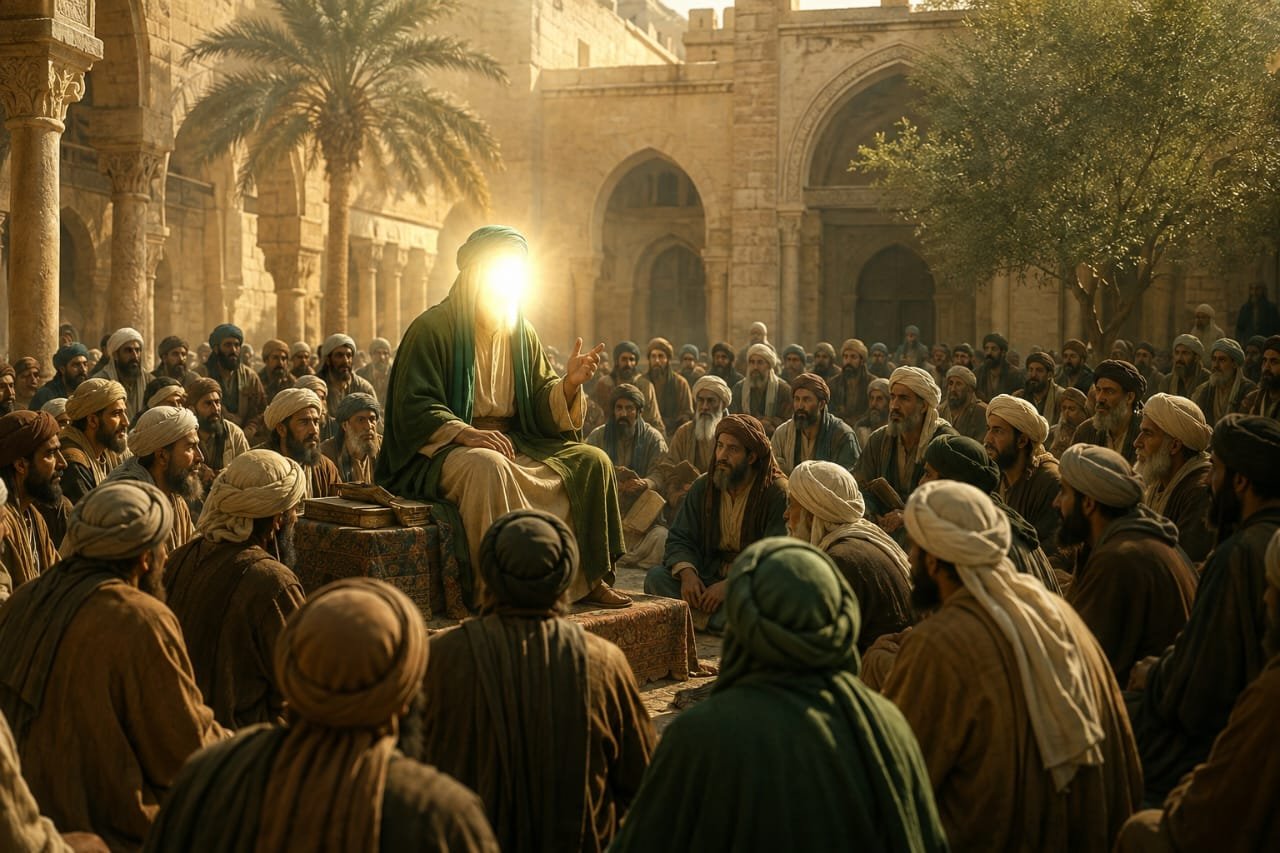
Imam Ja'far al-Sadiq (AS) is one of the greatest names in Islamic history. He was the sixth Shia Imam, the son of Imam Muhammad al-Baqir (AS), and one of the most influential teachers of knowledge, law, theology, and ethics in the Muslim world.
When people speak about Imam al-Sadiq, they are not speaking about a minor historical figure. They are speaking about a man whose school shaped generations. His life came at a time of political collapse, social fear, and cultural confusion, yet he turned that difficult era into an age of learning.
That is why his legacy still matters.
Introduction: Why Imam al-Sadiq (AS) Stands Out
Some leaders are remembered because they ruled. Others are remembered because they taught. Imam Ja'far al-Sadiq (AS) is remembered for both his divine leadership and his extraordinary knowledge.
He lived during the end of the Umayyad dynasty and the rise of the Abbasids, a period full of tension and change. While governments fought for power, he built something more lasting: a school of thought, a living intellectual tradition, and a generation of scholars.
If you want to understand why the Ja'fari school is named after him, you first need to understand who he was, where he came from, and why his knowledge became legendary.
Family Background and Noble Lineage
Imam Ja'far's full name was Ja'far ibn Muhammad. His father was Imam Muhammad al-Baqir (AS), the fifth Shia Imam. His mother was Umm Farwah, also known as Fatimah (AS), the daughter of Qasim bin Muhammad bin Abi Bakr.
The source describes her as a pious, believing, and beneficent woman. Through both her father and her mother, she was considered a noble lady from the lineage of Abu Bakr. Her grandfather, Muhammad bin Abi Bakr, was raised by Imam Ali (AS) after Imam Ali married Asma bint Umays. Imam Ali taught him, and he became a devoted servant of Islam and later governed Egypt until he was killed by Mu'awiyah's orders.
This background shows something important: Imam al-Sadiq (AS) came from a deeply respected and spiritually rich family on both sides.
Titles and Honorifics of Imam al-Sadiq
Imam al-Sadiq (AS) was known by many titles, each reflecting a different side of his character and station.
| Title | Meaning |
|---|---|
| Sadiq | The Truthful |
| Sabir | Patient |
| Fadil | Virtuous |
| Tahir | Pure |
| Qahir | Victorious |
| Baqi | Everlasting |
| Kamil | Perfect |
| Munji | Savior |
| Fatir | Originator |
| Tam | Complete |
| Qa'im | The Riser |
| Kafil | Guarantor |
His most famous title was al-Sadiq, meaning "the truthful one." According to the source, this title was given by Prophet Muhammad (PBUH) to distinguish him from a later false claimant to Imamate known as "Ja'far the Liar."
That title fits him perfectly. His truthfulness was not only in speech, but in thought, conduct, and spiritual character.
Kunyas and Known Names
Imam al-Sadiq (AS) was also known by several kunyas, or honorific names, including:
- Abu Abdullah
- Abu Isma'il
- Abu Musa
- Al-Khaalis
- Abu Ishaq
These names reflect how widely recognized and respected he was among scholars and believers.
Early Life Under the Guidance of Two Imams
Imam al-Sadiq (AS) grew up under the care of extraordinary men. He lived the early part of his life with his grandfather, Imam Sajjad (AS), and later with his father, Imam Baqir (AS).
This means his childhood was not ordinary. He did not grow up in a random environment. He grew up inside a house of worship, knowledge, patience, and divine guidance.
Everything around him prepared him for Imamate.
He saw firsthand what it meant to live with dignity under pressure. He learned how to speak, how to think, and how to carry the burden of leadership.
Birth of Imam al-Sadiq: Different Historical Reports
The source records several reports about the year of his birth.
The most common report places his birth in 83 AH. Other traditions mention 80 AH, 77 AH, or 86 AH. The majority of reports treat 83 AH as the main date, while some scholars considered 80 AH to be the closest to the correct date.
There are also different reports about the day and time of his birth.
Some say he was born on Friday at dawn. Others say it was Monday, either on the 17th of Rabi al-Awwal or when thirteen nights remained in Rabi al-Awwal.
Even with these differences, the overall picture is clear: Imam al-Sadiq (AS) was born into a world that would soon need his knowledge more than ever.
The Historical Era He Lived In
The Imamate of Imam al-Sadiq (AS) began during one of the most unstable periods in Islamic history.
He lived through the final decades of Umayyad rule and then into the Abbasid era. This transition was not peaceful. It was full of political collapse, fear, and struggle.
The Umayyad Period
The source describes the Umayyad age as a time of panic, insecurity, and social breakdown. According to the text, the government itself was responsible for much of this corruption because it opposed reform and created political crisis after political crisis.
Imam al-Sadiq (AS) lived under rulers such as:
- Hisham bin Abd al-Malik
- Walid bin Yazid bin Abd al-Malik
- Yazid bin Walid bin Abd al-Malik
His father, Imam Baqir (AS), was also among the oppressed figures of this period and was martyred under Umayyad rule.
The Abbasid Period
When the Umayyads fell in 132 AH, the Abbasids rose to power. But this new era was not a pure age of peace. It brought new cultural pressure and ideological conflict.
The Abbasid state tried to support schools of thought that challenged the Ahl al-Bayt. That could have been a disaster for Shia teachings.
But it was also a window of opportunity.
Imam al-Sadiq (AS) used that opening wisely. He built, expanded, and protected the intellectual life of Shia Islam before the cultural attack could fully take root.
That is one of the great achievements of his life.
The Beginning of His Imamate
Imam al-Sadiq (AS) assumed the divine position of major Imamate in 114 AH, at the age of 34, after the martyrdom of his father, Imam Baqir (AS).
His Imamate lasted for 34 years, from 114 AH to 148 AH.
He lived for a total of 65 years.
These were not quiet years. They were years of teaching, guidance, debate, and preservation of knowledge.
The Great Islamic University in Medina
One of the most beautiful things about Imam al-Sadiq (AS) is that he did not limit his mission to sermons. He built a real intellectual center.
After Imam Baqir (AS) passed away, he left behind a school filled with scholars. Imam al-Sadiq (AS) developed that nucleus into a great university.
Medina as the Center of Knowledge
He made Yathrib, later Medina, the center of his educational mission. The Prophet's Mosque became his main teaching place.
This was deeply symbolic. The same city that had welcomed revelation and migration became the heart of a new scientific and religious revival.
Students from Many Lands
People came to him from faraway regions to learn. His fame spread across the Muslim world. Even non-Muslim thinkers and scientists attended his sessions to discuss different subjects.
That is how wide his influence was.
Fields of Knowledge
Imam al-Sadiq (AS) taught in many areas, including:
- Theology ("Kalam")
- Jurisprudence ("Fiqh")
- Exegesis ("Tafsir")
- Hadith
- Mathematics
- Chemistry
Some of His Prominent Students
His students included many well-known names:
- Mufaddal bin Umar
- Mu'min al-Taq
- Hisham bin Hakam
- Hisham bin Salim
- Jaber bin Hayyan
- Zurarah
- Muhammad bin Muslim
- Jamil bin Darraj
- Humran bin A'yan
- Abi Basir
- Abdullah bin Sinan
This list alone shows how broad his influence was. He did not train one type of scholar. He trained thinkers, jurists, theologians, and scientists.
Why His Knowledge Is Considered a Miracle
The source makes a powerful comparison: just as the Qur'an was the miracle of Prophet Muhammad (PBUH), the all-encompassing knowledge of Imam al-Sadiq (AS) was his miracle.
That is a striking idea.
His knowledge was not limited to one field. It touched all human needs. It helped the Ja'fari school remain alive in every age because it answered real questions about belief, worship, ethics, and society.
In that sense, his knowledge was not only brilliant. It was protective.
His Character and Moral Excellence
Imam al-Sadiq (AS) was not only a scholar. He was a model of character.
The source describes him as someone who controlled worldly desires and showed true human nobility. He was generous, hospitable, and deeply respectful toward others.
His moral traits included:
- truthfulness
- honesty with people
- giving to those who asked
- repaying good deeds
- keeping trusts
- maintaining family ties
- kindness to neighbors and friends
- hospitality
- modesty and shame ("haya")
- asceticism toward worldly attachment
These are not small virtues. Together, they describe a complete moral personality.
He was the kind of man who made people trust both his words and his silence.
A Famous Encounter with Sufyan al-Thawri
One incident often mentioned in his life is his encounter with Sufyan al-Thawri in Masjid al-Haram.
Sufyan saw Imam al-Sadiq (AS) wearing fine clothing and approached him with criticism. He argued that neither the Prophet (PBUH) nor Imam Ali (AS), nor the earlier Imams, had worn such clothing.
This moment became a lesson about appearance, sincerity, and the right understanding of spiritual life. The point was not simply about clothing. It was about whether a person judges holiness by surface details or by inner reality.
The Year 114 AH: A Turning Point
The year Imam al-Sadiq (AS) became Imam was also a year of major events.
The source mentions:
- the death of Jaber bin Yazid Ju'fi, a trusted companion of the Imams
- the revolt and death of Bistam in Azerbaijan
- the birth of his son, Imam Musa bin Ja'far al-Kazim (AS)
So the beginning of his Imamate was tied to both loss and new life. One generation was closing. Another was beginning.
The Meaning of His Name: Ja'far
The source gives a beautiful explanation for his name.
Imam al-Sadiq (AS) said:
«إِنَّ أَبِی سَمَّانِی جَعْفَراً بِعِلْمٍ، عَلَی أَنَّهُ اسْمُ نَهَرٍ فِی الْجَنَّةِ»
"My father consciously named me Ja'far, as it is the name of a river in Paradise."
This is a meaningful detail. It shows that even his name carried spiritual purpose. It was not random. It was chosen with awareness and divine understanding.
The Prophecy Behind the Title "al-Sadiq"
Another narration explains why he was called al-Sadiq.
According to the source, the Prophet Muhammad (PBUH) instructed that when this child was born, he should be called al-Sadiq, because a later descendant named Ja'far would falsely claim Imamate. The Prophet's title protected the sanctity of truth and distinguished the truthful Imam from the liar.
This narration adds deep meaning to the title. It was not just praise. It was a warning and a marker of truth.
Ahl al-Bayt and the Qualities They Love
When asked about the highest moral virtues, Imam al-Sadiq (AS) said:
«إِنَّا لَنُحِبُّ مَنْ كَانَ عَاقِلاً، عَالِماً، فَهِماً، فَقِيهاً، حَلِيماً، مُدَارِياً، صَبُوراً، صَدُوقاً، وَفِيّاً.»
"We love anyone who is intelligent, knowledgeable, understanding, a jurist, forbearing, tolerant, patient, truthful, and loyal."
This statement is very important because it shows the moral and intellectual standards of the Ahl al-Bayt. Faith, in this view, is not empty emotion. It includes intelligence, patience, loyalty, and truthfulness.
Imam Ali's Knowledge as Seen Through Imam al-Sadiq's Teachings
The source also includes a powerful narration from Imam Ali (AS) about knowledge and the Qur'an. In that narration, Imam Ali describes how knowledge fills him, not as bodily fat, but as divine understanding of revelation.
The point of including this report is to show the intellectual world of the Imams: the Qur'an is not treated as a book of isolated verses, but as a complete source of guidance whose depths are understood through divine knowledge.
Imam al-Sadiq (AS), as a teacher, inherited and expanded that school of understanding.
The Legacy of Imam al-Sadiq (AS)
The legacy of Imam al-Sadiq (AS) is enormous.
He did not only preserve knowledge. He organized it, taught it, and passed it on to a generation of scholars who carried it into the future. He gave Shia Islam its intellectual backbone.
Without him, the Ja'fari school would not have become what it is today.
His legacy includes:
- the preservation of Shia jurisprudence
- the training of major scholars
- the expansion of theological thought
- the development of ethical teaching
- the defense of the Ahl al-Bayt's intellectual authority
- the transformation of Medina into a center of learning
He was, in a very real sense, a builder of civilizations through knowledge.
Lessons We Can Learn from Imam al-Sadiq Today
Imam al-Sadiq (AS) still speaks to modern readers because his life answers modern problems.
He teaches us that:
- knowledge should serve truth
- character matters as much as scholarship
- generosity is part of faith
- patience is strength
- leadership means protecting the future, not just reacting to the present
- real learning requires humility
- the best teacher is also a moral example
His life is a reminder that Islam is not only about ritual. It is also about intellect, ethics, and service.
Conclusion
Imam Ja'far al-Sadiq (AS) was more than a religious scholar. He was the sixth Shia Imam, a divinely guided leader, a teacher of many sciences, and one of the greatest protectors of Islamic knowledge.
He lived through one of the most unstable periods in Muslim history, yet he turned that instability into an opportunity for growth. He built a university in Medina, trained scholars across many fields, and left behind a school of thought that still shapes the Muslim world.
His title, al-Sadiq, the Truthful, suits him perfectly.
His life teaches us that truth is not only spoken. It is lived. And when truth is lived with patience, wisdom, and generosity, it can outlast empires.