
Shia vs. Sunni: What’s the Real Difference?
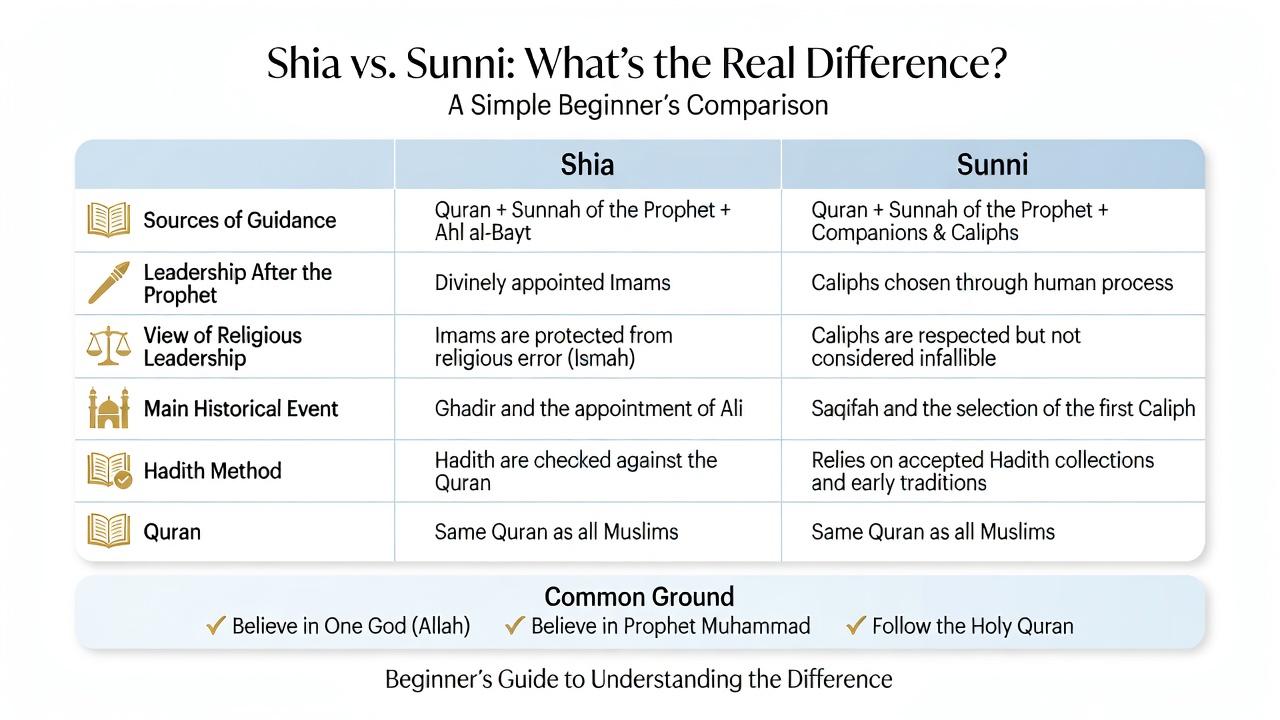
The real difference between Shia and Sunni Islam is not whether they believe in the same God or follow the same Prophet. It is how they define religious authority after Prophet Muhammad’s passing. In the Shia view, true guidance continues through the Quran, the Sunnah of the Prophet, and the Sunnah of the Ahl al-Bayt. In the Sunni view, guidance is understood through the Quran, the Sunnah of the Prophet, and the practice of the Companions and Caliphs.
That difference sounds small at first, but it shapes almost everything else: who has the right to lead the Muslim community, how religious law is understood, and how conflicting narrations are judged. So if you want to understand Shia vs. Sunni, start here.
The Core Difference: Who Carries Religious Authority?
The simplest way to explain the split is this:
- Shia Islam says religious guidance must continue through the Prophet’s family, the Ahl al-Bayt.
- Sunni Islam gives religious weight to the wider community of the Prophet’s Companions and the early Caliphs as well.
This is why the two schools do not only disagree about history. They also disagree about who can be trusted as the best source of Islam after the Prophet.
A student might ask: “Why does that matter so much?”
Because once you answer that question, you have already answered many others: Who leads? Who interprets the Quran? Which Hadith are strongest? Which rulings are accepted?
Why This Difference Matters So Much
This is not just a technical issue. It affects the whole structure of belief and practice.
1) Leadership in the Muslim Ummah
In Shia thought, leadership after the Prophet is not a political accident. It is a matter of divine appointment. That leadership is called Imamate.
In Sunni thought, leadership is not based on that same idea of divine appointment. It is treated as an earthly leadership matter, with the Caliph chosen through a human process.
So the big question becomes:
Was leadership meant to be chosen by people, or appointed by God?
2) The Length of Infallible Guidance
According to the dossier, Sunni guidance through the Prophet covers the 23 years of his mission. Shia thought adds the guidance of the infallible Imams, extending that protected guidance over a much longer period.
That matters because if a person is believed to be free from error in religion, people can trust that person’s explanation of the faith in a deeper way.
3) How Religious Law Is Understood
The two schools also differ in how they handle Hadith and legal rulings.
According to the dossier, Shia scholars filter every narration through the Quran first. If a report contradicts the Quran, it is rejected.
The dossier also says Sunni methodology may accept narrations in ways that can override or abrogate Quranic meaning. That difference leads to different legal conclusions in many areas.
The Quran in This Debate
The dossier highlights two Quranic verses that are especially important in Shia argumentation.
Surah An-Nisa (4:59)
يَا أَيُّهَا الَّذِينَ آمَنُوا أَطِيعُوا اللَّهَ وَأَطِيعُوا الرَّسُولَ وَأُولِي الْأَمْرِ مِنْكُمْ
“O you who have believed, obey Allah and obey the Messenger and those in authority among you.”
Surah An-Nisa (4:59)
In the Shia reading, the phrase “those in authority” refers to the infallible Imams. Why? Because the verse calls for absolute obedience, and Shia scholars argue that such obedience must be to leaders who do not lead people into error.
Surah Al-Ma’idah (5:55)
إِنَّمَا وَلِيُّكُمُ اللَّهُ وَرَسُولُهُ وَالَّذِينَ آمَنُوا الَّذِينَ يُقِيمُونَ الصَّلَاةَ وَيُؤْتُونَ الزَّكَاةَ وَهُمْ رَاكِعُونَ
“Your guardian is only Allah, His Messenger, and those who have believed—those who establish prayer and give zakah while they are bowing.”
Surah Al-Ma’idah (5:55)
The dossier explains this verse as evidence for the divine leadership of Ali ibn Abi Talib, since it is understood to refer to the moment he gave his ring in charity while in bowing position during prayer.
For Shia readers, these verses are not minor details. They are part of the foundation for understanding legitimate leadership.
The Hadith That Shape the Discussion
The dossier points to three major narrations.
Hadith al-Thaqalayn: The Two Weighty Things
“I am leaving among you two weighty things: the Book of Allah and my progeny, my Ahl al-Bayt.”
This Hadith is central because it links the Quran with the Prophet’s family. In the dossier’s explanation, it shows that the Ahl al-Bayt are not just respected relatives. They are a lasting source of guidance alongside the Quran.
Hadith of Ghadir
“Whomsoever I am his Mawla, this Ali is his Mawla. O Allah, befriend whoever befriends him.”
In Shia understanding, this is the Prophet’s clear appointment of Ali ibn Abi Talib as his successor. Sunni interpretation does not treat it in the same way. That difference is one of the major reasons the two schools read early Islamic history differently.
Hadith of the Ark
“My Ahl al-Bayt are like the Ark of Noah; whoever boards it is saved, and whoever abandons it drowns.”
This hadith presents the Ahl al-Bayt as a means of safety and correct understanding. The point is simple: just as Noah’s ark was a place of rescue, the Prophet’s family is understood as a guide for preserving true religion.
What Happened After the Prophet Passed Away?
According to the dossier, the community split into two main directions after the Prophet’s death.
The Sunni view accepted the caliphate decided at Saqifah. The Shia view held that Ali ibn Abi Talib had already been designated by divine text and prophetic instruction as the rightful successor.
This is one of the most important historical turning points in Islamic history, because the decision about leadership shaped everything that came after it.
A useful way to think about it is this:
If two people read the same family will differently, they may end up with two very different understandings of who should lead the household. The same thing happened here, but on the scale of an entire community.
What Is Infallibility in Shia Islam?
The dossier uses the term Ismah, which means complete protection from sin and error in religious guidance.
Shia theology says an Imam must have this quality because people need someone trustworthy enough to guide them without making mistakes in the religion.
That is a major difference from Sunni thought, where Caliphs are not required to be infallible. They may be respected leaders, but not protected from error in the same way.
How the Difference Affects Law
These theological differences are not abstract. They affect real-life rulings.
One example in the dossier is Mut’ah, or temporary marriage.
According to the dossier, this practice was allowed during the Prophet’s lifetime and during the time of Abu Bakr. Then Caliph Umar banned it. Sunnis followed that ban, while Shias kept the original permissibility they understood from the Prophet’s Sunnah.
This example shows something important: once you disagree about who has the final authority, you can end up with different legal conclusions even when you are reading from the same religious tradition.
How Shia Scholars Handle Conflicting Hadith
The dossier says Shia scholars use the Quran as the final filter.
That means if a Hadith contradicts the Quran, Shia scholars reject it as false. They do not place a narration above the Book of Allah.
The dossier also mentions Taqiyyah, which is a precautionary form of concealment used during persecution. In difficult political situations, Shia Imams sometimes gave rulings that matched the dominant law in order to protect their followers from harm.
That helps explain why some historical rulings may look similar on the surface even when the underlying methodology is different.
Common Misunderstandings
Many people get the Shia-Sunni difference wrong. The dossier clears up a few important misunderstandings.
“Do Shia Muslims Have a Different Quran?”
No. Shia Muslims follow the same Quran as other Muslims. The Quran is the supreme and ultimate standard in their faith.
“Is Shia Islam a Different Religion?”
No. In the dossier’s framing, Shia Islam is not a separate religion. It is understood as Islam lived through the Quran and the Ahl al-Bayt.
“Did Shia Islam Appear Much Later?”
The dossier says the term “Shia of Ali” was already used during the Prophet’s lifetime to describe those who were loyal to Ali ibn Abi Talib.
“Do Shias Put the Imams Above the Quran?”
No. The dossier says Shia belief is the opposite: the Imams are bound to the Quran, and their sayings must be rejected if they contradict it.
The Real Difference in One Sentence
If you want the shortest possible answer, it is this:
Shia and Sunni Islam differ mainly in where they place religious authority after the Prophet—Shia Islam centers that authority in the Quran and the Ahl al-Bayt, while Sunni Islam gives authority to the Quran, the Prophet’s Sunnah, and the broader legacy of the Companions and Caliphs.
That one difference shapes leadership, law, history, and interpretation.
Conclusion
Shia vs. Sunni is not just a label. It is a disagreement about who should guide the Muslim community after the Prophet Muhammad and which sources should define authentic Islam.
Once you understand that, the rest starts to make sense. The disagreement about Imamate, the importance of the Ahl al-Bayt, the role of Saqifah, the meaning of Hadith al-Thaqalayn, and even legal matters like Mut’ah all flow from that original split in authority.
For a beginner, that is the real starting point.
Frequently Asked Questions
Yes. According to the dossier, both follow the same Quran.
The biggest difference is how each school understands religious authority after the Prophet Muhammad.
Yes. The Ahl al-Bayt are central to Shia guidance and understanding of Islam.
No. The dossier presents Shia Islam as part of Islam, not a different religion.
It is seen as evidence that Ali ibn Abi Talib was appointed by the Prophet as his successor.