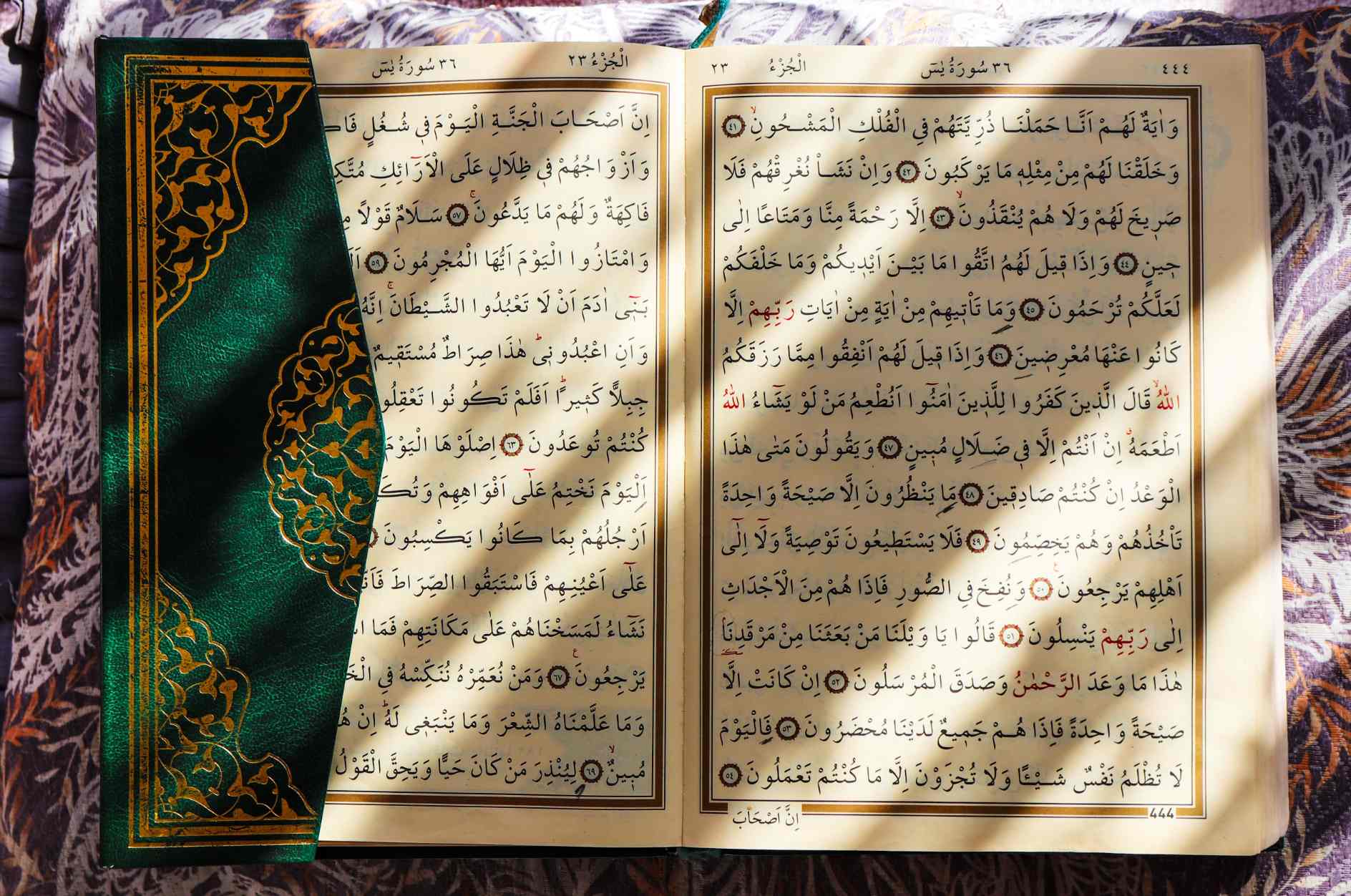
Can a book revealed more than 1,400 years ago offer insights that connect with discoveries in modern science?
Many Muslims believe that certain verses of the Quran point toward remarkable facts about the natural world. They often discuss the beginning of the universe, the development of the human embryo, the darkness of the deep ocean, and the movement of celestial bodies.
Some of these connections are fascinating. Others require a closer look at the original Arabic, classical Quranic interpretation, and what scientists have actually discovered.
In this article, we will explore 10 Quranic verses often discussed in connection with modern science, examine the scientific evidence behind each topic, and consider what we can—and cannot—conclude from the comparison.
The goal is not to force science into every verse. It is to examine the Quran carefully, understand the natural world more deeply, and see where meaningful questions emerge.
In One Minute: What Are the Scientific Miracles of the Quran?
The phrase scientific miracles of the Quran refers to the belief that certain Quranic verses describe natural phenomena that became better understood through modern scientific research.
Frequently discussed examples include the darkness of the deep ocean, the development of the human embryo, the expansion of the universe, the meeting of different bodies of water, and the importance of water for life.
However, these examples are not equally strong. Some describe observable natural phenomena, while others depend on particular interpretations of Arabic words. The scientific fact and the claim that the Quran predicted it should therefore be examined separately.
Let us look at ten examples.
1. The Darkness of the Deep Ocean
Quranic reference: Surah An-Nur (24:40)
Imagine diving into the ocean. At first, sunlight surrounds you. As you descend, the water becomes darker. Colors disappear, and eventually the sunlight can no longer reach you.
Now consider a verse revealed long before modern oceanographic instruments existed.
The Quran says:
Arabic:
أَوْ كَظُلُمَاتٍ فِي بَحْرٍ لُّجِّيٍّ يَغْشَاهُ مَوْجٌ مِّن فَوْقِهِ مَوْجٌ مِّن فَوْقِهِ سَحَابٌ
Meaning:
"Or like darknesses in a deep sea, covered by waves, above which are waves, above which are clouds." (Quran 24:40; translation adapted from "Quran.com" (https://quran.com/24/40))
The verse continues by describing layers of darkness so intense that a person can hardly see their own hand.
What does modern science tell us?
According to the US National Oceanic and Atmospheric Administration (NOAA), there is rarely any significant sunlight beyond approximately 200 metres beneath the ocean's surface. Below approximately 1,000 metres, sunlight does not penetrate, creating what scientists call the aphotic zone.
In these depths, marine animals survive without sunlight reaching them directly. Some produce their own light through bioluminescence.
(Source: "NOAA — How Far Does Light Travel in the Ocean?" (https://oceanservice.noaa.gov/facts/light_travel.html))
Is this a scientific miracle?
The description of deep-sea darkness is striking when compared with what oceanographers know today. However, the context matters.
The verse uses the image of darkness in a deep sea as a comparison for spiritual darkness. Traditional Quranic commentary, including Tafsir al-Sa'di, explains the verse primarily as an illustration of layers of darkness in the human condition. (Source: "Tafsir al-Sa'di on Quran 24:40" (https://quran.ksu.edu.sa/tafseer/saadi/sura24-aya40.html))
We should therefore avoid claiming that the verse is explicitly teaching modern oceanography. The natural imagery is fascinating, but the claim of a scientific prediction requires further argument.
A question worth exploring: Why does the Quran use such a powerful image of darkness in a deep sea to explain a spiritual reality?
2. When Two Bodies of Water Meet: Is There a Barrier Between Them?
Quranic reference: Surah Ar-Rahman (55:19–20)
The meeting of rivers and oceans can produce striking sights. At certain locations, differences in color and sediment make two bodies of water appear to meet along a visible boundary.
The Quran describes two bodies of water coming together:
Arabic:
مَرَجَ الْبَحْرَيْنِ يَلْتَقِيَانِ بَيْنَهُمَا بَرْزَخٌ لَّا يَبْغِيَانِ
Meaning:
"He released the two seas, meeting together. Between them is a barrier they do not cross." (Quran 55:19–20; see "Quran.com" (https://quran.com/55/19-20))
The Arabic word barzakh can refer to a barrier, partition, or separating boundary.
What happens when fresh water meets salt water?
Modern oceanography shows that fresh water and salt water do not always mix immediately or uniformly.
Fresh water is generally less dense than seawater. Under suitable conditions, it can flow over the denser salt water, creating distinct layers. Scientists study these processes in places called estuaries, where rivers meet the sea.
The degree of mixing depends on several factors, including tides, wind, river flow, water depth, and the shape of the coastline.
(Source: "NOAA — Classifying Estuaries by Water Circulation" (https://oceanservice.noaa.gov/education/tutorial_estuaries/est05_circulation.html))
Does the water remain separate forever?
No. Fresh water and salt water can mix, and they frequently do. In some locations, mixing is extensive; in others, the difference in salinity remains noticeable for longer.
This distinction is important. The scientific evidence supports the existence of boundaries and layers under certain conditions, not an invisible wall that makes two bodies of water permanently unable to mix.
Some Muslim writers connect the Quranic barzakh with differences in salinity and density. That is an interpretation to investigate, rather than a scientific conclusion established by the verse alone.
Why this is interesting: A closer look at the verse opens a window into salinity, density, and the complex behaviour of water in the natural world.
3. The Development of the Human Embryo
Quranic reference: Surah Al-Mu'minun (23:12–14)
How does a single fertilized cell develop into a human being with a brain, heart, limbs, and millions of specialized cells?
Human development is one of the most complex processes studied by modern biology. It is also one of the Quranic topics most frequently discussed in debates about scientific miracles.
The Quran describes several stages of human development.
Arabic:
ثُمَّ خَلَقْنَا النُّطْفَةَ عَلَقَةً فَخَلَقْنَا الْعَلَقَةَ مُضْغَةً فَخَلَقْنَا الْمُضْغَةَ عِظَامًا فَكَسَوْنَا الْعِظَامَ لَحْمًا
Meaning:
"Then We made the drop into a clinging substance, then We made the clinging substance into a lump, then We made the lump into bones, then We clothed the bones with flesh." (Quran 23:14; translated terminology varies. See "Quran.com" (https://quran.com/23/12-14))
Three Arabic terms receive particular attention:
- Nutfa: Commonly translated as a drop, often understood in this context as a reproductive fluid or sperm-drop.
- Alaqah: Translated in different ways, including a clinging substance and a clot.
- Mudghah: Commonly translated as a lump resembling something chewed.
What does embryology reveal?
Modern embryology documents a sequence of highly coordinated developmental changes. Cells divide, organize into tissues, and develop structures that eventually form the body's organs.
Some Muslim writers argue that the Quran's descriptions correspond to important stages of this process.
However, the comparison is not straightforward. The meaning of the Arabic terms is debated, and modern embryonic development is more complex than a simple series of separate stages. Bone and muscle development, for example, involve overlapping processes rather than a perfectly separated sequence in which one is completely finished before the other begins.
Researchers have also examined how ancient Greek medical ideas about embryonic development relate to later interpretations of these verses. (For a discussion of this debate, see "the academic study on Quranic embryology and Greek medical traditions" (https://www.magiran.com/paper/2170426/critique-of-the-qur-anic-adaptation-of-the-findings-of-aristotle-and-galen-on-the-stages-of-embryonic-development?lang=en).)
Is embryology a proven scientific miracle?
The Quran clearly speaks about stages of human creation. Whether those descriptions constitute a precise prediction of modern embryology is a separate and more contested question.
A responsible comparison must examine the Arabic vocabulary, classical interpretations, and actual developmental biology—not simply match individual words with modern medical diagrams.
Why this topic matters: It brings together questions about human origins, the meaning of life, and the relationship between religious belief and scientific investigation.
4. The Beginning of the Universe: Does the Quran Point Toward the Big Bang?
Quranic reference: Surah Al-Anbiya (21:30)
Look up at the night sky. Every visible star belongs to an enormous universe containing galaxies, planets, gas, and other forms of matter.
Modern cosmology investigates how this universe evolved and what its earliest stages were like.
The Quran contains a verse that many Muslim writers connect with the beginning of the universe.
Arabic:
أَوَلَمْ يَرَ الَّذِينَ كَفَرُوا أَنَّ السَّمَاوَاتِ وَالْأَرْضَ كَانَتَا رَتْقًا فَفَتَقْنَاهُمَا
Meaning:
"Have those who disbelieve not considered that the heavens and the earth were once joined together, then We separated them?" (Quran 21:30; see "Quran.com" (https://quran.com/21/30))
Two words are central to this discussion:
- Ratq: Something joined, closed, or brought together.
- Fataq: To open, split, or separate.
Some Muslim interpreters understand these words as a reference to the early unity of the heavens and the earth, connecting the verse to the Big Bang.
What does the Big Bang theory actually say?
The Big Bang model describes the evolution of the universe from an early, extremely hot and dense state. As the universe expanded and cooled, conditions changed, eventually allowing stars and galaxies to form.
Evidence supporting modern cosmology includes the expansion of the universe and the cosmic microwave background, which is radiation left over from the early universe.
(Source: "NASA — What Is the Big Bang?" (https://spaceplace.nasa.gov/big-bang/en/))
The Big Bang should not be imagined simply as an ordinary explosion occurring at one point inside otherwise empty space. It describes the expansion of the universe itself from its early hot, dense state.
Does Quran 21:30 describe the Big Bang?
The similarity between the language of joining and separating and a modern account of cosmic history is interesting. But the verse does not explicitly describe cosmic expansion, the cosmic microwave background, or the equations used in modern cosmology.
Classical interpretations also differ over precisely what the joining and separation refer to. Tafsir al-Tabari records more than one interpretation of the verse. (Source: "Tafsir al-Tabari on Quran 21:30" (https://quran.com/en/21%3A30/tafsirs/ar-tafsir-al-tabari))
For that reason, it is more accurate to say that some readers see a connection between the verse and the Big Bang than to claim that the verse unambiguously states the modern scientific model.
The bigger question: How should a reader compare an ancient religious text with a scientific theory developed through modern observation and mathematics?
5. Is the Universe Expanding? A Remarkable Quranic Expression
Quranic reference: Surah Adh-Dhariyat (51:47)
One of the most widely discussed Quranic verses in debates about science concerns the heavens.
The verse reads:
Arabic:
وَالسَّمَاءَ بَنَيْنَاهَا بِأَيْدٍ وَإِنَّا لَمُوسِعُونَ
Meaning:
"And the heaven We constructed with strength, and indeed, We are lamūsiʿūn." (Quran 51:47; see "Quran.com" (https://quran.com/51/47))
The final expression, lamūsiʿūn, is central to the discussion.
Some modern translations and interpretations understand it as meaning that God is expanding the universe. Others understand it in terms of God's vast power, ability, or the vastness of the heavens.
What has astronomy discovered?
Modern astronomy has established that the universe is expanding on large scales.
One important line of evidence is cosmological redshift. As light travels through expanding space, its wavelength stretches. Scientists use measurements of this effect, alongside other observations, to investigate cosmic expansion.
(Source: "NASA — What Is Cosmological Redshift?" (https://science.nasa.gov/asset/hubble/what-is-cosmological-redshift/))
Does the Arabic clearly mean continuous expansion?
This is where careful interpretation becomes essential.
Tafsir al-Tabari explains lamūsiʿūn in terms of God's capacity and vastness, rather than explicitly identifying the phrase with the modern cosmological theory of continuous expansion. (Source: "Tafsir al-Tabari on Quran 51:47" (https://quran.com/ar/51%3A47/tafsirs/ar-tafsir-al-tabari))
Modern readers may find the expansion interpretation meaningful, but they should recognize that it is not the only possible interpretation of the Arabic.
The scientific fact of cosmic expansion is well established. The claim that this particular verse specifically predicted it depends on how the language is interpreted.
Why it attracts attention: Few subjects are as fascinating as the size, age, and continuing evolution of the universe. This verse provides a starting point for exploring the relationship between cosmology and Quranic interpretation.
6. Does the Quran Describe the Wrapping of Night and Day?
Quranic reference: Surah Az-Zumar (39:5)
Have you ever watched a time-lapse video of Earth from space?
The boundary between day and night moves across the planet as Earth rotates. Sunrise in one country can happen while another country is experiencing sunset.
The Quran describes night and day using an interesting Arabic expression.
Arabic:
يُكَوِّرُ اللَّيْلَ عَلَى النَّهَارِ وَيُكَوِّرُ النَّهَارَ عَلَى اللَّيْلِ
Meaning:
"He wraps the night around the day and wraps the day around the night." (Quran 39:5; see "Quran.com" (https://quran.com/39/5))
The verb yukawwiru is commonly translated as “wraps” or “winds around.”
What does science tell us?
Earth is approximately spherical and rotates on its axis. As it rotates, different regions face toward or away from the Sun, producing the cycle of daylight and darkness.
Because Earth is curved, the boundary between day and night is not a straight line across a flat surface. It forms a moving transition across the globe.
Does this verse prove that the Quran describes Earth's shape?
Some Muslim writers consider the language of wrapping night around day compatible with a spherical Earth.
Nevertheless, the verse does not explicitly state, in scientific terminology, that Earth is spherical or that it rotates on its axis. Its wording is a description of night and day, not a technical lesson in planetary geometry.
Readers can find the imagery meaningful without treating it as a mathematical proof of Earth's shape.
A thought to consider: Sometimes an ancient description of an everyday phenomenon can invite questions about the larger physical system behind it.
7. The Movement of the Sun and Moon
Quranic reference: Surah Al-Anbiya (21:33)
When you look at the sky, the Sun and Moon appear to move across it. Modern astronomy reveals a much larger picture: Earth rotates, Earth orbits the Sun, the Moon orbits Earth, and the Sun itself travels through the Milky Way.
The Quran says:
Arabic:
وَهُوَ الَّذِي خَلَقَ اللَّيْلَ وَالنَّهَارَ وَالشَّمْسَ وَالْقَمَرَ كُلٌّ فِي فَلَكٍ يَسْبَحُونَ
Meaning:
"And He is the One who created the night and the day, the Sun and the Moon—each floating in an orbit." (Quran 21:33; see "Quran.com" (https://quran.com/21/33))
The expression kullun fi falakin yasbahun is commonly translated as describing each of them moving along an orbit or course.
What do we know about their motion?
The Moon orbits Earth, while Earth orbits the Sun. The Sun also moves through the Milky Way, carrying the solar system with it.
According to NASA, the solar system takes approximately 230 million years to complete one orbit around the centre of our galaxy.
(Source: "NASA — Solar System Facts" (https://science.nasa.gov/solar-system/solar-system-facts/))
Is this a prediction of modern orbital mechanics?
The Quran's description of celestial bodies moving along courses is compatible with the general fact that celestial objects move. However, it does not provide the mathematical details of modern orbital mechanics.
Ancient people also observed the regular movements of the Sun, Moon, and planets. The distinctive scientific question is not simply whether movement was mentioned, but how specifically a passage describes the physical process.
Why it is worth reading: The verse offers an opportunity to appreciate the ordered motion of the heavens while learning how modern astronomy explains it.
8. The Water Cycle: From Winds and Clouds to Rain
Quranic reference: Surah Ar-Rum (30:48)
Every time rain falls on a city, it connects the atmosphere, oceans, soil, rivers, and living organisms in a continuous natural process.
The Quran repeatedly describes winds, clouds, rainfall, and the revival of dry land.
One example is the following passage:
Arabic:
اللَّهُ الَّذِي يُرْسِلُ الرِّيَاحَ فَتُثِيرُ سَحَابًا فَيَبْسُطُهُ فِي السَّمَاءِ كَيْفَ يَشَاءُ وَيَجْعَلُهُ كِسَفًا فَتَرَى الْوَدْقَ يَخْرُجُ مِنْ خِلَالِهِ
Meaning:
"Allah is the One who sends the winds, which raise clouds; then He spreads them across the sky as He wills and makes them into fragments, and you see rain emerging from within them." (Quran 30:48; translation adapted from "Quran.com" (https://quran.com/30/48))
How does the water cycle work?
The modern scientific account describes water moving continuously between the Earth's surface and atmosphere.
Water evaporates from oceans, lakes, and other surfaces. Plants also release water vapour through transpiration. The vapour cools and condenses into droplets or ice crystals, forming clouds. Water eventually returns to the surface as rain, snow, or other forms of precipitation.
It may then flow into rivers, soak into soil, replenish groundwater, or return to the oceans.
NOAA explains that the water cycle is more complex than a simple loop: it includes many storage areas and pathways involving the atmosphere, ice, land, vegetation, and underground water.
(Source: "NOAA — The Water Cycle" (https://www.noaa.gov/education/resource-collections/freshwater/water-cycle))
Did the Quran describe the entire water cycle?
The verse clearly refers to winds, clouds, and rainfall. Those are important parts of the process described by meteorology.
However, the verse does not explicitly provide a complete scientific account of evaporation, condensation, groundwater recharge, and every other component of the modern hydrological cycle.
Its value as a passage about the natural world does not depend on claiming that it contains a modern science textbook.
A practical connection: Understanding the water cycle is important today because drought, flooding, pollution, and changing rainfall patterns affect communities around the world.
9. Iron in the Quran: What Is Its Connection to the Stars?
Quranic reference: Surah Al-Hadid (57:25)
Iron is everywhere in modern life. It is used in buildings, tools, machines, bridges, and countless other objects. It is also essential to human biology because iron is a component of haemoglobin, the protein that helps red blood cells carry oxygen.
The Quran mentions iron in Surah Al-Hadid:
Arabic:
وَأَنْزَلْنَا الْحَدِيدَ فِيهِ بَأْسٌ شَدِيدٌ وَمَنَافِعُ لِلنَّاسِ
Meaning:
"And We sent down iron, in which there is great strength and benefits for people." (Quran 57:25; see "Quran.com" (https://quran.com/en/57/25))
The Arabic expression anzalna al-hadid is commonly translated as “We sent down iron.”
What does astrophysics tell us?
Iron has a cosmic history.
The early universe produced mainly hydrogen and helium, along with small amounts of other light elements. Many heavier elements formed later through nuclear processes in stars. Massive stars can produce iron in their cores, and stellar events release material that becomes part of the gas and dust from which later generations of stars and planets form.
In this sense, much of the iron found on Earth has a history that reaches back to ancient stars.
(Source: "NASA — Are We Really Made of Star Stuff?" (https://science.nasa.gov/astrobiology/learning-resources/alp/are-we-really-made-of-star-stuff/))
Does “sent down iron” refer to its cosmic origin?
Some Muslim writers connect the Quran's wording with the astronomical history of iron. It is an intriguing idea, but the scientific history of an element and the interpretation of a Quranic phrase are two different questions.
The verse does not explicitly mention stars, supernovae, meteorites, or nuclear fusion. The Arabic expression should therefore not be treated as proof that the Quran specifically describes those processes.
The verse also places iron in a wider discussion of messengers, scripture, justice, and the means by which people uphold justice. Its message is not limited to the physical properties of a metal.
Why this example stands out: Iron links the smallest structures of matter to the life cycles of stars and the formation of planets. It is a fascinating way to explore both the natural world and the Quran's wider message about human society.
10. “We Made Every Living Thing from Water”
Quranic reference: Surah Al-Anbiya (21:30)
What do a human being, a tree, a fish, and a microscopic bacterium have in common?
They all depend on water.
The Quran states:
Arabic:
وَجَعَلْنَا مِنَ الْمَاءِ كُلَّ شَيْءٍ حَيٍّ
Meaning:
"And We made every living thing from water." (Quran 21:30; see "Quran.com" (https://quran.com/21/30))
This statement appears in the same verse that some readers connect with the beginning of the universe. Here, however, the focus is on life.
Why is water essential for life?
Water is not simply something living organisms drink. It is central to the chemistry of life.
Cells use water as a medium for chemical reactions. It helps substances move within organisms, supports the transport of nutrients and waste, and plays an important role in regulating temperature.
Scientists searching for life beyond Earth also pay close attention to the possibility of liquid water, because every form of life currently known to science depends on it.
(Source: "NASA — Why Is Water So Important for Life as We Know It?" (https://science.nasa.gov/astrobiology/learning-resources/alp/water-so-important-for-life/))
Is this a scientific discovery?
The dependence of life on water is a well-established scientific fact. But the statement should be interpreted carefully.
Modern biology supports the importance of water for all life known on Earth. It does not establish that every conceivable form of life elsewhere in the universe must depend on water in exactly the same way.
Nor does the fact that a religious text mentions water, by itself, prove that it predicted modern biology.
Still, the verse gives readers a meaningful starting point for reflecting on the relationship between water, living organisms, and the conditions that make life possible.
The remarkable point: A substance that seems ordinary in everyday life is indispensable to almost every biological process we know.
Are These Really Scientific Miracles of the Quran?
After examining these ten examples, an important distinction becomes clear.
Modern science can establish facts about the universe, oceans, water, stars, and human development. Quranic interpretation, meanwhile, requires attention to the original language, the context of a passage, and the way earlier scholars understood it.
Sometimes a Quranic description corresponds in an interesting way with a scientific fact. In other cases, the connection depends on a disputed interpretation or a modern attempt to read a scientific idea into an older text.
These are not the same thing.
For example, the expansion of the universe is supported by astronomical evidence. But whether the wording of Quran 51:47 specifically predicts that phenomenon is a separate interpretive question. Similarly, the scientific importance of water is well established, while the claim that the Quran's wording constitutes a unique scientific prediction requires a different kind of argument.
A fair investigation should ask three questions:
- What does the Quranic verse actually say in Arabic?
- What does modern scientific evidence establish about the phenomenon?
- Does the proposed connection follow from the text and evidence, or does it depend on an additional interpretation?
Asking these questions does not diminish the importance of the Quran for believers. Instead, it allows the relationship between faith and science to be explored with greater care.
The Quran repeatedly invites people to observe the natural world, reflect on creation, and think about the signs around them. For many readers, that invitation remains meaningful whether a particular verse is understood as a scientific prediction, a description of nature, or a spiritual reflection.
Final Thoughts: Does the Quran Invite Us to Think About Science?
From the darkness of the deep ocean to the movement of galaxies, the natural world contains phenomena that continue to inspire scientific research and philosophical reflection.
The Quran speaks about the heavens, the Earth, rain, water, human development, and the order of creation. These subjects give modern readers many opportunities to investigate its language and compare its descriptions with scientific knowledge.
But genuine understanding requires more than finding similarities.
A strong discussion of the Quran and science should present the evidence, explain the Arabic carefully, acknowledge different interpretations, and avoid claiming that a scientific theory has been proven by a verse when the connection remains uncertain.
For a believer, reflection on the natural world may deepen appreciation of creation. For a curious reader, it can open a conversation about religion, language, history, and science.
And for anyone approaching the Quran for the first time, the most valuable question may be not simply whether a verse contains a scientific miracle, but what the verse says, why it says it, and how thoughtfully we can understand its message.
Frequently Asked Questions
1. What are the most famous scientific miracles attributed to the Quran?
Common examples include the expansion of the universe, the development of the human embryo, the darkness of the deep ocean, the meeting of different bodies of water, the movement of celestial bodies, and the importance of water for life. The strength of the proposed scientific connections varies.
2. Does the Quran mention the Big Bang?
Some Muslims connect Quran 21:30, which describes the heavens and the Earth as once joined and then separated, with the Big Bang model. However, the verse does not explicitly describe the scientific details of modern cosmology, and classical interpretations differ.
3. Does the Quran say that the universe is expanding?
Some modern translations and interpretations of Quran 51:47 understand the Arabic expression lamūsiʿūn as referring to expansion. Other interpretations understand it in terms of God's power or the vastness of the heavens. The connection with modern cosmology is therefore interpretive.
4. Is the Quran a science textbook?
The Quran is primarily a religious scripture concerned with God, human responsibility, worship, morality, and reflection on creation. Although it mentions natural phenomena, interpreting those passages as modern scientific statements requires care.
5. Do scientists agree that the Quran contains scientific miracles?
There is no universal scientific consensus that these verses constitute scientific miracles. The natural phenomena themselves may be well established, while the interpretation of the verses and the claim that they predicted modern discoveries remain matters of discussion.
6. Why should scientific claims about the Quran be checked carefully?
Because accurate science and accurate interpretation are both important. Scientific theories must be evaluated using evidence, while scriptural claims must be assessed in their linguistic and historical context. Confusing the two can lead to conclusions that go beyond what either source establishes.