
The Prophet Muhammad (PBUH) had spent the final years of his life building a Muslim community in Medina. He was not only its religious guide but also its political leader. So when he became seriously ill, one question stood above many others:
Who would lead the Muslim community after him?
For Shia Muslims, the answer had already been made clear. They believe that the Prophet had repeatedly designated Imam Ali ibn Abi Talib (AS) as his successor and that leadership after the Prophet was not something to be decided by political discussion.
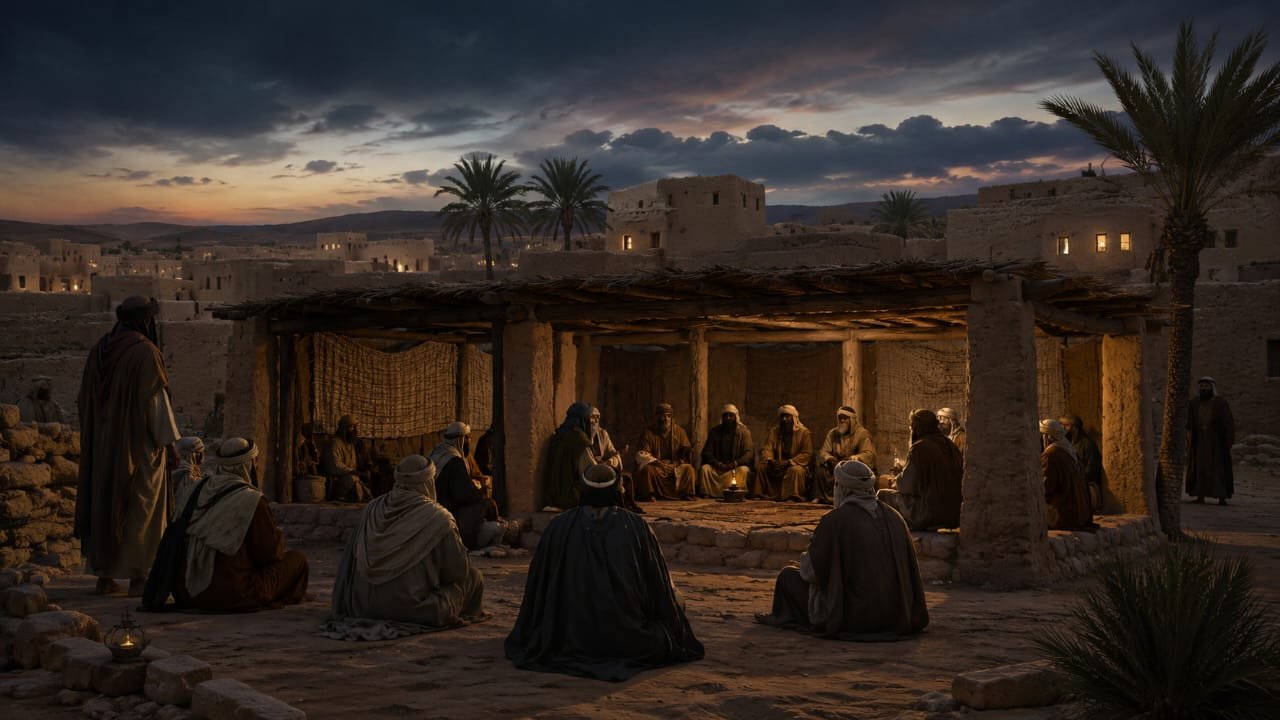
Yet shortly after the Prophet's death, a meeting took place at a roofed gathering place belonging to the Banu Sa'idah clan.
It became known as Saqifah Banu Sa'idah.
What happened there became one of the most important turning points in early Islamic history. It changed the question of succession from a matter of prophetic designation, in the Shia understanding, into a political struggle over who would lead the Muslim community.
And according to the Shia historical account presented in the sources behind this article, the consequences reached far beyond that single meeting.
Quick Answer
Saqifah Banu Sa'idah was a meeting held shortly after the death of Prophet Muhammad (PBUH), where a group of the Ansar and later several Muhajirun discussed who should lead the Muslim community. In the Shia understanding, this meeting bypassed the Prophet's designation of Imam Ali (AS) as his successor and led to the political removal of Ali's rightful authority. Shia historians view Saqifah as a major turning point whose later consequences contributed to the political conflicts that eventually culminated in Karbala.
The Muslim Community Before Saqifah
To understand Saqifah, we first need to understand the situation in Medina before the Prophet's death.
After the migration from Mecca to Medina, Prophet Muhammad (PBUH) became the central religious and political authority of the Muslim community.
That meant decisions about faith, public affairs, leadership, and the protection of the community were all connected to the Prophet.
There was therefore a serious question waiting at the edge of history:
What would happen when that leadership was no longer physically present?
From the Shia point of view, this question had already been answered.
The Prophet had not left the Muslim community without direction. Rather, he had repeatedly identified Imam Ali (AS) as the person who would continue the Prophet's divinely guided leadership.
That is why the events immediately before and after the Prophet's death are so important in Shia history.
Why Was the Prophet Concerned About Succession?
According to the historical account presented in the sources, the Prophet Muhammad (PBUH) was deeply concerned about what might happen after his death.
The concern was not simply about choosing an ordinary political ruler.
It was about preserving the unity and direction of the Muslim community.
The sources used for this account describe a conflict between two paths.
One was the continuation of the leadership designated by the Prophet.
The other was a return to political practices shaped by the old social and tribal traditions of the Jahiliyyah, the pre-Islamic period often described as the "Age of Ignorance."
From this perspective, the struggle surrounding succession was not a minor disagreement. It was a question about what kind of political and religious order the new Muslim community would follow after the Prophet.
The Prophet's Designation of Imam Ali
The Shia position is built around the belief that Imam Ali (AS) had been appointed by divine instruction, communicated through the Prophet.
The material provided for this history emphasizes that the Prophet did not present Ali's leadership as a personal preference. It was understood as an instruction connected to divine guidance.
One statement attributed to the Prophet says:
«"Ali is most certainly with the Quran and the Quran is most certainly with Ali. They shall never leave each other until they join me by the Divine Pool."»
— Prophet Muhammad (PBUH)
The meaning presented in the historical material is significant.
Ali is not described merely as a political candidate. His authority is connected directly with the Quran, presenting him as a guide inseparable from the revelation.
For Shia Muslims, this helps explain why the events at Saqifah are viewed not simply as an election dispute, but as a break from a leadership that had already been designated.
The Military Campaign to Syria
The crisis did not begin at Saqifah.
According to the account preserved in the research material, the Prophet took steps during his final illness to prevent opposition to his succession decision.
He ordered certain individuals whom he suspected of opposing his leadership arrangement to join a military force that was to travel toward Syria.
The stated purpose was strategic: if these individuals left Medina, the risk of a leadership struggle immediately after the Prophet's death would be reduced.
But they did not obey the order.
The Prophet's illness was severe, yet he reportedly went to the minbar and commanded them to join the deployment. The material also states that he strongly condemned anyone who disobeyed that order.
This episode matters because, in the Shia interpretation, the Prophet was trying to prevent exactly the political crisis that later emerged.
But the military order was not carried out as intended.
The people he wanted away from Medina remained there.
And events moved rapidly toward the Prophet's final days.
The Calamity of Thursday
One of the most famous episodes associated with the Prophet's final illness is known as the Calamity of Thursday.
The name refers to a deeply important moment during the Prophet's last days.
According to the account presented here, the Prophet continued to insist that the military group should leave Medina. However, those who opposed the deployment remained behind.
The issue was no longer simply military.
Behind it stood the larger question of what would happen to the Muslim community after the Prophet's death.
The Prophet was seriously ill.
His time was running short.
And yet the dispute over obedience had still not been resolved.
This gives the events of those final days a remarkable historical weight. The succession question was already present before the Prophet's death. Saqifah did not create the issue from nothing. It became the place where that unresolved political conflict exploded into action.
The Death of Prophet Muhammad
Then the moment came that the Muslim community had feared.
Prophet Muhammad (PBUH) died.
The death of the Prophet was an enormous loss for the Muslims. His family and close supporters were faced with grief, while the wider community was suddenly confronted with a question that could not be postponed:
Who would lead the Muslims now?
For the Ahl al-Bayt, the Prophet's family, this was a moment of mourning.
Yet while the Prophet's family was occupied with the events surrounding his death, a political gathering was taking place elsewhere in Medina.
That place was Saqifah Banu Sa'idah.
What Happened at Saqifah Banu Sa'idah?
The Ansar, the people of Medina who had supported the Prophet after his migration, gathered at the Saqifah of Banu Sa'idah to discuss the future leadership of the Muslim community.
At first, the gathering was an internal discussion among the Ansar.
Then several leading Muhajirun arrived.
The Muhajirun were the Muslims who had emigrated from Mecca to Medina.
The people identified in the historical material as the main figures arriving from the Muhajirun side were:
- Abu Bakr
- Umar ibn al-Khattab
- Abu Ubaydah ibn al-Jarrah
- Salim
The discussion quickly became a struggle over leadership.
The central issue was no longer simply grief over the Prophet's death.
It was political authority.
Who would govern the Muslim community?
The Shia historical interpretation presented in the sources argues that this was precisely the problem: the matter of leadership was being decided through a political gathering when, according to Shia belief, the Prophet had already designated Imam Ali (AS).
That is why Saqifah occupies such an important place in Shia accounts of early Islam.
Who Was Present at Saqifah?
The people at Saqifah came from two main groups.
The Ansar
The Ansar were the inhabitants of Yathrib, later known as Medina, who supported the Prophet and the Muslim community after the migration.
They were not passive observers. They had gathered to discuss the future leadership themselves.
One figure associated with the gathering was al-Habbab ibn al-Mundhir, whose warnings about the future of the Ansar are highlighted in the historical material.
The Muhajirun
The Muhajirun were the Muslims who had migrated from Mecca.
The individuals identified in the supplied sources as the major Muhajirun participants at Saqifah were:
- Abu Bakr
- Umar ibn al-Khattab
- Abu Ubaydah ibn al-Jarrah
- Salim
The arrival of this group changed the balance of the meeting.
The gathering was no longer simply a discussion among the Ansar. It had become a direct contest over political leadership.
Why Was Imam Ali Not at Saqifah?
This is one of the first questions many beginners ask.
Why was Imam Ali not at the meeting if the future of the Muslim community was being decided?
The answer, in the historical account presented here, is closely connected to the Prophet's death.
Imam Ali (AS) and the Ahl al-Bayt were dealing with the Prophet's death and its immediate aftermath.
While the family of the Prophet was occupied with mourning, burial, and the responsibilities surrounding his passing, the political meeting at Saqifah moved forward.
This difference in circumstances is central to the Shia reading of the event.
One side was handling the death of the Prophet.
The other was handling the question of political leadership.
That separation is one reason the Shia tradition regards Saqifah as such a serious turning point.
Saqifah and the Succession of Imam Ali
For Shia Muslims, the main issue is not simply who won a political meeting.
The deeper issue is whether the leadership of the Muslim community could legitimately be decided in that way at all.
The sources presented in this account describe Imam Ali's authority as having already been established by the Prophet.
From that perspective, Saqifah did not create a legitimate new system of succession.
Instead, it bypassed the leadership that had already been designated.
This is why Shia historical literature often treats the events surrounding Saqifah as a usurpation of authority.
The disagreement therefore reaches beyond personalities.
It concerns the very meaning of Islamic leadership after the Prophet.
Was leadership to continue through divine designation?
Or was it to be settled through political agreement among influential members of the community?
The Shia answer is clear: the Prophet had already designated Ali.
Was Saqifah the Beginning of Shia-Sunni Political Disagreement?
The full history of Sunni-Shia relations is much more complex than one meeting.
Still, Saqifah is one of the central events behind the Shia understanding of why the question of succession became such a lasting divide.
For Shia Muslims, the issue is rooted in the Prophet's designation of Imam Ali (AS).
The political events after the Prophet's death therefore became the starting point of a broader history involving the authority of the Ahl al-Bayt.
This is why Saqifah cannot easily be treated as a forgotten political meeting from the seventh century.
Its meaning continued to shape later events.
From Saqifah to the Umayyads
The historical material provided for this article makes a much larger claim about the consequences of Saqifah.
It argues that the political system established after the Prophet's death helped create the conditions that later allowed the Umayyad dynasty to dominate the Muslim world.
The names Muawiyah ibn Abu Sufyan and Yazid therefore appear in the story much later than Saqifah, but the connection made in Shia historical interpretation is direct.
According to this account, the political precedent established after the Prophet weakened the authority of the Ahl al-Bayt and created a path through which later rulers could claim power.
Under Muawiyah, the material describes the oppression of opponents, including the deliberate humiliation and impoverishment of the Ansar.
Under his son Yazid, that pattern became even harsher.
Properties were seized.
Blood was shed.
Honors were abused.
And eventually the history reached Karbala.
From Saqifah to Karbala
Few historical journeys are as painful as the road from the death of the Prophet to the killing of his grandson.
For Shia Muslims, however, these events are connected.
The political conflict surrounding succession was not forgotten.
Generations later, the authority of the Ahl al-Bayt remained contested.
Then came Imam Husayn ibn Ali (AS).
He was the grandson of Prophet Muhammad (PBUH), the son of Imam Ali and Lady Fatimah al-Zahra (SA), and one of the central figures of the Ahl al-Bayt.
At Karbala, Imam Husayn and his companions were surrounded and killed.
The account presented in the supplied material describes the violence in stark terms: Imam Husayn was attacked with swords, spears, and lances, and was eventually beheaded. The tents of the Prophet's family were then attacked and burned, forcing the women and children to flee.
Among those who witnessed this catastrophe was Lady Zaynab (SA), the sister of Imam Husayn.
For Shia Muslims, Karbala was not an isolated tragedy.
It was the terrible culmination of a political struggle that had begun much earlier.
That is why Saqifah remains important in Shia historical memory.
The Ethics of the Ahl al-Bayt
The story of Saqifah can easily become only a story about political power.
But the historical material also presents another theme: the character of the Ahl al-Bayt.
Their significance was not limited to questions of authority.
They also represented a distinct moral standard.
One of the clearest examples comes from Imam Ali (AS) near the end of his life.
After Imam Ali was struck by his assassin, people were filled with anger toward the prisoner responsible.
Yet Imam Ali did not respond by demanding uncontrolled revenge.
Instead, the sources preserve this instruction to his son, Imam al-Hasan (AS):
«"O son, we are the household of mercy and forgiveness. Feed him from the food you eat and water him from the drink you take."»
— Imam Ali (AS)
The message is striking.
The prisoner was the man who had attacked Imam Ali.
Yet Imam Ali still insisted that he be treated humanely.
This moment reveals something essential about how the Ahl al-Bayt are portrayed in Shia thought.
Their struggle against injustice was not supposed to destroy justice itself.
Their answer to oppression was not cruelty.
Their authority was connected with responsibility, mercy, and obedience to Allah.
Timeline of Saqifah Banu Sa'idah
| Period | Event |
|---|---|
| Final days of the Prophet's life | The Prophet becomes seriously ill and continues to address the issue of leadership and the military deployment. |
| During the final illness | A military force is ordered to move toward Syria, but certain individuals refuse to leave Medina. |
| The Calamity of Thursday | The Prophet makes further efforts to secure obedience during his final days. |
| Death of Prophet Muhammad (PBUH) | The Muslim community loses its religious and political leader. |
| Shortly after his death | The Ansar gather at Saqifah Banu Sa'idah to discuss leadership. |
| The Saqifah meeting | Abu Bakr, Umar ibn al-Khattab, Abu Ubaydah ibn al-Jarrah, and Salim arrive and join the discussion. |
| After Saqifah | Political authority moves away from the leadership that Shia Muslims believe had been designated to Imam Ali (AS). |
| Later decades | The Umayyad dynasty rises to political dominance. |
| Reign of Yazid | The conflict culminates in the tragedy of Karbala and the martyrdom of Imam Husayn (AS). |
Why Is Saqifah Important in Shia Islam?
There are several reasons.
- It concerns the leadership of the Muslim community
Saqifah is fundamentally about who had the right to lead after the Prophet.
For Shia Muslims, that authority belonged to Imam Ali (AS).
- It marks a major political turning point
The meeting changed the direction of Muslim political history shortly after the Prophet's death.
- It affects how later history is understood
The Shia interpretation sees a connection between the political events following the Prophet and the later suffering of the Ahl al-Bayt.
- It helps explain the background of Karbala
Karbala did not appear from nowhere.
Shia historical interpretation sees it as the final and most tragic stage in a much longer conflict over the authority of the Prophet's family.
- It is tied to the question of justice
The debate is not only about political succession.
It is also about whether authority should follow divine designation or political power.
Frequently Asked Questions
What Happened at Saqifah?
Saqifah Banu Sa'idah was a meeting held shortly after the death of Prophet Muhammad (PBUH), where a group of the Ansar and later several Muhajirun discussed who should lead the Muslim community. In the Shia understanding, this meeting bypassed the Prophet's designation of Imam Ali (AS) as his successor and led to the political removal of Ali's rightful authority.
Why Is Saqifah Important in Shia Islam?
Saqifah is important because it concerns the leadership of the Muslim community, marks a major political turning point, affects how later history is understood, helps explain the background of Karbala, and is tied to the question of justice regarding divine designation versus political power.
Why Did the Ansar Gather at Saqifah?
The Ansar gathered because the Prophet had died and the community needed leadership. Their meeting shows how quickly the question of succession became a political emergency. But the arrival of the Muhajirun changed the nature of the gathering and turned it into a wider contest for authority.
Why Did the Prophet Order a Military Campaign to Syria?
According to the account presented in the historical sources, the Prophet wanted certain people to leave Medina because he feared they would challenge the succession arrangement after his death. The campaign therefore had a political purpose as well as a military one. Removing potential opponents from the city would reduce the possibility of an immediate uprising.
What Was the Calamity of Thursday?
The term refers to a major episode during the Prophet's final illness. The historical account used here describes the Prophet as repeatedly urging obedience to his military command while certain companions remained in Medina. The event matters in the context of succession because it is presented as part of the struggle over what would happen after the Prophet's death.
Who Were the Muhajirun at Saqifah?
The Muhajirun were the Muslims who had emigrated from Mecca to Medina. The individuals identified in the supplied material as the leading participants arriving at Saqifah were: Abu Bakr, Umar ibn al-Khattab, Abu Ubaydah ibn al-Jarrah, and Salim.
What Does Saqifah Mean in Shia Islam?
In Shia Islam, Saqifah is generally remembered as the point at which political authority was taken in a direction different from the one the Prophet had designated. The Shia interpretation holds that Imam Ali (AS) was the divinely appointed successor. Therefore, the decision made at Saqifah is viewed as a wrongful removal of his rightful authority rather than a legitimate selection of a new leader.
Did Saqifah Lead Directly to Karbala?
The relationship is historical and political rather than a claim that one meeting immediately caused the later battle. The Shia historical material presented here understands Saqifah as the beginning of a chain of political developments that weakened the authority of the Ahl al-Bayt and eventually allowed oppressive rulers to dominate. That chain ultimately reaches the Umayyads and, under Yazid, the tragedy of Karbala.
Why Does Saqifah Still Matter?
Imagine the history of a nation being changed in a single meeting. That is how Saqifah is remembered in Shia thought. The meeting itself happened centuries ago. But its central question has never really disappeared: Who has the right to lead a community after a prophet? For Shia Muslims, the answer is tied to Imam Ali (AS), the Ahl al-Bayt, and the idea that legitimate religious leadership comes through divine designation rather than political struggle. Understanding Saqifah therefore helps explain much more than one event. It helps explain why Imam Ali's leadership is so important in Shia Islam. It helps explain the historical role of the Ahl al-Bayt. And it helps explain why the road from the Prophet's death to Karbala is remembered not as a series of unrelated events, but as one long and painful struggle over authority, justice, and the future of the Muslim community.
Sources and Further Reading
The historical material used for this article identifies the following works as its sources and references:
- Ahmad Husayn Yaqub, The Conception of the Sahaba's Ultimate Decency and the Political Authority in Islam, translated by Badr Shahin, Ansariyan Publications, Qum, 1998
- al-Sawaiq al-Muhriqah
- Kanz al-Ummal by al-Muttaqi al-Hindi
- al-Tabaqat by Ibn Sa'd
- Tarikh al-Khamis