
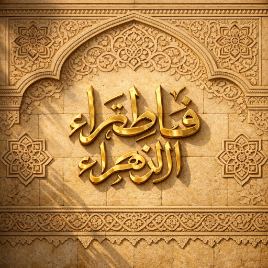
Lady Fatima al-Zahra (a.s.) is one of the most important women in Islamic history. She was the daughter of Prophet Muhammad (S) and Lady Khadijah, and she lived a life shaped by faith, courage, purity, and deep love for Allah. Even in the earliest Islamic sources, she appears as more than a family member of the Prophet. She is shown as a woman of knowledge, worship, patience, and strength.
For a beginner, her story can feel large at first. But once you follow it step by step, it becomes clear why her name still matters so much. She stood at the center of the Prophet’s household, witnessed some of the hardest moments in early Islam, and left behind a legacy that still speaks to believers today.
At a glance
- Birthplace: Mecca
- Parents: Prophet Muhammad (S) and Lady Khadijah bint Khuwaylid
- Husband: Imam Ali (a.s.)
- Children: Imam al-Hasan, Imam al-Husayn, Lady Zaynab, Lady Ummu Kulthum, and al-Muhsin
- Known for: Purity, worship, knowledge, courage, and devotion
- Important titles: al-Siddiqah al-Kubra, al-Zahraa, Chief of the Women of the World
Early Life and Family Background
Lady Fatima al-Zahra was the youngest child of Prophet Muhammad (S) and Lady Khadijah. Her mother was the first Muslim woman, and she supported Islam with her wealth and her full heart when the faith was still facing severe opposition. That background mattered. Fatima grew up in a home built on sacrifice, truth, and loyalty to Allah.
She was born in Mecca and had siblings including Zaynab and Ruqayyah. According to the research dossier, she was the only daughter through whom the Prophet’s noble descendants continued. That makes her place in Islamic history especially significant.
Her early years were not easy. She saw her father struggle openly against unbelievers and remembered the hardships of that time. So from the beginning, her life was tied to patience, struggle, and faith.
Why Her Titles Matter
Lady Fatima was honored with titles that reveal how deeply she was respected.
Chief of the Women of the World
The Prophet Muhammad (S) called her the Chief of the Women of the World or Chief of the Women of this Ummah. In simple terms, this means she was seen as the highest model for believing women of her time.
Al-Siddiqah al-Kubra
This title means the Great Truthful One. It points to her honesty, sincerity, and spiritual clarity. The dossier also notes that her daughter Zaynab later inherited a similar title, al-Siddiqah al-Sughra, showing how this quality was seen as part of the family’s moral identity.
Al-Zahraa
This title is widely understood as the Resplendent or the Radiant One. It reflects purity and spiritual light.
Among the Best Women of Paradise
The research states that she was counted among the four best women of Paradise, along with Khadijah, Mary, and Asiyah. That places her in the company of the most honored women mentioned in the Islamic tradition.
Her Character and Inner Life
What made Lady Fatima al-Zahra remarkable was not only her family position. It was her character.
She was described as pure and free from uncleanness, and the Holy Quran is connected to this meaning in the Verse of Purity. She also lived with great asceticism, which means she chose a simple life instead of luxury. The dossier says she owned almost nothing beyond a rug made of date-palm leaves and the skin of an ewe. That alone tells you something important: she did not chase comfort.
She was also deeply knowledgeable. The research says she understood the philosophy behind Islamic law and taught her children with discipline, mercy, and piety. In other words, she was not only a mother. She was a teacher.
And above all, she was devoted to Allah. The dossier describes her as a copy of her father in worship and piety. That is a powerful description, because it shows that her life reflected the same spiritual seriousness the Prophet himself embodied.
Marriage to Imam Ali (a.s.)
Her marriage to Imam Ali (a.s.) is one of the most beautiful parts of her biography.
The marriage took place in Medina after the Muslim victory in the Battle of Badr. Because of the Prophet’s status, Lady Fatima’s own rank, and her great personality, many wealthy men wanted to marry her. But the Prophet refused earlier proposals. According to the dossier, he was waiting for a divine decision, because nobody was truly worthy of her.
That decision came when Imam Ali, who was extremely poor, was encouraged by others to ask for her hand. The Prophet consulted Fatima herself, received her consent, and then informed Ali.
The Prophet’s endorsement was clear. He told her that he agreed to the marriage with a man who was most advanced in moral excellence and among the earliest believers in Islam. That statement matters because it shows the marriage was not based on wealth or status. It was based on faith, character, and divine approval.
Their children were:
- Imam al-Hasan
- Imam al-Husayn
- Lady Zaynab
- Lady Ummu Kulthum
- al-Muhsin
This family became one of the most central families in Islamic memory.
Her Deep Bond with the Prophet Muhammad (S)
The bond between Lady Fatima and her father was extraordinary. It was not only emotional. It was spiritual.
«“Fatimah is a part of me. Whatever hurts her is certainly hurtful to me and whatever pleases her is certainly pleasing to me.”»
He also said:
«“Fatimah, most surely Allah is pleased when you are pleased and enraged when you are enraged.”»
These statements show that her happiness and pain were tied to the Prophet himself. They also show how highly she was valued.
On his deathbed, the Prophet told her that he would soon depart. She wept. Then he told her that she would be the first to join him in the heavens, and she smiled. This moment captures something very human and very moving: grief, love, and hope in the next life.
Major Historical Events in Her Life
Lady Fatima was present during several of the most serious moments in early Islamic history.
The Event of Mubahalah
She was the only woman chosen to take part in the Mubahalah, together with the Prophet, Imam Ali, Imam al-Hasan, and Imam al-Husayn. The dossier presents this event as proof of her special place in the Prophet’s family. It also shows that she was not a side figure in history. She stood in the very center of it.
The Final Days of the Prophet
She witnessed the last days of her father’s life and saw efforts to marginalize his will regarding Imam Ali. After the Prophet passed away, she was filled with grief. This was not a small personal sadness. It became one of the major emotional and historical turning points in her life.
The Confiscation of Fadak
After the Prophet’s death, the dossier says that Abu Bakr’s government confiscated her property, including the land of Fadak, which the Prophet had gifted to her. It also says that the Khums tax meant for the Prophet’s family was canceled.
This part of her life is often discussed because it was not only about land. It was about rights, authority, and the treatment of the Prophet’s household.
Her Great Sermon
In response to the economic blockade and the taking of Imam Ali’s rights, Lady Fatima delivered a powerful sermon in the Prophet’s mosque. She spoke from behind a screen and moved the audience to tears. Then she explained deep theological ideas, the philosophy of Islamic law, the virtues of Imam Ali, and why the claim that prophets leave no inheritance was false.
The dossier says she also warned that the deviation would bring future hardship to the Muslim community. Her sermon is remembered because it combined sorrow, courage, and intellectual strength.
Bayt al-Ahzan, the House of Griefs
Her grief over her father continued. Some people in Medina were disturbed by her constant mourning, so Imam Ali built a shelter for her outside Medina called Bayt al-Ahzan, which means House of Griefs. There, she could mourn freely with her children.
That detail is sad, but it also shows her dignity. She was not told to hide her pain. A place was made for it.
The Rejected Apologies
The dossier reports that Abu Bakr and Umar later came to ask for her forgiveness. She turned away from them. She made them confirm that they had heard the Prophet say that angering her was the same as angering him. Then she called Allah and the angels to witness that they had angered her, and she said she would complain to the Prophet and invoke Allah against them in every prayer.
This is one of the strongest statements in the research dossier, and it is presented as part of her final position on what had happened.
Quranic Connections
The dossier connects Lady Fatima al-Zahra to two important Quranic verses.
The Verse of Purity
إِنَّمَا يُرِيدُ اللَّهُ لِيُذْهِبَ عَنكُمُ الرِّجْسَ أَهْلَ الْبَيْتِ وَيُطَهِّرَكُمْ تَطْهِيرًا
“Allah only desires to keep away the uncleanness from you, O people of the House! and to purify you a thorough purifying.”
Surah Al-Ahzab (33:33)
Simple explanation: This verse is linked to the Ahl al-Bayt, the Prophet’s household. In the dossier, Lady Fatima is described as a central pillar of that household, so the verse is used to explain her purity and special status.
The Verse of Mawaddah
قُل لَّا أَسْأَلُكُمْ عَلَيْهِ أَجْرًا إِلَّا الْمَوَدَّةَ فِي الْقُرْبَىٰ
“Say: I do not ask of you any reward for it but love for my near relatives.”
Surah Ash-Shura (42:23)
Simple explanation: This verse is presented as a command to love the Prophet’s close family, which includes Fatima, Ali, Hasan, and Husayn. It helps explain why love for this household is treated as a religious duty in the research.
Important Hadiths About Lady Fatima
The research dossier includes several important narrations.
“Fatimah is a part of me”
This famous saying of the Prophet shows how closely he tied her honor to his own. It also means that hurting her was treated as hurting him.
“Allah is pleased when you are pleased”
This narration shows the spiritual weight of her character. It tells the reader that her pleasure and anger were not ordinary feelings. They had religious meaning.
A Report from Aishah
Aishah is reported to have said that nobody was preferred more than Fatimah except Prophet Muhammad (S). This supports the view that Fatima held an exceptionally high rank.
A Report About Her Progeny
The dossier mentions a narration from Imam Ja‘far al-Sadiq (a.s.) saying that because Fatima guarded her chastity, Allah would forbid Hell from taking in her progeny. This narration connects her virtue to her descendants.
Her Own Narration
Fatima herself narrated the story of heavenly food served to her father, and she also passed on a social principle: neighbors should be given priority before family members. That shows her role not only as a subject of history, but also as a narrator and teacher.
Her Final Illness, Will, and Burial
After the oppression and grief she experienced, her health declined quickly. She became bedridden. The dossier presents her final days as calm, serious, and full of awareness.
She gave Imam Ali strict instructions:
- her body should be buried in the darkest part of the night,
- those who wronged her should not attend the funeral,
- and the location of her tomb should remain unknown.
On her last day, she prepared herself with care. She washed her sons, prepared food, sent them to their grandfather’s tomb, asked Asma bint Umays for water, wore mourning clothes, placed her bed in the center of the house, and recited the Quran until she passed away.
Imam Ali washed her body with the help of Salman and a few Hashemite men, and she was buried secretly at night. The grave was hidden, and even Aishah was not allowed to see the body.
The secrecy of her burial remains one of the most striking parts of her story.
Historical Differences in the Reports
The dossier includes two historical differences that should be stated carefully.
Her Birth Year
One report places her birth in the fifth year after Hijrah. Another says she was born five years after prophethood. The dossier presents both views without forcing one final conclusion.
Her Year of Death
Some sources place her death in the tenth year of Hijrah, while others say the eleventh year. Both reports agree on one important point: she died while still young.
Why Lady Fatima al-Zahra Still Matters
Lady Fatima al-Zahra matters because her life brings together faith, family, courage, suffering, and dignity in one story. She was the daughter of the Prophet, the wife of Imam Ali, the mother of the Ahl al-Bayt, and a woman whose words and actions still shape how believers understand purity and devotion.
She was not loud in the worldly sense, but she was powerful. She did not seek comfort, but she lived with honor. She did not live long, but her influence was immense.
That is why her name continues to be remembered with love. Her life teaches that greatness in Islam is not measured by wealth, comfort, or public applause. It is measured by truth, worship, patience, and loyalty to Allah.
Conclusion
Lady Fatima al-Zahra (a.s.) stands as one of the purest and most important figures in Islamic history. Her early life in Mecca, her closeness to the Prophet, her marriage to Imam Ali, her courage after the Prophet’s death, and her secret burial all show a life filled with meaning.
For beginners, her story offers more than history. It offers a clear example of how faith can shape a person’s entire life. She remains a symbol of purity, knowledge, dignity, and steadfastness — and that is why she is remembered so deeply.