
Introduction
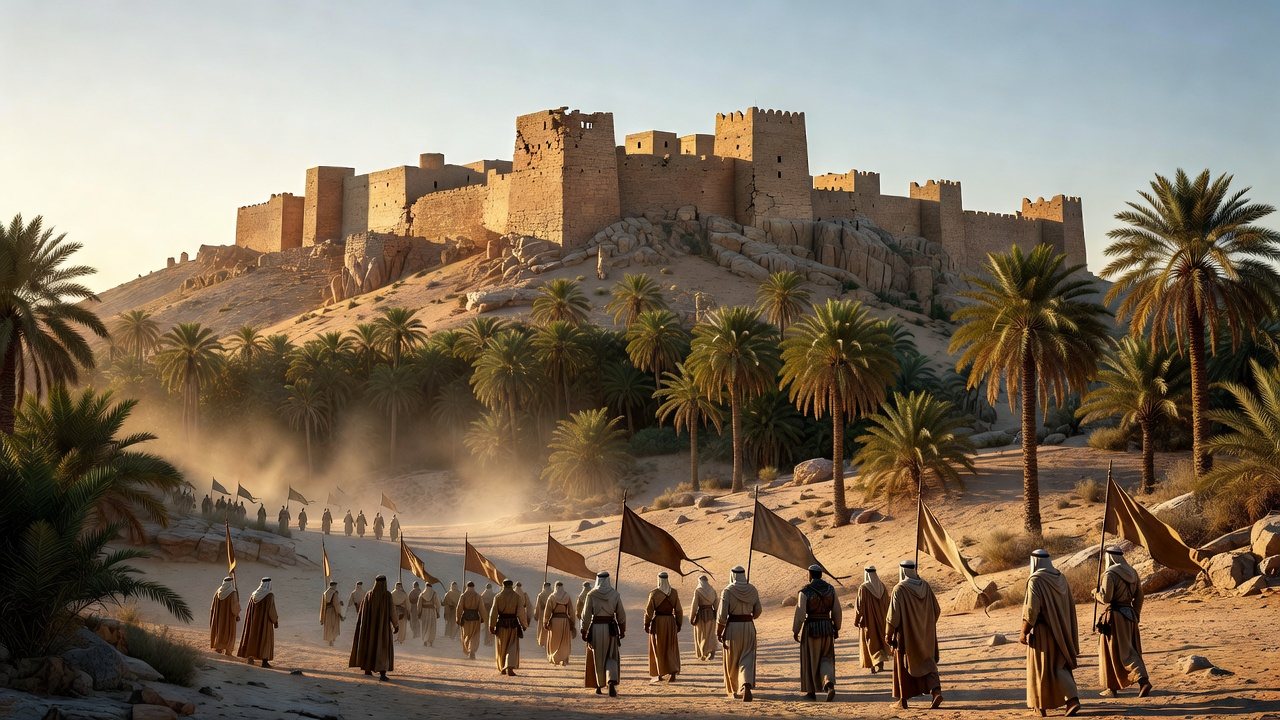
The Battle of Khaybar is one of the most important military campaigns in early Islamic history. It came soon after the Treaty of Hudaybiyyah, at a time when the Muslim community was moving from years of pressure and uncertainty toward a stronger political position.
But Khaybar was not just about forts and fighting. It was also about strategy, loyalty, courage, supply, and the changing balance of power in Arabia.
Why did the Prophet march toward Khaybar so soon after Hudaybiyyah?
How did the Jews of Khaybar lose their strong fortresses?
And why does the victory at Khaybar still matter in Islamic memory?
This article tells the story step by step in simple English.
Quick Answer
The Battle of Khaybar took place in Muharram, 7 AH, shortly after the Treaty of Hudaybiyyah. The Muslim army advanced toward the Jewish strongholds of Khaybar, blocked the Ghatafan tribe from joining the defense, and captured major fortresses one by one. According to the dossier, Imam Ali played the decisive role, and the conquest brought important agricultural wealth under Muslim control.
Historical and Political Background
According to the dossier, the expedition to Khaybar took place in Muharram of 7 AH. The same year is also called Sanat al-Istighlab, meaning the Year of Conquest.
The campaign began shortly after the Prophet Muhammad returned from the Treaty of Hudaybiyyah and stayed for a short time in Medina. That peace treaty had changed the political mood in Arabia. The Muslim community was no longer trapped in constant open conflict with Mecca, and this gave the Prophet room to act against other threats.
Khaybar was important because it was not a small settlement. It was a powerful area with fortified strongholds, agricultural lands, and military value. In other words, this was not an easy target.
The Road to Khaybar
The Muslim army left Medina and moved toward the strongholds of Khaybar through a specific route.
According to the dossier, they passed:
- the mountain of Asr (عصر)
- then Sahba' (صهباء)
- and finally camped in the valley of Raji' (رجیع)
This location was chosen carefully. It placed the Muslim army between Khaybar and the Ghatafan tribe, which was allied with the people of Khaybar.
That was a smart move. It did not just prepare the battlefield. It also cut off support before the battle even started.
The Poetry of Aamir bin Akwa'
One of the most memorable moments on the way to Khaybar was the poetry recited by Aamir bin Akwa'.
He chanted war poetry to lift the morale of the army. The dossier preserves the Arabic verses, which speak about faith, prayer, and standing firm in battle.
The Prophet responded with a supplication for him: “May God have mercy on you.”
The companions understood this as a sign that the Prophet’s battlefield prayer often pointed to martyrdom. And that is exactly what happened later. Aamir bin Akwa' was martyred during the Battle of Khaybar.
Why this moment matters
It shows the emotional side of the campaign. Khaybar was not only a military movement. It was also a moment of faith, courage, and spiritual meaning.
The Prophet’s Supplication at Khaybar
When the army reached the outskirts of Khaybar, the Prophet ordered them to stop. He then made a supplication asking God for the good of the village, its people, and what was inside it, while seeking refuge from its evil.
After that prayer, he ordered the army forward.
This detail matters because it shows that the campaign was framed not only as a military action but also as a morally guided one.
In many Islamic historical narrations, the Prophet’s prayers and words are linked closely with battlefield events. Khaybar is one of the clearest examples of that pattern in the dossier.
Why the Ghatafan Tribe Withdrew
The Ghatafan tribe had planned to help the Jews of Khaybar. But when they saw that the Muslim army had camped in the Raji' valley, they realized something dangerous.
The Muslim position separated them from their own families and property.
That changed everything.
Fear overtook them, and instead of joining the battle, they withdrew. The Jews of Khaybar had to face the Muslim army without that promised support.
This was one of the most important strategic moments in the campaign. The battle was not won only by fighting. It was also shaped by positioning, pressure, and timing.
The Siege and Capture of the Fortresses
Khaybar was not one fortress. It was a chain of fortified positions. The Muslims conquered them step by step.
1. Na'im Fortress
The first fortress captured was Na'im.
During the assault, Mahmud bin Maslamah was martyred. His death is one of the early sacrifices remembered in the campaign.
2. Qamus Fortress
After Na'im fell, the Muslim forces advanced and captured Qamus.
This was a major development because it showed that the first victory had broken the enemy line and opened the way deeper into Khaybar.
3. Sa'b bin Mu'adh Fortress
The dossier describes Sa'b bin Mu'adh as the richest of the fortresses.
This fortress was especially valuable because it held large reserves of:
- food
- oil
- provisions
Those resources were important because some of the other strongholds lacked them.
Why the fortresses mattered
The conquest of these forts was not only about military victory. It also meant control of land, food, and wealth.
Imam Ali’s Decisive Role
One of the clearest points in the dossier is the importance of Imam Ali bin Abi Talib in the conquest of Khaybar.
The research says that Imam Ali played the decisive role in defeating the enemy warriors. Later, in a speech attributed to Imam Hasan, this achievement is recalled with the words:
“and by him the people of Khaybar were killed.”
That phrase is strong, but its purpose is clear: it highlights Imam Ali’s central role in the battle’s outcome.
For readers new to Islamic history, this matters because Khaybar became one of the battles most closely associated with Imam Ali’s bravery and battlefield strength.
Why Imam Ali’s role stands out
The dossier does not present him as a side figure. It presents him as the man whose action turned the battle.
The Outcome and the Wealth of Khaybar
After the conquest, Khaybar became part of Muslim-controlled territory. The dossier says the lands and income of Khaybar were treated as fay', meaning state wealth gained without direct booty from open battle in the usual sense.
That meant the conquest had a financial and administrative consequence, not only a military one.
Distribution of the wealth
According to the dossier, the Prophet distributed part of this income specifically to:
- Banu Hashim
- Banu Abd al-Muttalib
The dossier also says that Banu Abd Shams and Banu Nawfal were excluded from this distribution.
This is important because it shows how closely Khaybar was tied to questions of family rights, public wealth, and the Prophet’s own kinship line.
Later administration
The dossier adds that in the caliphate of Umar bin al-Khattab, the Khaybar lands were managed under specific conditions by the designated families.
That later arrangement shows that Khaybar remained important long after the battle itself had ended.
Timeline of the Battle of Khaybar
| Stage | Event |
|---|---|
| 7 AH, Muharram | The campaign toward Khaybar begins after Hudaybiyyah |
| Early march | The army moves from Medina past Asr and Sahba' |
| Strategic encampment | The Muslim army camps in the valley of Raji' |
| On the road | Aamir bin Akwa' recites battle poetry |
| At the outskirts | The Prophet makes a supplication for the village |
| Ghatafan response | The Ghatafan tribe withdraws |
| First fortress | Na'im fortress is captured |
| Loss in battle | Mahmud bin Maslamah is martyred |
| Next advance | Qamus fortress is captured |
| Final major stronghold | Sa'b bin Mu'adh fortress falls |
| Aftermath | Khaybar lands and income become part of Islamic administration |
Important Historical Figures
| Person | Role in the Battle of Khaybar |
|---|---|
| The Prophet Muhammad | Led the expedition and set the strategy |
| Imam Ali bin Abi Talib | Played the decisive battlefield role |
| Aamir bin Akwa' | Recited poetry and was later martyred |
| Mahmud bin Maslamah | Martyred during the assault on Na'im |
| The Ghatafan tribe | Planned to support Khaybar but withdrew |
| The people of Khaybar | Defended the fortified settlements |
Historical Lessons
The Battle of Khaybar gives several important lessons.
- First, strategy matters. The Prophet did not simply rush into battle. He chose a route, a camp, and a position that weakened the enemy’s alliances.
- Second, morale matters. The poetry of Aamir bin Akwa' was not just decoration. It helped strengthen the spirit of the army.
- Third, spiritual life and military life were connected. The supplication at the edge of Khaybar shows that prayer and action worked together.
- Fourth, battle outcomes can reshape wealth and administration. Khaybar was not only conquered; its lands were reorganized in a way that affected later history.
- Fifth, some battles become closely linked to one figure’s courage. In this dossier, Khaybar is strongly associated with Imam Ali’s decisive action.
Frequently Asked Questions
1. When did the Battle of Khaybar take place?
According to the dossier, it took place in Muharram, 7 AH, shortly after Hudaybiyyah.
2. Why did the Muslims go to Khaybar?
They marched toward Khaybar after Hudaybiyyah in a campaign against the fortified strongholds there.
3. Why did the Ghatafan tribe withdraw?
They withdrew because the Muslim camp at Raji' cut them off from their families and property.
4. Which fortress was conquered first?
The first fortress captured was Na'im.
5. Which fortress had the most resources?
The dossier identifies Sa'b bin Mu'adh as the wealthiest fortress, with food and oil reserves.
6. What was Imam Ali’s role in Khaybar?
The dossier says Imam Ali played the decisive role in defeating the enemy warriors.
7. What happened to Aamir bin Akwa'?
He recited poetry on the march and later attained martyrdom at Khaybar.
8. How was Khaybar’s wealth treated?
It was treated as fay', and part of it was distributed to Banu Hashim and Banu Abd al-Muttalib.
Conclusion
The Battle of Khaybar was more than a siege. It was a carefully planned campaign that combined faith, strategy, battlefield courage, and political outcome.
From the route out of Medina to the fall of the forts, every stage of the campaign mattered. The withdrawal of the Ghatafan tribe, the poetry of Aamir bin Akwa', the prayer of the Prophet, and the decisive role of Imam Ali all shaped the final result.
Khaybar also changed the future. It brought land, income, and influence into the Muslim state. In that sense, it was not just a victory on the battlefield. It was a turning point in early Islamic history.
Key Takeaways
- Khaybar took place in Muharram, 7 AH, after Hudaybiyyah.
- The Prophet used smart military strategy by camping at Raji'.
- Aamir bin Akwa' inspired the army with poetry and was later martyred.
- The Ghatafan tribe withdrew when they saw their families and property were exposed.
- Na'im, Qamus, and Sa'b bin Mu'adh were major fortresses in the conquest.
- Imam Ali played the decisive role in the battle.
- Khaybar’s land and income became an important part of Islamic administration.