
Ali al-Asghar is remembered in Shia Islam as the infant son of Imam Husayn (AS) who was martyred during the Battle of Karbala in 680 CE. Also known as Abd Allah ibn al-Husayn, he represents the innocence of a child caught in one of the most tragic events in Islamic history. His story is closely connected with the thirst, suffering, and sacrifice of Imam Husayn’s family on the day of Ashura.
But what do historical sources actually tell us about his martyrdom? How old was he? Was his killer Harmala ibn Kahil? And what does the famous Ziyarat al-Nahiya say about him?
Let us explore his story through historical accounts, Shia devotional traditions, and the differences between early reports and later narrations.
Who Was Ali al-Asghar?
Ali al-Asghar was the youngest son of Imam Husayn ibn Ali (AS), the grandson of Prophet Muhammad (PBUH) and the third Imam in Shia Islam. His mother is commonly identified as Rubab bint Imra al-Qays, the wife of Imam Husayn and the mother of Sukayna.
The name Ali al-Asghar means “Ali the Younger” in Arabic. However, many early historical sources refer to the infant as Abd Allah ibn al-Husayn or Abd Allah al-Radi, meaning Abd Allah the nursing infant.
According to Encyclopaedia Iranica and the biographical information collected by Al-Islam.org, the name Abd Allah appears in early accounts, while Ali al-Asghar became the better-known name in later Shia tradition.
This difference is important because several children from the family of Imam Husayn and Imam Hasan were killed at Karbala, and later accounts sometimes confused their names and stories.
Sources: "Encyclopaedia Iranica: Ali Asghar" and "Al-Islam.org: Abd Allah ibn al-Husayn" .
.jpg)
The Story of Ali al-Asghar’s Martyrdom at Karbala
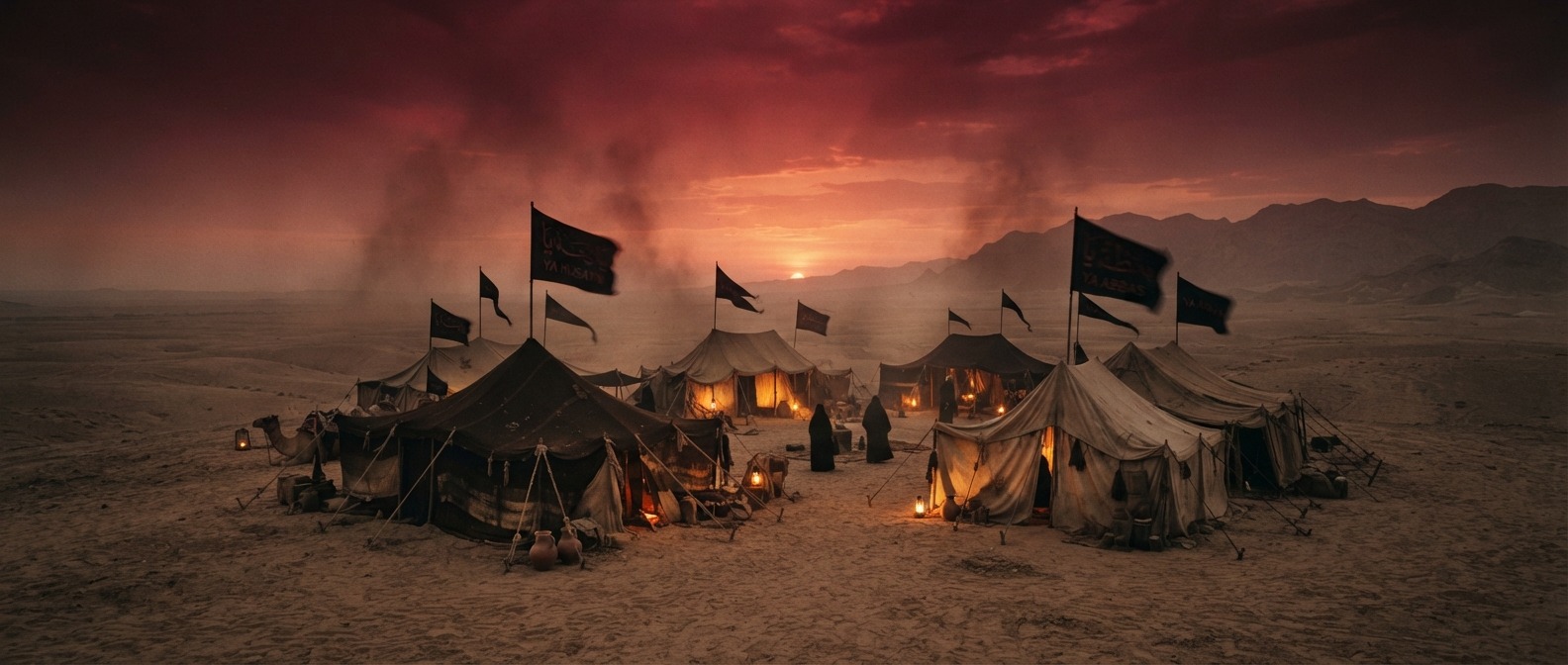
The Battle of Karbala took place on the 10th of Muharram, 61 AH, in 680 CE. Imam Husayn and a small group of his companions and family members faced the army sent against them under the authority of the Umayyad government.
The suffering of the camp grew as the battle continued. Imam Husayn lost many of his companions and members of his family. Historical accounts also describe the death of his young son, Abd Allah.
The infant in his father’s arms
One account preserved in early historical tradition describes Imam Husayn, wounded and surrounded by enemies, holding his infant son in his lap. A man from the Banu Asad tribe shot an arrow at the child, striking his neck and killing him.
According to the account discussed by Encyclopaedia Iranica, Imam Husayn gathered the child’s blood in his hands, poured it onto the ground, and called upon God against those responsible for the injustice.
This account presents a terrible moment: a father holding his dying child in the middle of a battle, with almost no way to protect him.
The report is associated with the historical traditions preserved by al-Tabari and other writers. It is important, however, to distinguish this account from later narrations that describe the scene in greater detail.
The farewell described in later Shia accounts
In the well-known account preserved in Al-Luhuf by Sayyid Ibn Tawus, Imam Husayn approaches the tents and asks his sister Zaynab (AS) to bring him his young child so that he can say farewell.
As he holds the infant, an arrow is fired, striking the child’s throat. The child is martyred in his father’s arms.
This account became influential in Shia mourning gatherings, where the image of Imam Husayn holding his infant son expresses the depth of the tragedy at Karbala.
Another widely known version describes the infant as suffering from thirst. In that account, Imam Husayn brings him before the opposing army and asks for water for the child. An arrow strikes the infant during this appeal.
These versions share the central tragedy of a young child being killed at Karbala, but their precise sequence of events is not identical. They should therefore be presented as different historical and devotional accounts, rather than combined into one scene without explanation.
Did Imam Husayn Ask the Enemy for Water for Ali al-Asghar?
The image of Imam Husayn asking the opposing soldiers to give water to his infant son is one of the best-known parts of the story of Ali al-Asghar.
In later Shia mourning literature, the appeal is often expressed through a powerful question:
The words express the moral force of the story: even if the opposing army considered itself justified in fighting Imam Husayn, why should an infant suffer?
However, this sentence should not automatically be treated as a verified, word-for-word statement by Imam Husayn. The exact wording is not consistently established in the earliest historical accounts. It is safer to describe it as a saying associated with later mourning traditions unless a reliable source for the specific wording is provided.
The same caution applies to the famous request for water. It is central to the devotional telling of the martyrdom, but the exact dialogue and sequence of events differ across sources.
For a comparison of these accounts, see "IslamQuest’s discussion of Ali al-Asghar’s name, age, and martyrdom" .
What Does Ziyarat al-Nahiya Say About Ali al-Asghar?
One of the most important devotional texts associated with the martyrs of Karbala is Ziyarat al-Nahiya al-Muqaddasa, a visitation text traditionally attributed to Imam al-Mahdi (AJ).
It contains a moving passage about Abd Allah ibn al-Husayn, the infant martyr.
Arabic text
«السَّلَامُ عَلَى عَبْدِ اللَّهِ بْنِ الْحُسَيْنِ، الطِّفْلِ الرَّضِيعِ، الْمَرْمِيِّ الصَّرِيعِ، الْمُتَشَحِّطِ دَمًا، الْمُصَعَّدِ دَمُهُ فِي السَّمَاءِ، الْمَذْبُوحِ بِالسَّهْمِ فِي حِجْرِ أَبِيهِ، لَعَنَ اللَّهُ رَامِيَهُ حَرْمَلَةَ بْنَ كَاهِلٍ الْأَسَدِيَّ وَذَوِيهِ.»
English translation
“Peace be upon Abd Allah ibn al-Husayn, the nursing infant, struck down and fallen, drenched in blood, whose blood was raised to the heavens, slain by an arrow in his father’s lap. May Allah curse the one who shot him, Harmala ibn Kahil al-Asadi, and his supporters.”
The passage remembers the infant by name and describes his death in his father’s lap. It also identifies Harmala ibn Kahil al-Asadi as the archer.
For Shia Muslims, this passage is an important expression of love for the martyrs of Karbala and remembrance of the suffering of Imam Husayn’s family.
At the same time, a visitation text serves a devotional purpose. Its wording and traditional attribution should be distinguished from the reports preserved by early historians when reconstructing the exact details of a historical event.
The Arabic passage can be found in the "Imam Husayn Holy Shrine’s article on the martyrdom of Ali al-Asghar".
Who Killed Ali al-Asghar: Harmala ibn Kahil or Another Man?
The name most commonly associated with Ali al-Asghar’s martyrdom today is Harmala ibn Kahil al-Asadi.
His name appears in Ziyarat al-Nahiya, and later Persian accounts also identify him as the archer who killed the infant.
However, the historical record is more complicated.
In its discussion of al-Tabari’s account, Encyclopaedia Iranica identifies Hani ibn Thabit al-Hadrami as the man responsible for the death of Abd Allah ibn al-Husayn. It also explains that some later accounts confused Abd Allah ibn al-Husayn with Abd Allah ibn Hasan, the young nephew of Imam Husayn.
Other reports describe the archer simply as a man from the Banu Asad tribe.
| Source or tradition | Name associated with the killing |
|---|---|
| Account discussed in Encyclopaedia Iranica based on al-Tabari | Hani ibn Thabit al-Hadrami |
| Account in Al-Irshad by Shaykh al-Mufid | A man from Banu Asad, without a name in that passage |
| Ziyarat al-Nahiya | Harmala ibn Kahil al-Asadi |
| Later Persian mourning tradition | Commonly Harmala ibn Kahil |
This disagreement does not mean that every account is false. It means that the identity of the archer should be discussed with care.
Harmala is the best-known name in later Shia tradition, but not every historical report gives the same name. Confusion between accounts of different young members of the Prophet’s family may help explain some of these differences, although the surviving evidence does not establish every detail with certainty.
How Old Was Ali al-Asghar When He Was Martyred?
Many Shia Muslims know Ali al-Asghar as a six-month-old baby. This is the most familiar description in contemporary mourning gatherings.
Yet early sources do not agree on his exact age.
According to the reports reviewed in the Persian-language study by IslamQuest and the article in Encyclopaedia Iranica, different accounts describe the child in different ways:
- Some traditions suggest that he was a newborn.
- A report preserved by Balami describes the child as about one year old.
- A verse attributed to the fourth-century Persian poet Kasa'i Marvazi refers to a five-month-old child.
- The six-month figure is particularly famous in later Shia devotional tradition.
- Another early report refers to a three-year-old child, although the identification of that child with the infant in other accounts is debated.
These reports cannot all describe the same age at the same time. Some of the differences may reflect conflicting traditions or confusion between accounts of different children.
His exact birth date is also uncertain. The claim that he was born on 10 Rajab, which appears in some modern religious calendars, does not have clear support in reliable early historical evidence.
For this reason, a careful historical article can say that Ali al-Asghar is commonly remembered as six months old, while explaining that his precise age has not been firmly established.
Was Ali al-Asghar Buried Near Imam Husayn?
According to the established Shia tradition, Ali al-Asghar was buried with the martyrs of Karbala near the grave of Imam Husayn in Karbala, Iraq.
This is the account presented by Encyclopaedia Iranica.
Sometimes, however, a more specific claim appears in mourning literature: that the infant’s body was buried directly on Imam Husayn’s chest.
That detail should not be presented as a firmly established historical fact. The available historical evidence does not clearly prove the exact placement described in that claim.
It is therefore more accurate to say that Ali al-Asghar is traditionally remembered among the martyrs buried near Imam Husayn’s grave.
Why Is Ali al-Asghar Important to Shia Muslims?
Ali al-Asghar has become one of the most powerful symbols of the innocence and suffering associated with Karbala.
His story reminds believers that the tragedy affected not only warriors and adults but also the youngest members of Imam Husayn’s family.
During Muharram, the infant is remembered in sermons, elegies, devotional gatherings, and traditional performances such as ta'ziya. In some communities, a symbolic cradle is used to represent the child and recall the suffering of the family.
These practices have helped preserve his memory across generations and across languages, particularly in Arabic, Persian, Urdu, and other languages spoken by Shia communities.
The story also raises a simple moral question: what responsibility does an army have toward innocent people, especially children, during a conflict?
For many Shia Muslims, remembering Ali al-Asghar is not only an act of mourning. It is also a way to reflect on injustice, compassion, and the moral cost of violence.
.jpg)
Frequently Asked Questions About Ali al-Asghar
Was Ali al-Asghar the son of Imam Husayn?
Yes. In the traditional Shia account, Ali al-Asghar was the youngest son of Imam Husayn (AS). Many early historical sources call the infant Abd Allah ibn al-Husayn.
Was Ali al-Asghar six months old?
Six months is the most famous traditional age, but historical sources differ. Some describe him as a newborn or about one year old, while other reports give different ages. His exact age remains uncertain.
Who killed Ali al-Asghar?
Harmala ibn Kahil al-Asadi is the name most widely associated with the infant’s martyrdom in later Shia tradition and Ziyarat al-Nahiya. However, a report discussed in Encyclopaedia Iranica based on al-Tabari identifies Hani ibn Thabit al-Hadrami. The names should not be presented as unanimous across all sources.
Did Imam Husayn ask the enemy for water for his infant son?
This is a famous account in Shia mourning tradition. The precise dialogue and sequence of events, however, are not consistent across the earliest historical reports.
What is the Arabic name of Ali al-Asghar?
He is widely known as Ali al-Asghar (علي الأصغر). Many early sources refer to him as Abd Allah ibn al-Husayn (عبد الله بن الحسين), and devotional texts also use the description Abd Allah al-Radi (عبد الله الرضيع).
Where is Ali al-Asghar buried?
Shia tradition places him among the martyrs of Karbala, buried near the tomb of Imam Husayn in Karbala, Iraq.
Conclusion
The martyrdom of Ali al-Asghar remains one of the most moving stories associated with Ashura. Remembered as the infant son of Imam Husayn, he represents the innocence caught in the tragedy of Karbala.
Historical reports support the account of a young son of Imam Husayn being killed during the battle, but they differ over his exact name, age, the identity of the archer, and the details of the scene. Later Shia traditions, including Ziyarat al-Nahiya, preserve the powerful memory of his death in his father’s arms.
Understanding both the historical reports and the devotional tradition allows readers to appreciate why Ali al-Asghar holds such a special place in Shia memory. His story continues to call people toward compassion for the innocent and reflection on the terrible consequences of injustice.
Sources and Further Reading
- Encyclopaedia Iranica — Ali Asghar: A scholarly overview of his identity, age, the historical reports about his martyrdom, and his place in Muharram ceremonies.
- IslamQuest — Was an Infant Named Ali al-Asghar Martyred at Karbala? A Persian-language comparison of reports about the infant’s name, age, birth date, and martyrdom.
- Al-Islam.org — Abd Allah ibn al-Husayn: A concise biographical introduction to the infant known in later tradition as Ali al-Asghar.
- Imam Husayn Holy Shrine — The Martyrdom of Ali al-Asghar: A Shia devotional and historical discussion that includes the text of Ziyarat al-Nahiya.