
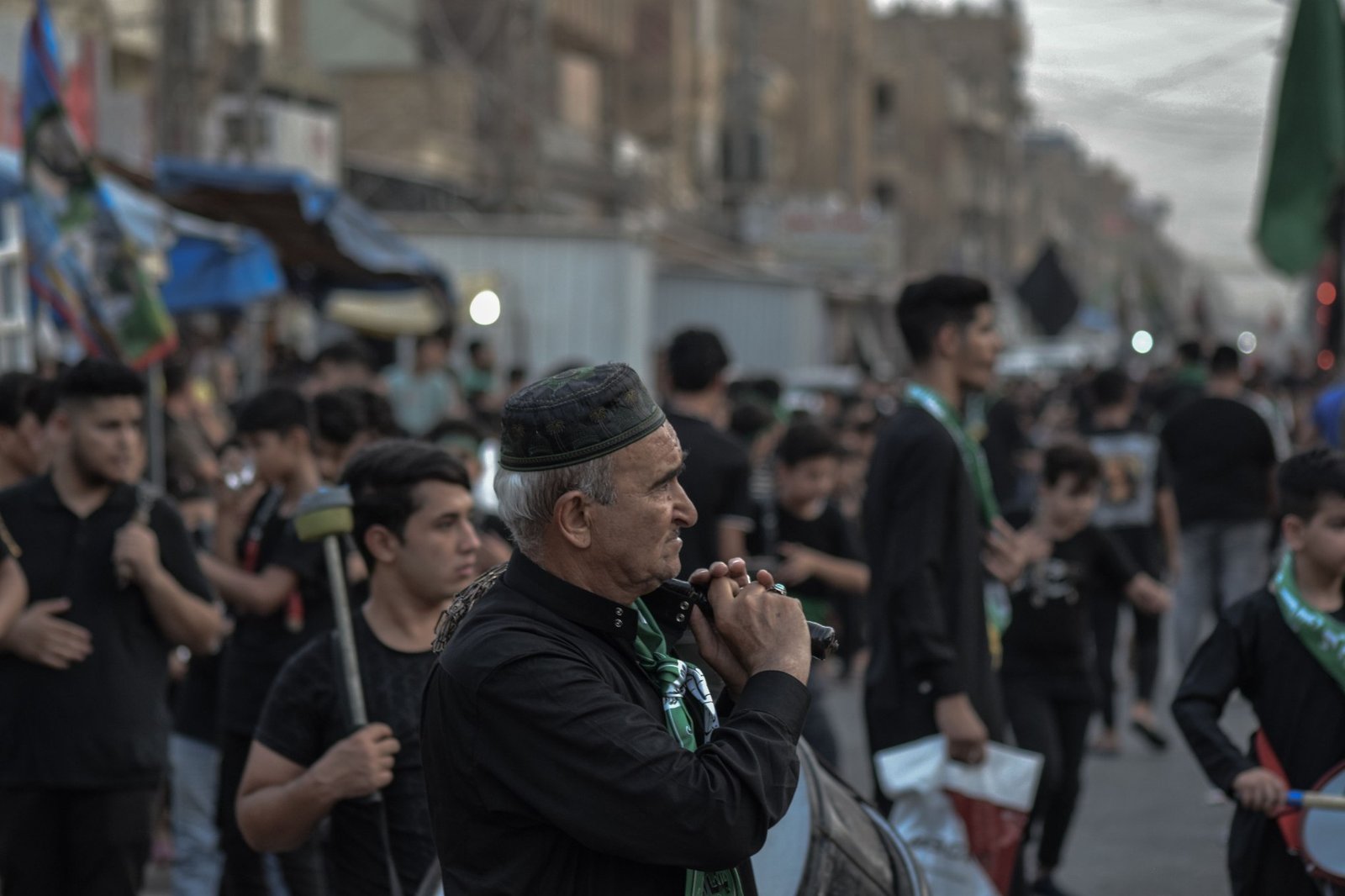
Every year during Ashura, some Shia Muslims gather in mosques, religious centers, and streets to mourn by striking their chests with open palms. To someone unfamiliar with the tradition, this practice may seem confusing. Why would people deliberately hit themselves during a religious commemoration?
The main reason is grief for Imam Husayn, the grandson of Prophet Muhammad, who was killed at Karbala in 680 CE. For many Shia Muslims, chest-beating is a physical expression of sorrow, love, loyalty, and solidarity with Imam Husayn and his family.
However, not every form of physical mourning is the same. Chest-beating, chain flagellation, and striking the head with a blade are distinct practices with different physical consequences and religious rulings. Some Shia Muslims participate in these rituals, while others prefer to mourn through prayer, tears, religious gatherings, and charitable work.
Understanding the differences helps explain why these practices matter to their participants and why they remain the subject of discussion among Shia scholars.
Why Is Ashura So Important to Shia Muslims?
Ashura is the tenth day of Muharram, the first month of the Islamic calendar. For Shia Muslims, it is primarily a day of mourning for the martyrdom of Imam Husayn and his companions at Karbala, a place in present-day Iraq.
Imam Husayn was the son of Imam Ali and Lady Fatima, and the grandson of Prophet Muhammad. He is the third Imam in Twelver Shia Islam.
In 680 CE, Husayn refused to pledge allegiance to Yazid, the Umayyad ruler. His stand is remembered by Shia Muslims as a refusal to surrender important religious and moral principles to an unjust authority.
Husayn and a small group of family members and companions were surrounded by a much larger opposing force at Karbala. On the tenth of Muharram, Husayn and many of those with him were killed. His surviving family members were taken captive.
The tragedy became central to Shia religious memory because of both the suffering of Husayn's family and what his resistance represents: standing against injustice even when the cost is extremely high.
Ashura commemorations keep this history alive. Through sermons, poetry, tears, processions, and other mourning practices, participants remember the people who suffered at Karbala and reflect on the values associated with Imam Husayn.
Why Do Some Shia Muslims Beat Their Chests?
Chest-beating is commonly called latm, matam, or sina-zani, depending on the language, region, and particular practice. Participants strike their chests rhythmically, often while listening to or reciting mourning poetry.
For many participants, this is not an attempt to punish themselves. It is a way to give physical expression to grief that they feel deeply.
Consider someone who hears a detailed account of Husayn's final day, the suffering of his companions, or the death of members of his family. A participant may respond with tears, repeated expressions of sorrow, or chest-beating. The physical action becomes part of a shared act of mourning.
Several meanings can be involved.
First, it expresses grief. Participants use the body to express sorrow for a tragedy they regard as a defining moment in their religious history.
Second, it expresses love and loyalty. Many mourners understand their participation as a way of showing that Imam Husayn's sacrifice remains personally meaningful, even more than thirteen centuries later.
Third, it expresses solidarity with the victims of injustice. Karbala is not remembered only as a past event. Its moral message is often connected to resisting oppression and defending human dignity.
Finally, it strengthens communal memory. When people gather, recite elegies, and mourn together, they pass the story and its significance from one generation to the next.
These explanations do not necessarily apply to every participant in precisely the same way. Some people emphasize religious devotion, others focus on the emotional experience, and others stress the moral lessons of Karbala.
Shia mourning also includes many practices that involve no physical striking at all.
Is Chest-Beating the Same as Self-Flagellation?
No. Although both may occur during Ashura commemorations, they should not be treated as identical.
The English phrase hitting themselves can describe several different actions. The terminology used for these practices also varies by region.
| Practice | What happens? | Important distinction |
|---|---|---|
| Chest-beating (latm or sina-zani) | Participants strike their chests with open hands, often in rhythm with mourning poetry. | A common form of physical mourning that does not necessarily cause injury. |
| Chain flagellation (zanjeer zani) | Participants strike their backs or shoulders with chains. Some versions use blades attached to the chains. | The physical effects vary considerably depending on the implement and technique. |
| Head-striking (tatbir or qama-zani) | Participants strike the head with a blade or similar sharp implement to draw blood. | This involves deliberate injury and is strongly disputed among Shia religious authorities. |
Historical studies of Ashura processions distinguish chest-beaters from participants who use chains or blades. These practices have developed differently across regions and periods. Encyclopaedia Iranica discusses these forms in its accounts of Azadari and Dasta. The article on Dasta provides further historical detail.
The differences matter for two reasons.
The first is physical: open-handed chest-beating is not equivalent to cutting the scalp or striking the body with a bladed instrument.
The second is religious: a ruling that permits one form of mourning does not automatically establish that every other form is permitted or recommended.
For this reason, discussions about Shia mourning should identify the specific practice rather than treating every Ashura procession as an example of self-flagellation.
Did These Practices Begin at the Time of Imam Husayn?
The mourning of Imam Husayn has a long history, but the history of mourning itself should be distinguished from the development of particular rituals.
Accounts of early Shia religious life describe grief for Husayn expressed through weeping, mourning gatherings, and elegiac poetry. Later generations developed additional ways to commemorate Karbala.
One important milestone appears in historical accounts of Baghdad in 963 CE. Under the Buyid ruler Mu'izz al-Dawla, Ashura became the occasion for an organized public commemoration in which markets were closed and mourners processed through the streets. Historical descriptions mention public expressions of grief and striking the head or body. See Encyclopaedia Iranica's entry on Dasta.
Mourning ceremonies continued to develop in later centuries. During the Safavid period, when Twelver Shia Islam received official state support in Iran, public processions and other commemorative practices became more elaborate. Different forms of physical mourning also developed in different regional settings. Encyclopaedia Iranica, Azadari.
The history of blade-based self-flagellation is more complicated. Academic discussions, including Yitzhak Nakash's study An Attempt to Trace the Origin of the Rituals of Ashura, examine the historical development of these practices and their spread in later periods.
The available evidence does not justify claiming that every modern Ashura ritual was practiced in exactly the same form in 680 CE. Nor does it establish a single, universally agreed date for the origin of every form of physical mourning.
This distinction is important. The fact that Shia Muslims have mourned Imam Husayn for many centuries does not, by itself, prove that each particular ritual dates back to the first generation after Karbala.
Is Self-Flagellation Required in Shia Islam?
No. Self-flagellation is not one of the required pillars of Islam, and Shia Muslims are not required to injure themselves to demonstrate their love for Imam Husayn.
It is important, however, to distinguish between the religious significance of mourning and the legal status of a particular act.
In Twelver Shia Islam, mourning Imam Husayn is widely regarded as a meaningful religious practice. But chest-beating, chain flagellation, and blade-based self-flagellation are different actions, and scholars do not necessarily evaluate them in the same way.
For example, Grand Ayatollah Ali al-Sistani's official website states that loud crying, wailing, and striking one's head and face while mourning Imam Husayn are permissible. It also explains that the purpose of Ashura mourning is to remember Husayn's suffering and his stand for a sacred cause. Official ruling and explanation from Sistani's office.
That answer should not automatically be interpreted as a blanket ruling on every form of blade-based self-flagellation. The precise action and its circumstances matter.
Other major Shia authorities have taken a more restrictive position on tatbir. Ayatollah Ali Khamenei, for example, has ruled against it, arguing that it lacks an established precedent in the early Imams' practice and can bring Shia Islam into disrepute. His position is documented in published collections of his religious rulings. A compilation discussing rulings on qama-zani.
Other jurists have permitted certain forms of physical mourning under particular conditions. Therefore, it would be inaccurate to present a single ruling on tatbir as the unanimous position of every Shia scholar.
For believers who follow a particular religious authority, the relevant ruling is the one issued by that authority. Questions involving injury, health risks, and the exact form of a ritual should not be settled simply by assuming that every mourning practice has the same legal status.
Does the Quran Tell Shia Muslims to Hit Themselves?
No Quranic verse explicitly commands Shia Muslims to beat their chests, strike their heads with blades, or perform chain flagellation on Ashura.
Some Shia scholars discuss broader Quranic principles, including love for the Prophet's family and the importance of honoring religious values, when explaining the significance of commemorating Imam Husayn.
However, using a general religious principle to explain the importance of mourning is not the same as saying that the Quran directly prescribes a particular physical ritual.
The same distinction applies to hadith.
Shia hadith collections contain narrations that encourage remembering Imam Husayn and grieving over his martyrdom. Some narrations are also discussed in legal arguments about physical expressions of mourning. Yet evidence supporting the importance of mourning does not automatically establish the religious status of every method used to express it.
In other words, the religious significance of remembering Karbala and the legal evaluation of blade-based self-flagellation are related questions, but they are not identical ones.
Do All Shia Muslims Hit Themselves on Ashura?
No. Shia Muslims observe Ashura in different ways, and participation in physical mourning varies by community, region, family, and individual belief.
In some communities, chest-beating is a prominent part of public mourning processions. In others, the emphasis may be on religious lectures, elegies, prayer, or gatherings in which the story of Karbala is recounted.
Some people participate in chest-beating but reject blade-based self-flagellation. Others avoid physical striking altogether because of their religious understanding, personal preference, health, or concerns about injury.
Regional traditions also differ. Historical and cultural influences have shaped the commemorations found in Iran, Iraq, South Asia, Lebanon, and Shia communities elsewhere. These differences make it misleading to assume that a practice seen in one procession represents all Shia Muslims.
The absence of physical mourning does not mean that a person lacks love or respect for Imam Husayn. Nor should every person who takes part in a particular ritual be assumed to share the same motives or religious interpretation.
Shia communities contain a range of devotional practices and scholarly opinions.
Can Shia Muslims Mourn Imam Husayn Without Hitting Themselves?
Yes. Physical striking is not necessary to mourn Imam Husayn or to remember the tragedy of Karbala.
Many Shia Muslims express their grief in other ways, including:
- Attending a majlis: A religious gathering where a speaker explains the events of Karbala and their moral significance.
- Weeping and reciting elegies: Expressing sorrow through tears, poetry, and mourning prayers.
- Studying the history of Karbala: Learning about Husayn, his companions, and the choices they faced.
- Prayer and visitation: Reciting devotional prayers or ziyarat, a form of religious visitation or greeting associated with sacred figures.
- Serving others: Donating blood, feeding people, supporting the poor, and helping their communities.
These activities can express devotion without causing physical injury.
For many Shia Muslims, the purpose of remembering Husayn is not limited to displaying grief. It also involves reflecting on justice, courage, sacrifice, and responsibility toward others.
People may disagree about which forms of mourning are most appropriate, but participation in a specific physical ritual is not the only way to honor Imam Husayn.
Frequently Asked Questions
Generally, no. Chest-beating is usually understood by its participants as an expression of grief, love, solidarity, or remembrance. It should not be confused with a general belief that modern participants personally killed Imam Husayn.
Some participants regard these actions as intense physical expressions of mourning for the suffering and martyrdom at Karbala. However, their motivations, the forms of the rituals, and the religious rulings governing them vary. Blade-based self-flagellation is particularly disputed among Shia scholars.
Not as a universal rule. For example, Grand Ayatollah Ali al-Sistani's official website permits striking the head and face while mourning Imam Husayn. Other rulings depend on the act and circumstances involved. This should not be taken as proof that every form of self-flagellation is permitted.
There is no established historical evidence in the research discussed here that Imam Husayn performed the specific modern rituals of chest-beating processions or blade-based self-flagellation as they are practiced today. The history of mourning developed over many centuries, and claims about the origins of particular rituals must be evaluated separately.
No. Some authorities prohibit it, while others have permitted it under particular conditions. The disagreement concerns the specific practice and the legal reasoning applied to it, not simply whether Imam Husayn should be remembered and mourned.
Conclusion: Why Do Shia Muslims Hit Themselves on Ashura?
Some Shia Muslims beat their chests on Ashura to express grief for Imam Husayn and his companions, demonstrate their attachment to his legacy, and keep the memory of Karbala alive. For participants, the physical action can be a powerful expression of sorrow and solidarity with those who suffered.
But not every form of physical mourning is the same. Open-handed chest-beating differs from chain flagellation and blade-based self-flagellation, particularly in its physical consequences and scholarly evaluation.
Shia Muslims also differ in how they observe Ashura. Many mourn through prayer, tears, religious gatherings, and acts of service rather than physical striking.
The central point is that remembering Imam Husayn is deeply important in Shia Islam, but self-injury is not a required act of faith, and the permissibility of particular mourning rituals remains a matter of scholarly judgment and, in some cases, disagreement.