
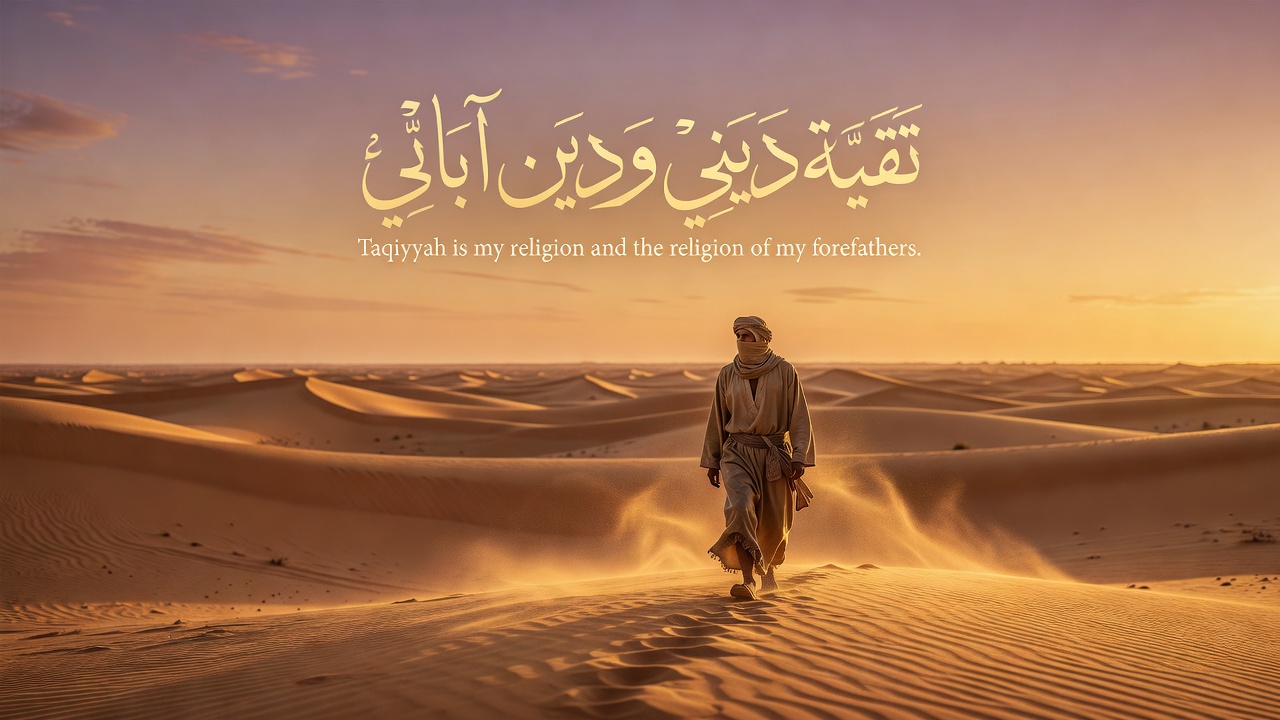
Taqiyyah is the practice of hiding one’s belief or outwardly conforming to a hostile demand when speaking the truth would bring serious danger. In Shia Islam, it is not seen as cowardice or hypocrisy. It is a legal and ethical ruling used to protect life, honor, and important property when open honesty would lead to harm.
That is the simple idea. Taqiyyah is about survival under pressure, not about lying for fun or personal gain.
The Meaning of Taqiyyah
The word Taqiyyah comes from the Arabic root waqa, which means to guard, protect, or preserve. In Shia jurisprudence, it refers to concealing one’s true religious belief or practice, or outwardly following another position, when a person is under threat, coercion, or severe danger.
Shia scholars describe it as a secondary emergency ruling. That means it can temporarily override the normal ruling when the normal ruling would lead to serious harm.
A simple way to understand it is this:
If telling the truth will save nothing and only cause punishment, Taqiyyah allows a person to protect life first.
Why Taqiyyah Matters in Shia Islam
Taqiyyah became especially important in Shia history because the Shia community and its scholars faced long periods of persecution under the Umayyad and Abbasid caliphates. In those conditions, open declaration of belief could bring imprisonment, torture, or death.
It mattered for three main reasons:
- It helped preserve the Shia community from being destroyed by oppression.
- It protected the Twelve Imams and their close followers so they could continue teaching.
- It prevented unnecessary bloodshed when open resistance would only bring more harm.
In other words, Taqiyyah was a way to protect truth when truth was surrounded by violence.
Quranic Evidence for Taqiyyah
The research dossier gives three Quranic examples that support the idea.
1. Surah Al-Imran 3:28
"Let not believers take disbelievers as allies rather than believers. And whoever [does that] has no association with Allah, except when taking precaution against them in fear of danger."
— Surah Al-Imran 3:28
This verse shows an exception. Under normal conditions, believers should not ally themselves with hostile people against other believers. But when there is fear and danger, precaution is allowed.
2. Surah An-Nahl 16:106
"Whoever disbelieves in Allah after his belief... except for one who is forced [to express disbelief] while his heart is secure in faith..."
— Surah An-Nahl 16:106
This verse is linked to Ammar ibn Yasir. He was tortured by the Quraysh and forced to say words of disbelief to save his life. The Prophet Muhammad confirmed that his heart remained full of faith. The Quran made a clear distinction between forced outward speech and real disbelief inside the heart.
3. Surah Ghafir 40:28
"And a believing man from the family of Pharaoh who concealed his faith said, 'Do you kill a man because he says, "My Lord is Allah"?'"
— Surah Ghafir 40:28
This is a powerful example of concealed faith. The believer in Pharaoh's court hid his belief, and that concealment helped him protect Prophet Musa and speak at a critical moment.
These verses show that Taqiyyah is not an invention of later scholars. It is rooted in the Quran itself.
Hadith Evidence
The dossier also includes important narrations.
"Taqiyyah is my religion and the religion of my fathers."
— Imam Ja'far al-Sadiq
This shows that Taqiyyah was understood as part of a divine pattern used by the prophets and Imams in times of danger.
"He who has no Taqiyyah has no faith."
This does not mean every situation requires hiding one's belief. It means that in dangerous times, wisdom and protection are part of responsible faith. Reckless exposure that destroys a community is not praised.
A Historical Example: Ali bin Yaqtin
One of the clearest examples in the dossier is Ali bin Yaqtin. He was a high-ranking minister in the Abbasid court of Harun al-Rashid, but he was secretly a devoted follower of Imam Musa al-Kadhim.
Because the Abbasid state watched people closely, his Shia loyalty could have led to his death. When Harun became suspicious, Imam Musa al-Kadhim instructed Ali bin Yaqtin to perform wudhu in a way that matched the Sunni method, so that spies would think the rumors were false.
Harun secretly watched him, saw what looked like the state-approved practice, and concluded that Ali was not Shia. That saved him.
Later, when the danger was gone, Imam Musa al-Kadhim told him to return to the original Shia method.
This story shows the main purpose of Taqiyyah very clearly: protect life now, preserve the true ruling, and return to it when danger ends.
How Shia Jurists Classify Taqiyyah
Taqiyyah is not one fixed rule for every case. Shia jurists divide it into five legal categories.
- Obligatory
Taqiyyah becomes obligatory when revealing the truth would likely lead to murder, serious injury, or major harm without any greater benefit to Islam. - Forbidden
Taqiyyah is forbidden when it would destroy the foundations of Islam, corrupt revelation, or lead to the killing of innocent people.
The dossier includes the famous principle:
«"Taqiyyah was established to protect blood; if blood is reached, there is no Taqiyyah."»
That means Taqiyyah can never be used to justify killing innocent people. - Recommended
It can be recommended when it reduces tension, prevents fitnah, or avoids minor harm. - Permissible
In some situations, using Taqiyyah or not using it may be equally acceptable. - Disliked
It can be disliked when a person could safely endure hardship with patience, and there is no serious danger.
This is important because it shows Taqiyyah is not an automatic rule. It depends on context.
Primary Ruling and Secondary Ruling
To understand Taqiyyah properly, you need one simple legal idea.
The primary ruling is the normal rule of Islam under ordinary conditions.
The secondary ruling applies in emergencies, danger, or coercion.
Taqiyyah belongs to the second category.
So the normal ruling remains true. But when a person is under threat, the law recognizes that preserving life and preventing destruction can temporarily come first.
That is why the dossier describes Taqiyyah as a legal mechanism, not a denial of faith.
Taqiyyah and Contradictory Hadiths
Sometimes Shia narrations appear to disagree with one another. The dossier explains that one reason for this is Taqiyyah.
Why would that happen?
Because the Imams often lived under surveillance. If hostile rulers or spies were present, an Imam might give a ruling that matched the state's position to protect people from harm. Later, in private, the true ruling could be explained to trusted companions.
This is one reason Shia scholars study contradictory narrations carefully. If a report matches the state-approved ruling of the time, it may have been given under Taqiyyah.
That does not make the report useless. It helps scholars understand the setting in which it was spoken.
Common Misunderstandings About Taqiyyah
- Is Taqiyyah the same as hypocrisy?
No. Hypocrisy means pretending to believe while hiding disbelief inside. Taqiyyah is the opposite: a person genuinely believes in the heart, but hides that belief outwardly because of danger. The Quran's example of the believer from Pharaoh's family makes this difference clear. - Does Taqiyyah mean Shia Muslims must always hide their beliefs?
No. It can be obligatory, recommended, permissible, disliked, or forbidden depending on the situation. - Is Taqiyyah just lying for convenience?
No. It is not a tool for comfort, laziness, or personal advantage. It is a legal response to serious danger, coercion, or oppression. - Can Taqiyyah ever justify harming an innocent person?
No. The dossier is very clear on this. Taqiyyah is meant to protect life, not destroy it.
The Bigger Lesson Behind Taqiyyah
At first glance, Taqiyyah may sound like simply "hiding the truth." But its deeper meaning is more serious and more human than that.
It asks a hard question:
What should a believer do when speaking openly will not change anything, but will only lead to suffering?
Shia Islam answers by balancing courage with wisdom. There are times to speak clearly. There are also times to protect life so that truth can survive for another day.
That is why Taqiyyah has remained so important in Shia thought. It is not about surrendering truth. It is about guarding truth until the danger passes.
Conclusion
Taqiyyah in Shia Islam is a protective legal ruling used under threat, coercion, and extreme danger. It is rooted in the Quran, supported by hadith, and deeply tied to Shia history. It is not hypocrisy, and it is not a license for deception. It is a careful response to oppression, designed to preserve life, faith, and the survival of the community.
In the simplest words, Taqiyyah means this: when truth is under attack and speaking openly would only bring destruction, protection becomes part of faith.
Frequently Asked Questions
No. The Quranic foundation appears in broader Islamic tradition, but Shia scholars developed its jurisprudence in great detail because of long persecution.
No. It is a legal response to danger, not a general permission to lie for convenience.
No. The dossier explicitly says it cannot be used to justify bloodshed or killing.
Sometimes they spoke under threat or in the presence of spies, so they gave a ruling that protected themselves and their followers.
No. It depends on the situation. Shia jurists classify it into five legal categories, including obligatory, forbidden, recommended, permissible, and disliked.