
Quick Answer
Ghaybah (الغيبة, al-ghaybah) means occultation or being hidden. In Twelver Shia Islam, it refers to the divinely willed period in which Imam Muhammad ibn al-Hasan al-Mahdi lives on earth but is hidden from public view until the time of his reappearance, called Zuhūr (ظهور, ẓuhūr).
Shia belief does not say that the Imam is on another planet or in another dimension. He is believed to be alive on earth, among people, but not publicly recognized. This belief is one of the most important ideas in Shia theology because it protects the living proof of Allah, tests faith, and keeps hope alive during times of injustice.
What Does Ghaybah Mean?
The Arabic word الغيبة (al-ghaybah) means hiddenness or occultation. In Shia Islam, it refers to the long period in which the Twelfth Imam is alive but not openly seen by the public.
This belief is not about disappearance in a magical sense. It is about divine concealment. The Imam remains part of human society, sees what happens, and continues to be the living Hujjah (حجّة, ḥujjah), meaning the proof of Allah on earth.
That idea is important because Shia theology teaches that the world can never be without a living divine guide.
Why Does the Belief in Ghaybah Matter?
For Shia Muslims, Ghaybah is not a small historical detail. It is a major part of faith.
1) It preserves the living proof of Allah
The Imam is the divine proof on earth. His existence means that guidance has not been cut off. Even when he is hidden, the world is not left without a living link to divine leadership.
2) It tests the believers
Ghaybah is a real test of faith. It is easy to believe when a leader is visible and present. It is much harder to remain firm when that leader is hidden. For this reason, Shia belief sees occultation as a deep test of sincerity.
3) It gives hope
Ghaybah creates Intizār (انتظار, intiẓār), meaning awaiting or active waiting. The believer does not give up. Instead, the believer waits with hope, discipline, and readiness for the Imam’s reappearance.
«In simple words: Ghaybah teaches that justice may be delayed, but it is not lost.»
The Two Periods of Occultation
Shia belief divides Ghaybah into two major stages.
1) Ghaybah al-Sughra — The Minor Occultation
Ghaybah al-Sughra (الغيبة الصغرى, al-ghaybah al-sughrā) means the Minor Occultation.
It began in 260 AH, after the martyrdom of Imam Hasan al-Askari (a.s.), and lasted until 329 AH. During this time, the Twelfth Imam did not appear publicly, but he remained in contact with the Shia community through four special representatives known as the Nuwwāb al-Arba‘ah (النوّاب الأربعة, al-nawwāb al-arba‘ah) — the Four Deputies.
These were:
- Uthman ibn Sa‘id al-‘Amri
- Muhammad ibn Uthman al-‘Amri
- Al-Husayn ibn Ruh al-Nawbakhti
- Ali ibn Muhammad al-Samarri
These deputies received letters and instructions from the Imam and passed them to the community.
2) Ghaybah al-Kubra — The Major Occultation
Ghaybah al-Kubra (الغيبة الكبرى, al-ghaybah al-kubrā) means the Major Occultation.
It began in 329 AH, after the death of the fourth deputy, Ali ibn Muhammad al-Samarri. From that time until today, the Imam has no publicly appointed special deputy.
This does not mean the community was left without guidance. In Shia thought, the responsibility of general religious leadership passed to qualified and just scholars, called fuqahā’ (فقهاء, fuqahā’).
Quranic Evidence
Shia scholars often connect the belief in Ghaybah with Quranic verses that speak about divine promise, inheritance, and belief in the unseen.
Surah al-Qasas 28:5
وَنُرِيدُ أَن نَّمُنَّ عَلَى الَّذِينَ اسْتُضْعِفُوا فِي الْأَرْضِ وَنَجْعَلَهُمْ أَئِمَّةً وَنَجْعَلَهُمُ الْوَارِثِينَ
“And We wanted to confer favor upon those who were oppressed in the land and make them leaders and make them inheritors.”
Surah al-Qasas (28:5)
This verse is understood as a promise that the oppressed will one day inherit the earth. Shia interpretation connects this promise to Imam Mahdi and his followers, especially after the long trial of occultation.
Surah al-Nur 24:55
وَعَدَ اللَّهُ الَّذِينَ آمَنُوا مِنكُمْ وَعَمِلُوا الصَّالِحَاتِ ... وَلَيُبَدِّلَنَّهُم مِّن بَعْدِ خَوْفِهِمْ أَمْنًا
“Allah has promised those among you who believe and do righteous deeds that He will surely grant them succession on the earth ... and that He will surely replace their fear with security...”
Surah al-Nur (24:55)
Shia scholars connect this verse with the future of the believers after the age of fear and concealment. The present age may feel full of pressure and uncertainty, but the promise of security remains.
Surah al-Baqarah 2:1–3
الَّذِينَ يُؤْمِنُونَ بِالْغَيْبِ
“Those who believe in the unseen.”
Surah al-Baqarah (2:1–3)
In Shia narrations, the word ghayb (غيب, ghayb) is sometimes linked to faith in the hidden Imam. Believing in the unseen becomes a sign of real piety.
Hadith About Ghaybah
The Imams of the Ahl al-Bayt spoke about Ghaybah long before it happened.
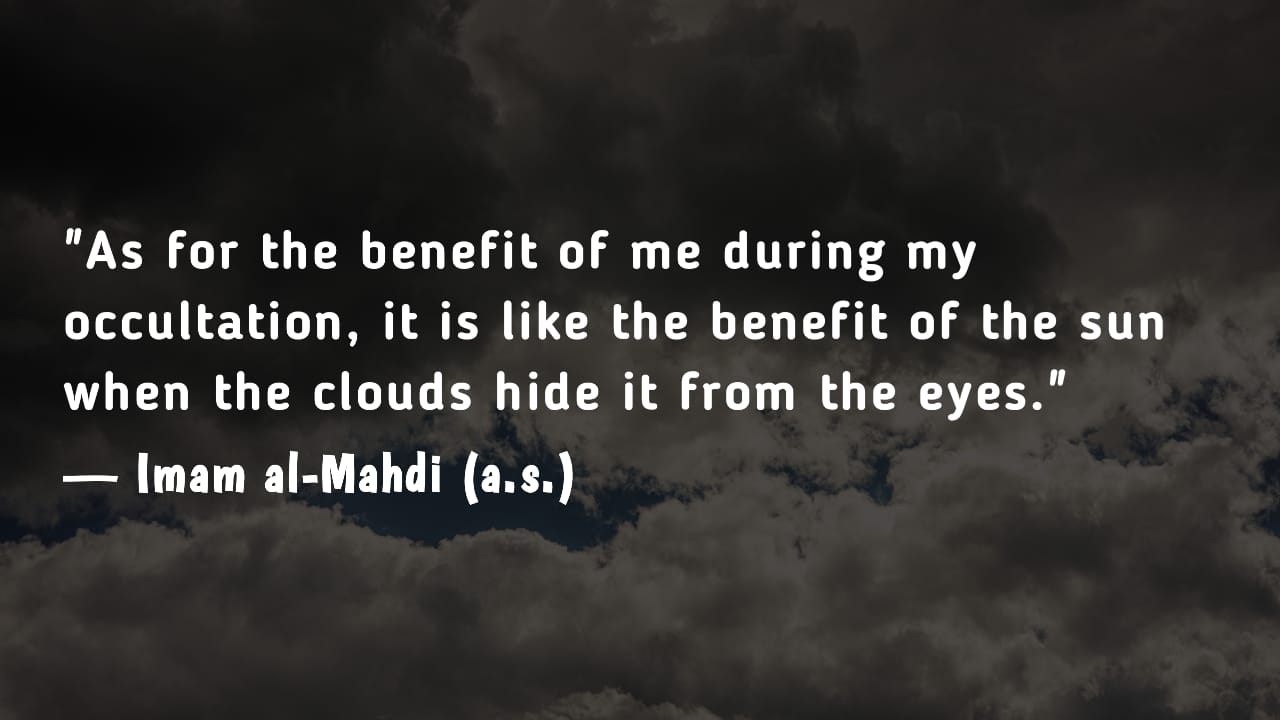
One of the most famous sayings attributed to Imam Mahdi describes his benefit during occultation like the sun hidden by clouds.
— Imam Mahdi (a.s.)
The meaning is simple and beautiful:
- the sun is not visible
- but it still gives light, warmth, and life
- in the same way, the hidden Imam still benefits the world
This is one of the clearest images for understanding Ghaybah.
Some narrations warn that the long duration of occultation will harden hearts. Over time, people may begin to doubt, forget, or become weak in their religion.
— Shia tradition
This is why Ghaybah is not only a theological idea. It is also a spiritual challenge.
Another important teaching says that when new issues arise, believers should return to the narrators of the traditions. This is the basis for general leadership in the Major Occultation.
— Shia tradition
In other words, when the Imam is not publicly accessible, the community does not collapse. It turns to those who know the religion carefully and can guide people by the Quran and the teachings of the Imams.
Why Is the Imam Hidden?
Shia thought gives several reasons for Ghaybah.
1) Protection of the Imam’s life
The Abbasid rulers knew that a twelfth Imam was expected. Because of that, the Imam’s early life was under severe pressure. Occultation protected him from immediate murder.
2) A test for believers
When the Imam is hidden, people are forced to choose faith without seeing everything with their own eyes. That deepens sincerity. It separates real conviction from shallow belief.
3) Freedom from tyrants
A hidden Imam is not trapped by political compromise with corrupt rulers. He does not owe loyalty to oppressive governments. That matters because his mission is global justice, not partial reform.
4) The world is not yet ready
Shia teaching also says that Ghaybah continues because the world is still not fully prepared for the Imam’s open rise. His mission is not small or local. It is universal.
What Do Shia Muslims Do During Ghaybah?
Ghaybah is not a time for hopelessness. It is a time for active waiting.
Intizār is not passive
Intizār (انتظار, intiẓār) does not mean sitting still and doing nothing. It means preparing yourself, your family, and your community for justice.
A true believer during Ghaybah:
- strengthens faith
- avoids ظلم (zulm, oppression)
- supports truth
- learns religion properly
- stays ready for the Imam’s return
So waiting is not weakness. In Shia thought, it is a form of worship.
Common Misunderstandings
“Does Ghaybah mean the Imam is dead?”
No. The Imam is believed to be alive.
“Does it mean he is in a cave forever?”
No. Shia belief does not say the Imam lives trapped in a cave. He is hidden by divine will, not imprisoned in a literal underground place.
“Does Ghaybah mean there is no leadership?”
No. In the Major Occultation, general leadership belongs to qualified scholars and jurists.
“Is waiting for the Imam passive?”
No. True waiting means preparing, reforming, and resisting injustice.
Frequently Asked Questions
What is Ghaybah in Shia Islam?
Ghaybah is the hidden period of the Twelfth Imam, when he lives on earth but is not publicly seen.
How long has Ghaybah lasted?
The Minor Occultation lasted from 260 AH to 329 AH. The Major Occultation continues today.
Who were the Four Deputies?
They were the four special representatives of the Imam during the Minor Occultation.
Why is Ghaybah important?
It preserves the living proof of Allah, tests faith, and gives believers hope in eventual justice.
What does Zuhur mean?
Zuhūr (ظهور, ẓuhūr) means reappearance. It refers to the Imam’s public return.
Conclusion
Ghaybah is one of the most meaningful beliefs in Twelver Shia Islam. It teaches that the Imam is alive, even if hidden. It teaches that divine guidance never disappears. And it teaches that oppression does not have the final word.
For Shia Muslims, the hidden Imam is not absent in meaning. He is hidden in sight, but present in truth.
That is why Ghaybah is more than a doctrine. It is a living hope.