
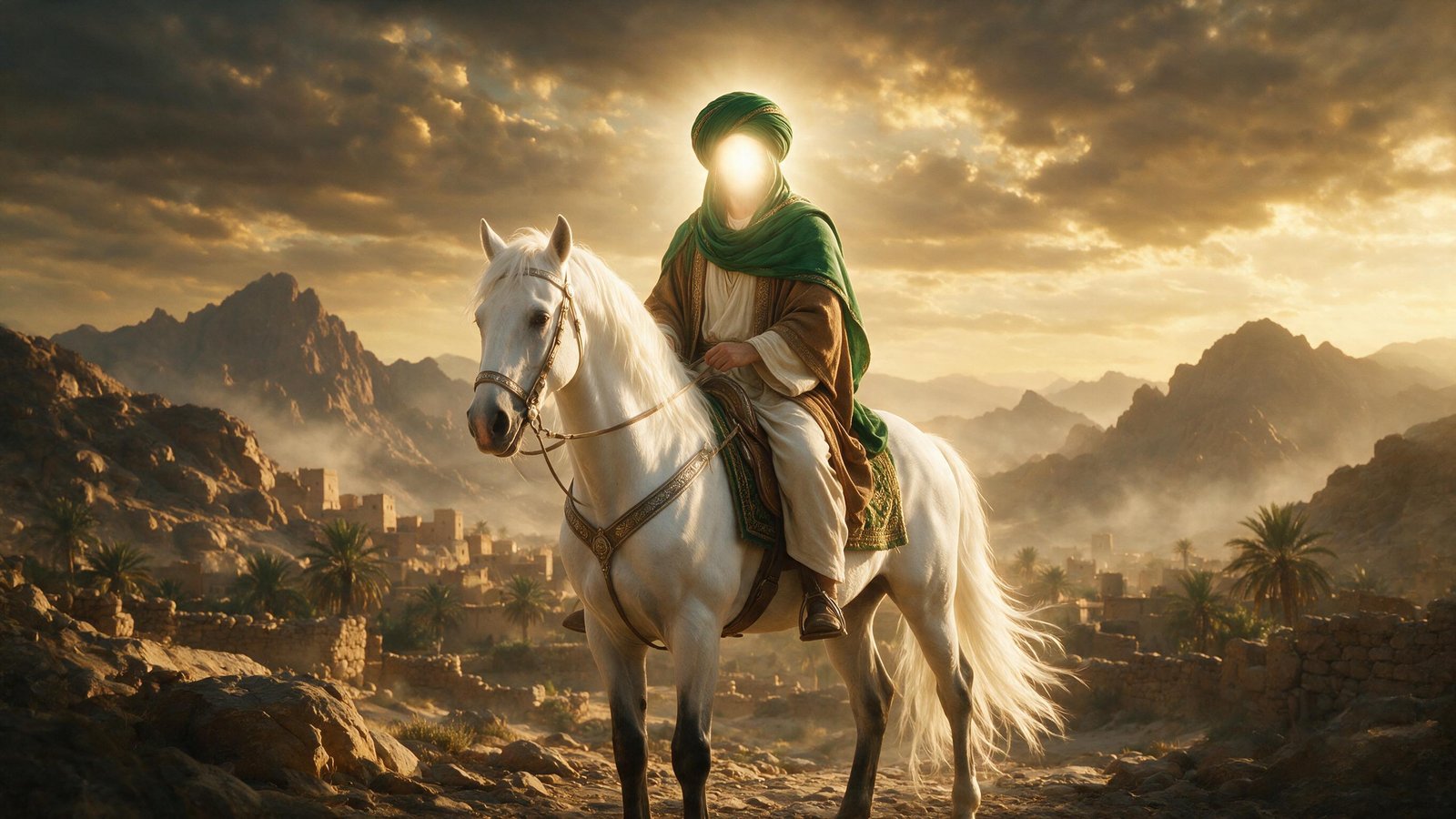
Imam Hasan ibn Ali (a) is one of the most important figures in Islamic history. He was the grandson of Prophet Muhammad (S), the son of Imam Ali (a) and Lady Fatimah al-Zahra (a), and the second Shia Imam. For many Muslims, his life represents a beautiful balance of honour, patience, wisdom, and self-control.
He was not only born into the Prophet's blessed household. He was part of the very heart of that household. His life shows what it means to carry a sacred trust in a difficult time, when loyalty was weak, enemies were strong, and the future of the Muslim community was under pressure.
If Imam Husayn (a) is often remembered for sacrifice on the battlefield, Imam Hasan (a) is remembered for a different kind of courage: the courage to choose peace when peace served Islam better than war.
Introduction: Why Imam Hasan (a) Still Matters
Imam Hasan (a) is sometimes misunderstood by readers who only know a little about Islamic history. Some people think leadership always means fighting. His life shows something deeper. Sometimes leadership means holding back, protecting lives, and refusing to let emotion destroy the community.
That is what makes his story so powerful.
He lived in a time when the Muslim world was fragile. He inherited leadership after the martyrdom of his father, Imam Ali (a), but the people around him were not as stable or loyal as they should have been. He faced a powerful opponent in Muawiyah, and yet he kept the dignity of the Ahl al-Bayt intact.
To understand Imam Hasan (a), we have to begin with his blessed family.
Family Background and Noble Lineage
Imam Hasan (a) was the direct grandson of Prophet Muhammad (S). His father was Imam Ali ibn Abi Talib (a), and his mother was Lady Fatimah al-Zahra (a), the beloved daughter of the Prophet.
This made Imam Hasan (a) one of the Prophet's closest family members and one of the direct roots of the Prophet's descendants. The lines of descent through him are known as Hasani, while those through his brother Imam Husayn (a) are known as Husayni.
In the early Islamic world, the title Sharif was broadly used for anyone belonging to the Prophet's household through figures such as al-Hasan, al-Husayn, Ali, Jafar, Aqil, or al-Abbas. Later, during the Fatimid period in Egypt, the term became especially associated with the descendants of Imam Hasan (a) and Imam Husayn (a).
This shows how deeply respected his family line was from the beginning.
His Special Status in the Prophet's Life
The love of Prophet Muhammad (S) for Imam Hasan (a) and Imam Husayn (a) was famous and deeply emotional. These two grandsons held a special place in the heart of their grandfather.
Their closeness to the Prophet was not only a matter of family. It was a sign of spiritual rank.
Historical reports also mention a miraculous event in infancy: the Prophet (S) placed his tongue in the mouths of the suckling children of Lady Fatimah, including Imam Hasan, Imam Husayn, Zaynab, and Ummu Kulthum, and they were satisfied. Whether one reads this as a miracle or a sign of divine blessing, the message is the same: these children were raised under extraordinary mercy.
Mubahalah: A Public Sign of His Greatness
One of the strongest proofs of Imam Hasan's special position is his participation in the event of Mubahalah.
Mubahalah was a historic event in which the Prophet (S), together with Imam Ali (a), Lady Fatimah (a), Imam Hasan (a), and Imam Husayn (a), confronted a religious dispute with truth and prayer. The presence of Imam Hasan (a) there matters greatly. It shows that he was not treated as an ordinary child. He stood among the most purified members of the Prophet's household.
This event has remained one of the clearest signs of the honour of the Ahl al-Bayt.
Early Life in the Prophet's Household
Imam Hasan (a) grew up in a home where faith was not a theory. It was lived every day.
He was raised in the house of the Prophet, surrounded by mercy, revelation, prayer, and truthfulness. His childhood was shaped by the most noble example possible. He saw the Prophet's character directly. He saw the humility of Imam Ali (a). He saw the purity and dignity of Lady Fatimah (a).
That upbringing mattered.
A child shaped in such a home does not grow up with ordinary habits. He grows up with a sense of responsibility before Allah.
Leadership After Imam Ali (a)
After the martyrdom of Imam Ali (a), Imam Hasan (a) became the leader of the Muslim community. People quickly came forward to swear allegiance to him, but the loyalty of many was weak and unstable.
This was a serious problem.
On the surface, the people supported him. In reality, many of them were uncertain, divided, or easily swayed. That is one of the most important facts for understanding his later decision. He did not inherit a unified army with strong discipline. He inherited a difficult and unstable situation.
Even so, he accepted leadership with dignity.
A Sign of His Honesty
Imam Hasan (a) also displayed the moral purity of the Ahl al-Bayt in practical matters. Regarding the estate of his father, Imam Ali (a), he declared that no gold or silver remained except seven hundred dirhams, which had been intended for a family need. Even those were returned to the public treasury.
That is the kind of governance the Ahl al-Bayt represented: clean hands, public trust, and no misuse of wealth.
Muawiyah and the Threat He Represented
Imam Hasan (a) faced Muawiyah, a ruler whose family background carried deep hostility toward the Prophet (S) and Islam. According to the dossier, Muawiyah inherited enmity from his parents, especially from the side of Abu Sufyan and Hind.
The historical memory of that enmity was very strong in Muslim consciousness. It was not forgotten, and it mattered because it shaped how people understood the struggle between Imam Hasan (a) and Muawiyah.
Muawiyah was politically strong. He had discipline, control, and a tightly managed force. Imam Hasan (a), by contrast, had to work with followers whose morale was weak and whose loyalty could not always be trusted.
That difference changed everything.
Why Imam Hasan (a) Chose Peace
This is the heart of his story.
Imam Hasan (a) did not make peace because he was weak in character. He made peace because the conditions around him made open war dangerous and likely to produce disaster for the Muslim community.
His army was unstable. Some supporters were weak in commitment. Others were ready to rebel. Muawiyah understood this reality and used it to his advantage.
In such a situation, a reckless war could have destroyed the remaining strength of the Ahl al-Bayt's followers and deepened chaos in the Muslim world.
Imam Hasan (a) saw further than many others. He understood that leadership is not always about fighting to the last moment. Sometimes leadership is about preventing a greater wound.
That is why his peace treaty became one of the most important decisions in Islamic history.
The Peace Treaty: Wisdom, Not Surrender
The peace treaty of Imam Hasan (a) is sometimes described too simply by people who do not understand the situation. It was not a surrender of principle. It was a strategic act of responsibility.
He preserved the life of the community. He protected the core of the believers. He refused to let unstable forces drag Islam into a destructive civil war.
This is the brilliance of Imam Hasan (a): he had enough courage to fight if necessary, but enough wisdom to know when peace served the truth better.
That is not a small virtue. It is one of the highest forms of leadership.
Character and Personality
Imam Hasan (a) was the child of a sacred house, and his personality reflected it.
He was known for dignity, patience, and spiritual nobility. He did not chase power for its own sake. He did not base leadership on pride. He carried himself with the calm and refined manner expected from someone raised in the Prophet's home.
His life also shows emotional strength. It is not easy to watch a community split. It is not easy to lead people who are unstable. It is not easy to give up the chance of military victory for the sake of a higher moral goal.
Yet Imam Hasan (a) did all of that with composure.
His Relationship with Prophet Muhammad (S), Imam Ali (a), and Lady Fatimah (a)
Imam Hasan (a) was deeply connected to the three greatest human influences in his early life.
From Prophet Muhammad (S), he inherited love, mercy, and sacred rank.
From Imam Ali (a), he inherited courage, justice, and integrity.
From Lady Fatimah (a), he inherited purity, dignity, and spiritual depth.
This family connection was not just biological. It shaped his mission. The Ahl al-Bayt were a living model of what faith looks like in action.
Why Imam Hasan (a) Is Called the Second Shia Imam
In Shia Islam, Imam Hasan (a) is the second Imam after Imam Ali (a). This means he was not only respected as the Prophet's grandson. He was also seen as the divinely guided leader of the community after his father.
His imamate is central because it shows that true leadership in Islam is not built on force alone. It rests on knowledge, purity, justice, and divine appointment.
Even when political power moved away from him, his spiritual authority remained.
Legacy of Imam Hasan (a)
The legacy of Imam Hasan (a) is often quieter than that of some other historical figures, but it is no less important.
He taught the Muslim world that:
- dignity is more valuable than ego
- peace can be a form of courage
- leadership is a trust, not a prize
- the Ahl al-Bayt must be understood through both love and loyalty
- not every battle should be fought with swords
- not every victory is visible immediately
His life also laid the groundwork for understanding the later history of the Prophet's family. Without Imam Hasan's (a) decision, the Muslim world might have entered an even darker period of chaos.
Lessons Readers Can Learn Today
Imam Hasan (a) still speaks to modern readers because his life deals with questions we still ask today.
- What should a leader do when followers are unreliable?
- How do you stay principled when politics becomes dirty?
- When is peace wiser than conflict?
- How do you protect values without destroying people?
Imam Hasan (a) answers these questions not with slogans, but with action.
He teaches us that real strength is not always loud. Sometimes it is quiet, disciplined, and deeply intelligent.
Conclusion
Imam Hasan (a) was more than a historical figure. He was a living expression of the Prophet's household, a noble grandson of Prophet Muhammad (S), a son of Imam Ali (a) and Lady Fatimah (a), and the second Shia Imam.
He stood at a painful turning point in Islamic history and made a decision that preserved the core of the faith community. His peace treaty was not weakness. It was wisdom under pressure.
His life reminds us that faith is not only proven in battle. It is also proven in restraint, patience, and the willingness to place truth above emotion.
That is why Imam Hasan (a) remains unforgettable.